

A few years ago, most Indian startup founders stayed invisible. The spotlight belonged to actors, cricketers, and celebrities — not entrepreneurs. Founders built companies quietly while investors and business media tracked growth numbers behind the scenes.
That reality has changed.
India’s startup ecosystem has entered an era where founders themselves are public personalities. Social media, podcasts, YouTube, and business reality shows have transformed entrepreneurs into recognisable figures — and few represent that shift more clearly than Aman Gupta.
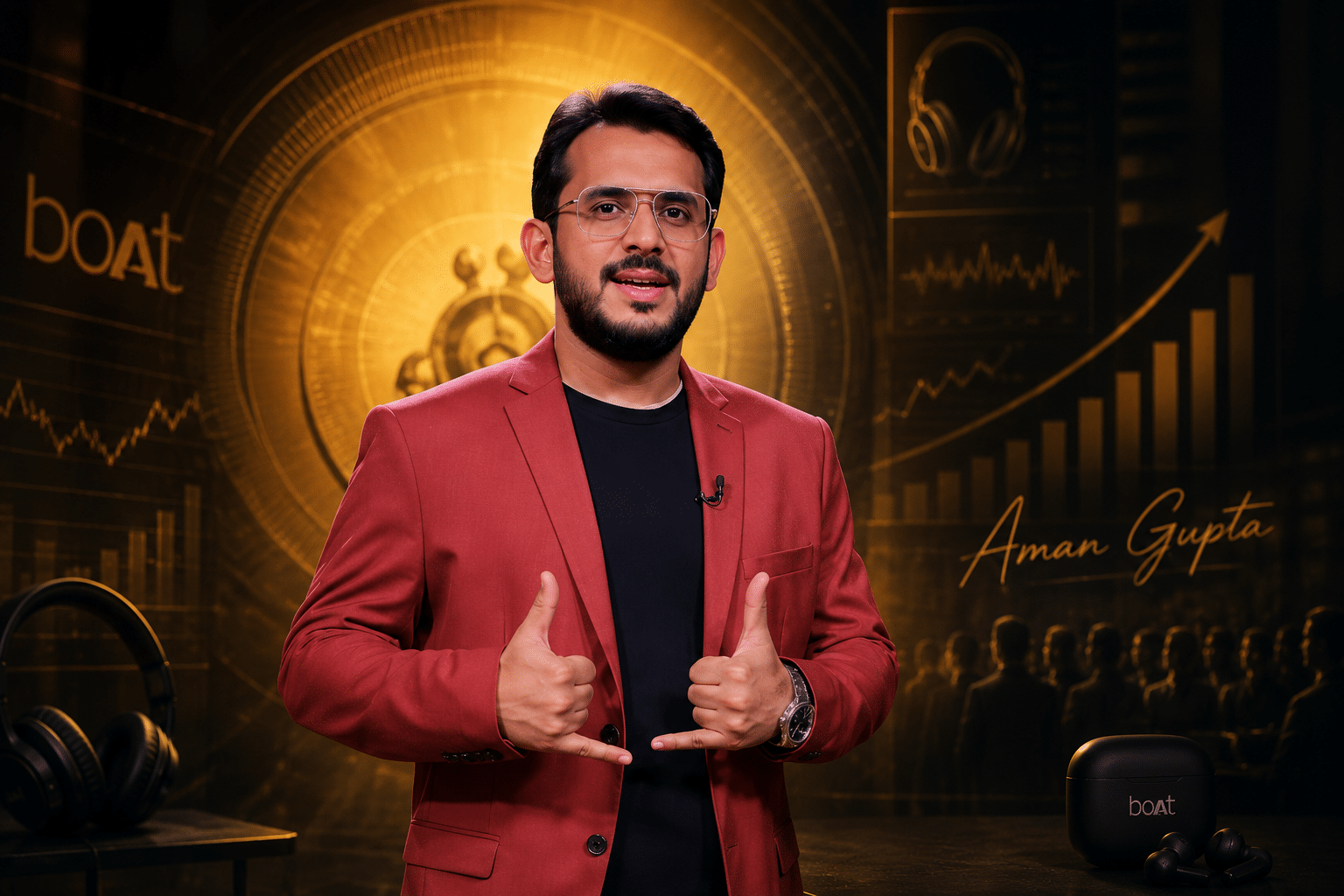
Over the past several years, Gupta has become one of the most recognisable faces in Indian entrepreneurship. As the co-founder of boAt and one of the prominent investors on Shark Tank India, he helped redefine how modern Indian consumer brands connect with younger audiences.
But the story of Aman Gupta is not only about headphones or startup metrics. It is a branding story — about understanding youth culture, building emotional connection ahead of premium perception, and creating a company that felt less like a tech brand and more like a lifestyle movement.
At a time when global companies dominated the electronics market, Gupta grasped something many competitors missed: young consumers don’t only buy products. They buy identity. That insight turned boAt into one of India’s biggest consumer startup success stories.
Who Is Aman Gupta?
Before becoming one of India’s most visible startup founders, Aman Gupta followed a relatively conventional path. Born and raised in India, he studied commerce and qualified as a Chartered Accountant — a trajectory that pointed toward a stable career in finance or corporate business.
But entrepreneurship kept pulling him in a different direction.
During his early career, Gupta grew increasingly focused on consumer behaviour and brand communication. He noticed that the companies people remember aren’t usually the most technically advanced — they’re the ones that understand the culture their customers live in. That observation became the operating logic behind boAt.
Unlike many tech founders who prioritised engineering complexity, Gupta paid close attention to youth trends, internet culture, and the shifting consumer landscape in India — not as abstract market research, but as signals about what a brand would need to look and feel like to earn that audience’s trust.
India’s electronics accessories market, at that time, offered a stark choice: expensive international brands positioned around premium prestige, or cheap local alternatives with little brand identity or emotional appeal. Gupta saw the gap between those two extremes — and inside that gap, he found the opportunity that became boAt.
The Beginning of boAt
When boAt launched in 2016, India’s audio accessories market was already crowded. International companies dominated premium electronics; local low-cost products competed aggressively on pricing. Breaking in as a new brand was extremely difficult — especially for a startup with no established supply chain or consumer trust.
Aman Gupta and co-founder Sameer Mehta approached the market differently. Instead of trying to compete with global technology giants on technical specifications, they focused on branding, lifestyle positioning, and youth identity. The goal wasn’t to sell earphones — it was to make consumers feel affiliated with the brand itself.
Building that affiliation required more than advertising. Indian consumers already associated quality audio with international names; convincing them to trust a new Indian startup demanded a shift in perception. That meant treating every touchpoint — packaging, design, influencer partnerships, social media — as part of the brand experience, not just the product.
This was Gupta’s core insight: modern brands are built emotionally before they are built financially. boAt positioned itself around music, energy, gaming, sports, and internet culture rather than audio specifications. The products felt accessible. The branding felt aspirational. That balance defined everything that followed.
The Struggles Before Success
Startup success stories often look smooth from the outside. The reality is usually far more unstable.
Before boAt became one of India’s leading consumer electronics brands, the company faced the same pressures that define most early-stage startups: limited trust, financial strain, intense competition, and constant uncertainty. The consumer electronics market moves fast — trends shift quickly, customer loyalty is fragile, and larger global companies carry marketing budgets and supply chains that dwarf what a new startup can deploy.
In the early stages, Gupta and his team had to solve manufacturing, branding, pricing, distribution, and customer trust simultaneously. A significant misstep in any one of those areas could have derailed growth entirely.
Like most founders, Gupta also navigated the emotional weight of entrepreneurship that rarely surfaces in public-facing interviews — projecting confidence while operating under relentless uncertainty, in a market that moved faster every month.
At the same time, India’s startup ecosystem itself was evolving rapidly. E-commerce platforms like Amazon and Flipkart were reshaping consumer behavior. Social media was transforming how products became popular. Influencer culture was expanding aggressively. Gupta adapted quickly, leaning into digital visibility rather than traditional retail expansion — recognizing that younger audiences were spending more time online than ever before, and that attention, wherever it concentrates, is where brands eventually have to go.
How Aman Gupta Built a Branding Machine
boAt’s rise owes less to engineering than to psychology. While rival brands filled their packaging with frequency ranges and decibel ratings, Gupta asked a different question: what does this product say about the person wearing it?
That reframe shaped the company’s early strategy. boAt positioned itself not as affordable audio equipment, but as a badge of modern Indian youth culture — energetic, visually assertive, and fluent in the aesthetics of gaming, streetwear, and short-form video. Consumers didn’t just buy earphones; they affiliated with a cultural identity that set the brand apart from a market otherwise defined by spec sheets.
Gupta also pursued influencer partnerships before they became standard practice in India’s startup ecosystem. By embedding boAt in communities that already commanded youth attention — musicians, esports players, fitness creators — the brand built visibility that felt organic rather than bought. That credibility compounded into trust, and trust drove the brand into college campuses, gaming communities, fitness culture, and music audiences across the country.
Gupta himself was the clearest proof of the strategy’s logic. Unlike conventional executives, he cultivated a public persona — candid, socially fluent, and accessible — that was indistinguishable from the brand he was building. Shark Tank India amplified this further, turning him from founder to national household name, and making the line between boAt and Aman Gupta nearly impossible to draw.

2 Comments
Pingback: Lightfield: The AI-Native CRM Transforming Customer Relationship Management
Pingback: Brendan Foody Mercor Built a $10 Billion AI Empire