

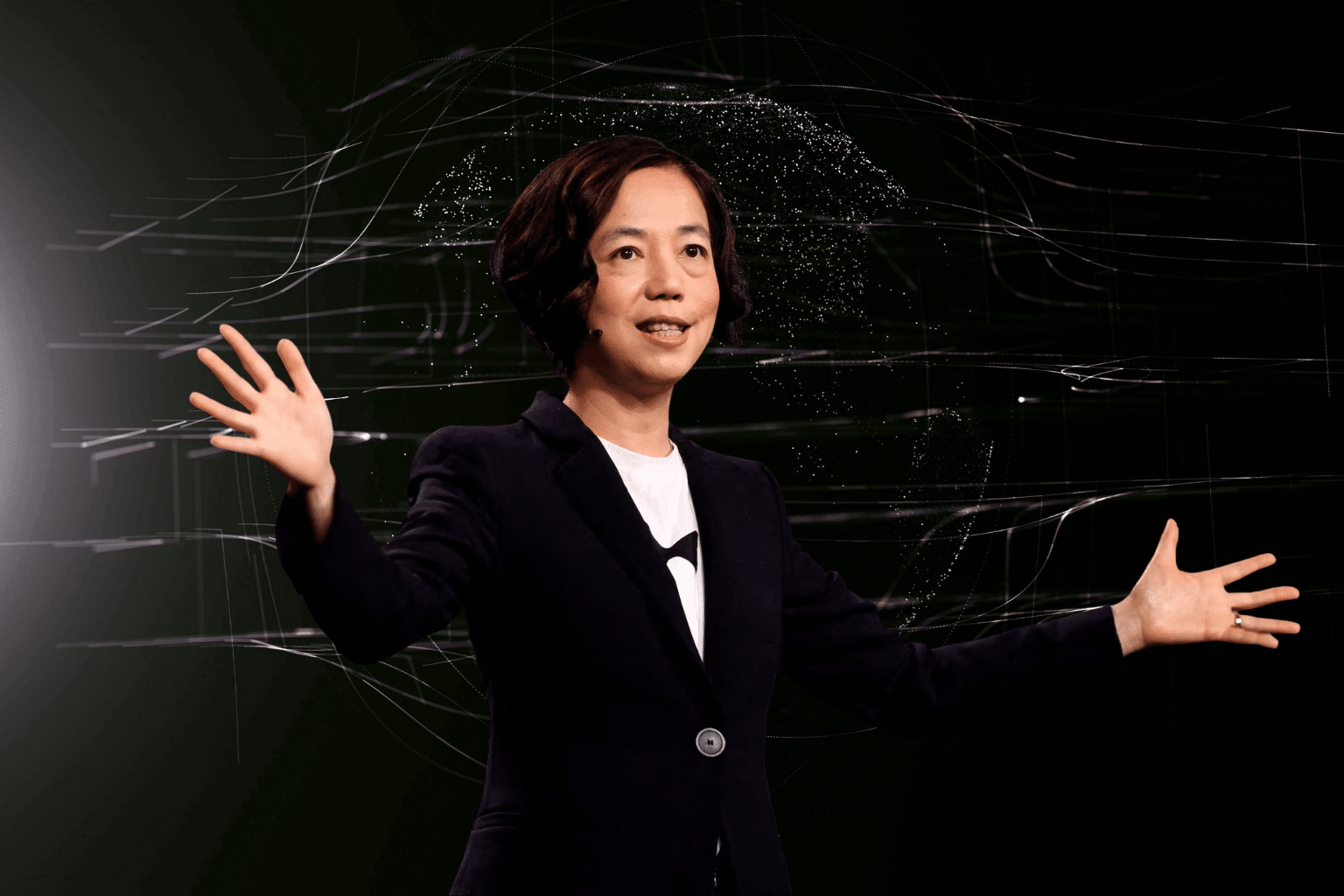
Fei-Fei Li World Labs is one of the most extraordinary founder stories in the history of artificial intelligence — not just because of the billions raised, but because of how far the journey started from.
She arrived in the United States at 15 years old with less than $20 in her pocket, speaking almost no English, and working weekends in her parents’ dry-cleaning business to help keep the lights on. Three decades later, Fei-Fei Li is the Godmother of AI — a Stanford professor, TIME Person of the Year 2025, Queen Elizabeth Prize laureate, and now the CEO of World Labs, a spatial intelligence startup valued at $5 billion after raising $1.23 billion in total funding.
The story of Fei-Fei Li World Labs is not just a startup story. It is a story about what happens when a lifetime of scientific conviction finally meets its moment.
Who Is Fei-Fei Li? The Mind Behind World Labs
Fei-Fei Li is the Co-Founder and CEO of World Labs, a San Francisco-based AI startup building large world models — AI systems capable of perceiving, generating, reasoning about, and interacting with three-dimensional environments.
Born on July 3, 1976 in Beijing, China, Li grew up in Chengdu, Sichuan. Her father worked in the computer department of a chemical factory; her mother was a secondary school teacher. When she was 12, her father emigrated to the United States in search of better opportunities.
In 1992, at age 15, Fei-Fei and her mother followed — arriving in Parsippany, New Jersey, with almost nothing. Her father fixed cameras for a living. Her mother worked as a supermarket cashier. The family squeezed into a one-bedroom apartment, and Fei-Fei worked part-time as a waitress and cleaner to help them survive.
But one person changed everything.
Her high school math teacher, Bob Sabella, recognized something in her that transcended the language barrier. He sacrificed his lunch hours to teach her Calculus BC one-on-one — a single act of generosity that helped a teenage immigrant earn a full scholarship to Princeton University.
“I’m optimistic about humanity because my own journey has shown me human kindness, compassion, integrity and generosity,” she has said.
She would go on to define the field of artificial intelligence. But first, she had to learn to see.
Fei-Fei Li World Labs: From Princeton Physics to the Godmother of AI
At Princeton, Li studied physics. She returned home most weekends to work in her parents’ dry-cleaning store while her classmates enjoyed college life. She graduated in 1999 with high honors — and rejected a job offer from McKinsey because she loved science too much to leave it.
At Caltech, she earned a PhD in electrical engineering in 2005, developing a deep interest in how the brain processes visual information. That question — how does a machine really understand what it sees? — would shape the next two decades of her career.
In 2006, she had an insight that changed AI forever.
Li realized that the rapid growth of online image data could unlock a new generation of computer vision models — but only if those images were systematically organized, annotated, and made available to researchers worldwide.
The result was ImageNet — a dataset of 15 million images across 22,000 categories, built through years of painstaking labor that most of the research community initially dismissed as too ambitious and too slow.
In 2012, a neural network called AlexNet entered the annual ImageNet competition and shattered every benchmark. The deep learning revolution — the foundation of every AI system used today — had officially begun. And it began because Fei-Fei Li refused to give up on an idea the world wasn’t ready for.
She later joined Stanford’s faculty in 2009, became Director of the Stanford AI Lab from 2013 to 2018, co-founded Stanford’s Human-Centered AI Institute (HAI), and served as Vice President and Chief Scientist of AI/ML at Google Cloud during a sabbatical in 2017 and 2018.
She was, by any measure, already one of the most consequential scientists in history. And she was just getting started.
The Birth of World Labs: Teaching Machines to See in 3D
In 2023, Fei-Fei Li co-founded World Labs with researcher Justin Johnson — her first commercial venture — on a thesis she had been building toward for decades.
Text-based AI had transformed how machines understand language. Image-based AI had transformed how machines understand flat visuals. But the physical world is neither flat nor text-based. It is three-dimensional, persistent, navigable, and interactive.
“AGI will not be complete without spatial intelligence,” Li wrote on her Substack.
World Labs describes itself as a spatial intelligence company building frontier models that can perceive, generate, reason, and interact with the 3D world. Its products are called Large World Models (LWMs) — a deliberate parallel to the Large Language Models that have dominated AI headlines since 2022.
The company’s first commercial product, Marble, launched in limited beta in November 2025. Marble is a large world model that accepts text prompts, photographs, video clips, panoramas, or rough 3D layouts and generates navigable, persistent, editable 3D environments as output.
As Silicon Republic reported, World Labs describes its mission as advancing spatial intelligence “to revolutionise storytelling, creativity, robotics, scientific discovery and beyond.”
The formal commercial launch of Marble followed in February 2026 — timed to coincide with the company’s landmark $1 billion funding announcement.
The Fei-Fei Li World Labs Funding Story: $1.23 Billion and Counting
The fundraising trajectory of Fei-Fei Li World Labs is a masterclass in how scientific credibility converts into investor conviction.
World Labs emerged from stealth in September 2024 with $230 million in initial financing, valuing the company at $1 billion — unicorn status before shipping a single product. Andreessen Horowitz was among the backers, alongside Nvidia’s venture arm and Radical Ventures.
Then came the round that made headlines globally.
On February 18, 2026, World Labs announced a $1 billion funding round backed by Nvidia, AMD, Autodesk (which invested $200 million alone and joined as an adviser), Fidelity Management and Research Company, Emerson Collective, and Sea. Bloomberg reported the round was discussed at a $5 billion valuation — a fivefold increase in just 15 months.
Total capital raised: $1.23 billion across two rounds. That cumulative figure places World Labs above the price Google paid to acquire DeepMind in 2014 — and it arrived before the company disclosed any revenue numbers.
The composition of investors tells the strategic story clearly. Chipmakers Nvidia and AMD signal the hardware demands of training complex 3D world models. Autodesk’s $200 million stake signals the enterprise design and architecture markets are hungry for spatial AI tools. And Fidelity’s participation signals institutional confidence in a long-term public market story.
World Labs By the Numbers
The data behind Fei-Fei Li World Labs paints a picture of one of the most credible deep-tech bets in Silicon Valley.
- $1.23 billion raised across two funding rounds since September 2024
- $5 billion estimated valuation following the February 2026 round
- $230 million raised in the September 2024 stealth exit round at $1 billion valuation
- $1 billion raised in the February 2026 round — backed by Nvidia, AMD, Autodesk, Fidelity, and Sea
- Autodesk invested $200 million — the single largest strategic check in World Labs history
- Marble launched commercially in February 2026 — first product to market
- 300+ peer-reviewed research papers published by Fei-Fei Li during her academic career
- 15 million images in the original ImageNet dataset across 22,000 categories
- TIME Person of the Year 2025 — named one of the eight Architects of AI
- Queen Elizabeth Prize for Engineering 2025 — alongside Jensen Huang and Geoffrey Hinton
As TechCrunch reported, World Labs launched Marble in limited beta in November 2025, roughly 14 months after the stealth exit — a tight execution timeline for a company building entirely new model architecture from scratch.
Why Spatial Intelligence Is the Next Frontier of AI
To understand why $1.23 billion has flowed into World Labs, you need to understand what spatial intelligence actually means — and why it matters.
Every AI system you interact with today — ChatGPT, Claude, Gemini — operates in two dimensions: language and flat images. They can read, write, analyze, and generate. But they cannot navigate a room, understand how objects relate to each other in physical space, or reason about what will happen when a robot picks up a glass.
Spatial intelligence fills that gap.
World Labs’ large world models are trained to understand the geometry, physics, and dynamics of three-dimensional environments. The applications are vast and commercially enormous.
Robotics is the most obvious. One of the primary bottlenecks in robotic automation has been the machine’s inability to generalize in unstructured real-world environments. World Labs’ spatial AI aims to close that gap by giving robots a “brain” that understands common-sense physics.
Architecture and design is Autodesk’s bet. Integrating Marble into CAD and design platforms would allow architects, engineers, and game developers to generate and explore fully navigable 3D environments from a text prompt or sketch.
Storytelling and creativity — filmmakers, game studios, and content creators could generate entire interactive 3D worlds as easily as typing a description.
Healthcare — understanding the human body as a 3D object, not a collection of 2D scans, opens new frontiers in surgical planning, medical imaging, and diagnostic AI.
As Li herself noted, “I believe spatial intelligence is as critical — and complementary to — language intelligence.”
The spatial AI category Li helped define is already attracting parallel capital: General Intuition raised $134 million for spatial reasoning and Mosaic SoC secured funding for spatial intelligence chips — signaling that infrastructure is forming around the segment World Labs is pioneering.
Beyond the Startup: A Life in Service of Human-Centered AI
What separates Fei-Fei Li from almost every other AI founder is that her commitment to responsible, human-centered AI predates the word “AI safety” entering the mainstream vocabulary by nearly a decade.
In 2017, she co-founded AI4ALL with Melinda French Gates and Jensen Huang — a nonprofit whose mission is to educate the next generation of AI technologists by promoting diversity and inclusion. The program began as a two-week summer camp for 24 high school girls and has since expanded to universities across the country.
She co-founded Stanford’s Human-Centered AI Institute (HAI) in 2019 — one of the world’s leading centers for AI research, education, and policy, dedicated to ensuring AI benefits humanity.
She has testified before the U.S. Senate and Congressional committees on AI governance. She serves as Special Advisor to the UN Secretary General. She was a member of the National AI Research Resource Task Force at the White House. And she consistently advocates for public funding of AI research, arguing that AI is too powerful to leave entirely to private capital.
“I’m not a tech utopian, nor am I a dystopian — I’m actually the boring middle,” she told Bloomberg. “AI governance should be based on science, not science fiction.”
It is a worldview forged not in boardrooms but in a one-bedroom apartment in Parsippany, New Jersey — where a 15-year-old immigrant learned that kindness, hard work, and the pursuit of knowledge can change everything.
Lessons for Entrepreneurs from Fei-Fei Li’s Journey
Fei-Fei Li’s path from immigrant teenager to $5 billion startup CEO contains some of the most powerful entrepreneurial principles ever lived — not just stated.
1. The best ideas look too slow at first. ImageNet took years to build and was repeatedly dismissed by the scientific community. Li built it anyway. The 2012 AlexNet breakthrough vindicated everything. Long-term conviction beats short-term validation.
2. Academic depth is a startup moat. Li did not arrive at spatial intelligence through product roadmaps. She arrived through decades of research into how vision and intelligence work. That depth is nearly impossible to replicate — and investors know it.
3. Credibility compounds. Stanford. Google Cloud. HAI. ImageNet. TIME Person of the Year. Each credential reinforced the next. By the time Li launched World Labs, investors did not need to understand the technology to trust the founder.
4. Purpose accelerates everything. Li has never separated her scientific work from its human implications. That clarity of purpose — AI for humanity, not just for profit — attracts the right partners, the right investors, and the right team.
5. Where you start does not determine where you finish. She arrived in America with less than $20. She built one of the most important datasets in human history. She is now leading the company betting that AI’s next great frontier is understanding the world we actually live in.
Conclusion
Fei-Fei Li World Labs represents something rare in the AI industry — a founder whose scientific credentials are unimpeachable, whose values are non-negotiable, and whose timing, after decades of foundational work, could not be better.
From a dry-cleaning business in New Jersey to the cover of TIME Magazine. From a database of 15 million images to a startup building machines that can navigate the three-dimensional world. From a 15-year-old with almost no English to the Godmother of AI.
The next chapter of artificial intelligence will not just be about what machines can say. It will be about what machines can do — in the physical, three-dimensional world we live in. And Fei-Fei Li has spent her entire life getting ready to write it.
Explore more founder stories on Denote Press: Adarsh Hiremath, CTO of Mercor | Surya Midha, Co-Founder of Mercor
Frequently Asked Questions
Q1. Who is Fei-Fei Li? Fei-Fei Li is the Co-Founder and CEO of World Labs, a San Francisco-based spatial intelligence AI startup. She is also a Stanford professor, the creator of ImageNet, co-founder of Stanford’s Human-Centered AI Institute (HAI), and widely known as the “Godmother of AI.” In 2025, she was named TIME Person of the Year.
Q2. What is World Labs and what does it do? World Labs is a spatial intelligence company co-founded by Fei-Fei Li in 2023. It builds Large World Models (LWMs) — AI systems that can perceive, generate, reason about, and interact with three-dimensional environments. Its first product, Marble, launched commercially in February 2026.
Q3. How much funding has World Labs raised? World Labs has raised $1.23 billion across two funding rounds — $230 million in September 2024 at a $1 billion valuation, and $1 billion in February 2026 with investors including Nvidia, AMD, Autodesk ($200 million), Fidelity, Emerson Collective, and Sea. The company’s estimated valuation following the second round is approximately $5 billion.
Q4. What is ImageNet and why does it matter? ImageNet is a dataset of 15 million images across 22,000 categories, created by Fei-Fei Li and her team beginning in 2006. The annual ImageNet competition, launched in 2010, directly triggered the deep learning revolution — when AlexNet won in 2012 using neural networks, it set off the AI era we live in today. ImageNet is widely regarded as one of the three foundational forces behind modern AI.
Q5. What is spatial intelligence in AI? Spatial intelligence refers to an AI system’s ability to perceive, generate, reason about, and interact with three-dimensional environments — as opposed to conventional AI that operates on 2D text and images. World Labs argues that spatial intelligence is the critical missing capability separating today’s AI from truly general intelligence.
Q6. What is Marble by World Labs? Marble is World Labs’ first commercial product, launched in November 2025 and made publicly available in February 2026. It is a large world model that generates navigable, persistent, editable 3D environments from text prompts, photographs, video clips, panoramas, or rough 3D layouts.
Q7. What other work is Fei-Fei Li known for beyond World Labs? Beyond World Labs, Fei-Fei Li co-founded Stanford’s Human-Centered AI Institute (HAI), co-founded the nonprofit AI4ALL with Melinda French Gates and Jensen Huang, served as VP and Chief Scientist of AI/ML at Google Cloud, directed the Stanford AI Lab from 2013 to 2018, advises the United Nations, has testified before the U.S. Senate on AI governance, and authored the bestselling memoir The Worlds I See (2023).
Sources: Silicon Republic — World Labs $1B Funding | TechCrunch — World Labs Marble Launch

1 Comment
Pingback: Puru Rastogi Mowito: The Founder Teaching Robots to Learn