

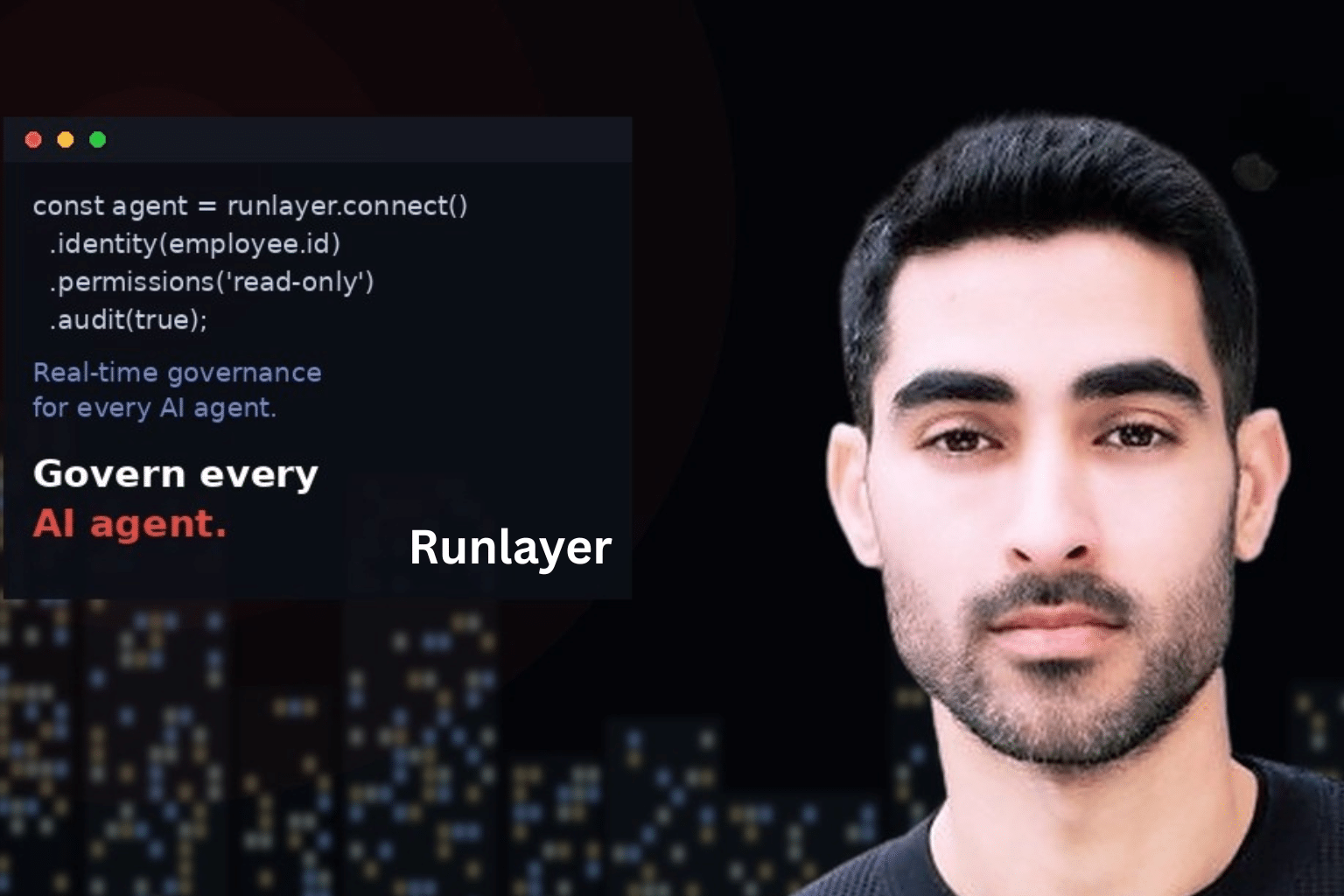
The Andrew Berman Runlayer story carries a detail that rarely happens in venture capital: when legendary investor Vinod Khosla heard that Runlayer was raising its Series A, his response was not the usual careful negotiation. He wanted to buy every available dollar of the round.
That single reaction tells you almost everything you need to know about why Runlayer — a 10-month-old enterprise AI governance startup founded by serial entrepreneur Andrew Berman — has become one of the most closely watched companies in Silicon Valley’s AI infrastructure race in 2026.
On June 24, 2026, Runlayer closed a $30 million Series A led by Felicis, with Khosla Ventures participating, bringing the company’s total funding to $42 million. According to Fortune, the round was preempted by Felicis specifically to lock in the deal before other investors could compete for it — a signal of just how much conviction the company has generated in less than a year.
Who Is Andrew Berman? The Three-Time Founder Behind Runlayer
Andrew Berman is the co-founder and CEO of Runlayer, an enterprise AI governance platform based in New York. Before founding Runlayer, Berman built a career that spans investment banking, venture capital, and two previous successful technology companies — giving him a rare combination of financial discipline and product-building experience.
Berman began his career as a tech investment banker at Lehman Brothers, before moving into venture capital at Norwest Venture Partners. That early investing experience would later prove valuable: Berman understands not just how to build a company, but how investors evaluate one.
He holds an MBA from the Wharton School at the University of Pennsylvania — one of the most prestigious business schools in the world, and a credential that reflects the strategic, business-first approach that has defined his founder career.
From Baby Monitors to AI: Berman’s First Company, Nanit
In 2014, Andrew Berman co-founded Nanit, a smart baby monitor company that used AI-powered computer vision to track infant sleep patterns and behavior. At the time, applying artificial intelligence to a consumer hardware product for parents was a novel idea.
Nanit became the category-leading AI baby monitor, and by 2024, the company was generating an estimated $100 million-plus in annual revenue. For a first-time hardware founder, building a company to nine-figure revenue is a rare achievement — and it gave Berman his first real proof that he could identify a meaningful problem and build a product people would pay for at scale.
Berman served as Founder and COO of Nanit from 2014 to 2018, helping shape the company’s early product and growth strategy before moving on to his next venture.
Vowel: The AI Meeting Platform That Led to Zapier
Berman’s second company was Vowel, an AI-powered video conferencing and meeting platform designed to make meetings searchable, shareable, and more inclusive. Vowel raised $17.8 million in venture funding and built a fully remote team spanning four continents, drawing talent from companies including Google, Airbnb, and Nanit itself.
In 2023, Vowel was acquired by Zapier — the workflow automation company best known for connecting thousands of business apps together. The acquisition was a clear strategic fit: Zapier wanted to bring AI-native meeting intelligence into its platform, and Berman’s team had already built exactly that.
Following the acquisition, Berman didn’t simply move on. He stayed at Zapier and took on a new role that would directly shape the idea behind Runlayer.
The Zapier Years: Where the Idea for Runlayer Was Born
After Vowel’s acquisition, Andrew Berman became Director of AI at Zapier. In this role, he worked directly with teams at OpenAI and Anthropic, helping build some of the earliest production implementations of the Model Context Protocol (MCP) — the now-foundational open standard, created by Anthropic, that lets AI agents connect to external tools and data sources.
Berman led the development of Zapier MCP and Agents, a product used by millions, working alongside his future Runlayer co-founders Tal Peretz and Vitor Balocco. Peretz brought deep machine learning expertise from his background leading ML in the Israeli Air Force, while Balocco served as a Staff AI Engineer at Zapier and became a recognized MCP security expert.
It was during this period that the team identified a critical gap. As Berman has explained, MCP was being adopted by enterprises at extraordinary speed, but the protocol itself included almost no built-in security. Blind spots in observability and auditing meant that companies rolling AI agents out to employees had little visibility into what those agents could actually access — or what they were doing with that access.
What Is Runlayer and What Problem Does It Solve?
Runlayer is an enterprise AI governance platform that functions as a centralized control layer for how employees use AI agents inside an organization. The easiest way to understand it: think of Runlayer as a corporate app store and security control room combined into one platform, purpose-built for the age of AI agents.
Here is the problem Runlayer was built to solve. As companies roll out AI tools like ChatGPT, Claude, Cursor, and custom internal agents, employees are increasingly using these tools to take real action inside company systems — pulling reports, sending emails, accessing financial data, and executing tasks autonomously. But most organizations have no centralized way to see what these agents can access, what they have actually done, or whether an employee is using an unauthorized tool entirely.
This last problem — known as “shadow AI” — is larger than most executives realize. According to data cited by Fortune, shadow AI usage may affect as much as 78% of enterprise AI users, meaning employees are frequently using AI tools their company’s IT and security teams don’t even know exist.
Runlayer’s Core Platform Features
Identity-Aware Permissions Runlayer connects to a company’s existing identity provider — tools like Okta and Entra — so that AI agents inherit the same permission structure as the humans using them. An employee with read-only access to financial data gets an AI agent with the same restriction.
Threat Detection The platform analyzes every request made through the Model Context Protocol, watching for prompt injection attacks, unauthorized data access attempts, and other emerging AI-specific security threats.
Full Observability IT and security teams get a single dashboard showing every AI agent’s activity across the organization — what data it touched, what actions it took, and what it cost.
Shadow AI Detection Runlayer surfaces unauthorized AI tools employees are using without company knowledge, helping security teams understand the true scope of AI usage across their organization.
Vendor-Neutral Architecture Critically, Runlayer does not require companies to standardize on one AI provider. It works across ChatGPT, Claude, Salesforce’s Agentforce, and custom internal agents simultaneously — what Felicis general partner Jake Storm has described as “a Switzerland business” that no single AI platform can own.
The Numbers Behind Runlayer’s Rapid Rise
The scale of Runlayer’s growth in under a year is extraordinary by any startup standard:
- 💰 $42 million total funding raised since November 2025
- 📈 $30 million Series A led by Felicis, June 2026
- ⚡ 10 months from founding to Series A close
- 👥 12+ unicorn or public company customers, including Instacart, Gusto, Opendoor, dbt Labs, AngelList, Lemonade, and Decagon
- 🏦 A Fortune 500 bank using Runlayer to monitor 100,000+ employees across 200,000 devices
- 📊 Half of Gusto’s entire workforce uses Runlayer daily
- 🚀 Company reportedly nine months ahead of the product roadmap presented to investors at seed stage
For context on the market opportunity: Gartner projects that 40% of enterprise applications will include AI agents by the end of 2026, up from less than 5% in 2025. Agentic AI spending is on pace to hit $201.9 billion this year, and the agentic AI security market alone is valued at $55 billion in 2026 — projected to reach $888 billion by 2035.
“I Signed the Term Sheet the Day My Son Was Born”
One detail from Berman’s Runlayer origin story has resonated widely across the startup community. According to Fortune, Berman signed his seed term sheet for Runlayer the same day his first child was born.
Berman’s reported reaction — signing his seed term sheet for Runlayer the same day his first child was born — captures something real about founder life that resonates with fellow young AI founders building category-defining companies at extraordinary speed.
“I think I was in the hospital,” Berman told Fortune. “We just kept seeing so much enterprise pull, and every company struggling with the same problem.”
It is a detail that captures something real about founder life at the earliest stages of a fast-moving company — the timing of a major life event colliding directly with the timing of a major business milestone, with no real choice but to hold both at once.
That same intensity has defined Runlayer’s pace ever since. The company launched out of stealth in November 2025 with eight unicorn customers already signed. Within four months, that number had grown to dozens of enterprise customers. By the Series A close just seven months later, Runlayer had assembled a team with experience from Nvidia, Anthropic, Databricks, Snowflake, Meta, Google, Uber, and Zapier.
Why Vinod Khosla Wanted “Every Available Dollar”
Vinod Khosla is not an investor known for hyperbole. As the founder of Khosla Ventures and an early backer of companies including OpenAI, his interest in a deal typically signals something more than just enthusiasm — it signals conviction about where a market is heading.
His reported reaction to Runlayer’s Series A — wanting to take the entire round himself — reflects a broader thesis that is reshaping how venture capital is flowing into AI in 2026. As Felicis general partner Jake Storm put it: “A lot of people view governance as a tax. This is actually the unlock. It flips it totally on its head.”
The framing matters. Rather than treating AI security and governance as a defensive cost center, investors are increasingly viewing it as the infrastructure layer that actually enables faster enterprise AI adoption — because companies that cannot govern AI agents safely will be forced to slow down or restrict their use entirely.
5 Lessons Every Founder Can Learn From Andrew Berman’s Journey
- Your second act benefits from your first. Berman’s experience scaling Nanit to nine-figure revenue and successfully exiting Vowel to Zapier gave him both the credibility and the pattern recognition to move faster with Runlayer than most first-time founders could.
- Work inside the problem before you build the solution. Berman didn’t dream up Runlayer in a vacuum. He spent two years at Zapier building MCP infrastructure directly with OpenAI and Anthropic, watching the security gaps emerge in real time before deciding to build the fix.
- Bring co-founders with complementary depth. Tal Peretz’s military-grade ML background and Vitor Balocco’s hands-on MCP security expertise gave Runlayer technical credibility from day one — the kind of team composition investors specifically look for in infrastructure plays.
- Position as neutral infrastructure, not a competing platform. Runlayer’s choice to remain vendor-agnostic — working across every AI provider rather than picking one — is a strategic decision that mirrors how the most durable infrastructure companies in technology history have built lasting moats.
- Speed compounds credibility. Going from eight customers at stealth launch to over a dozen unicorn customers and a $30 million Series A within ten months created its own momentum — investors increasingly look for velocity as a signal of product-market fit, not just revenue figures alone.
Conclusion
For founders and business leaders watching the next wave of enterprise AI infrastructure, Andrew Berman Runlayer represents a case study worth paying close attention to: a third-time founder who used hard-won experience from two previous companies to identify a problem before most of the market even recognized it existed, then moved fast enough to build the definitive solution.
As AI agents move from experimental tools to core operational infrastructure inside Fortune 500 companies, the question Runlayer is positioned to answer — who governs the agents doing the work — may turn out to be one of the defining infrastructure questions of this decade. And much like the founders behind an AI talent marketplace like Mercor, Berman’s path shows how the most successful entrepreneurs in this AI cycle are the ones who spot the structural gap before everyone else.
Frequently Asked Questions (FAQ)
Who is Andrew Berman? Andrew Berman is the co-founder and CEO of Runlayer, an enterprise AI governance platform that raised a $30 million Series A in June 2026. He previously co-founded Nanit, an AI baby monitor company generating $100 million-plus in revenue, and Vowel, an AI meeting platform acquired by Zapier in 2023.
What is Runlayer? Runlayer is an enterprise AI governance platform that gives companies centralized visibility and control over how employees use AI agents, chatbots, and tools across their organization. It functions as a security and management layer sitting between AI agents and corporate systems, with customers including Instacart, Gusto, Opendoor, and Fortune 500 companies.
How much funding has Runlayer raised? Runlayer has raised $42 million in total funding, including an $11 million seed round in November 2025 and a $30 million Series A in June 2026, both led by Felicis with participation from Khosla Ventures.
Why did Vinod Khosla want to fund all of Runlayer’s Series A? According to Fortune, longtime investor Vinod Khosla expressed strong conviction in Runlayer’s category — enterprise AI agent governance — and wanted to take the entire funding round himself, signaling unusually high confidence in the company’s market position.
What companies use Runlayer? Runlayer’s customers include more than 12 unicorn or public companies, including Instacart, Gusto, Opendoor, dbt Labs, AngelList, Lemonade, and Decagon, as well as a Fortune 500 bank using the platform to monitor over 100,000 employees.
What is “shadow AI” and why does it matter? Shadow AI refers to employees using AI tools their company’s IT and security teams are unaware of. Industry estimates suggest this affects up to 78% of enterprise AI users, creating significant security and compliance blind spots that platforms like Runlayer are built to address.
Sources: Fortune · TechCrunch · Dealroom · citybiz · SuperbCrew · Runlayer Official Site

1 Comment
Pingback: Leroy Kerry Filed Founder: An Incredible $17M Journey