

If you’re building a startup for the first time, one of the earliest and most confusing questions you’ll face is: where does the money come from before you have a product, revenue, or traction?
The answer, for many founders, is pre-seed funding — the earliest form of institutional capital available to startups. But what exactly is it, how much can you raise, who writes those first checks, and what do investors actually expect from you at this stage?
This guide breaks it all down clearly, with updated 2026 data and practical advice for first-time founders navigating early-stage fundraising for the first time. If you’re also curious about what comes next, see our guide on How to Raise a Seed Round in 2026 to understand where this stage leads.
What Is Pre-Seed Funding?
Pre-seed funding is the earliest stage of startup financing. It typically comes before a formal seed round and is used to turn an idea into a working product — or at minimum, to validate that the idea is worth building.
At the pre-seed stage, most startups have no revenue, no product in market, and often just a founding team and a strong thesis about a problem worth solving.
Think of it as the capital that buys you time to figure things out before you have the proof investors require at later stages.
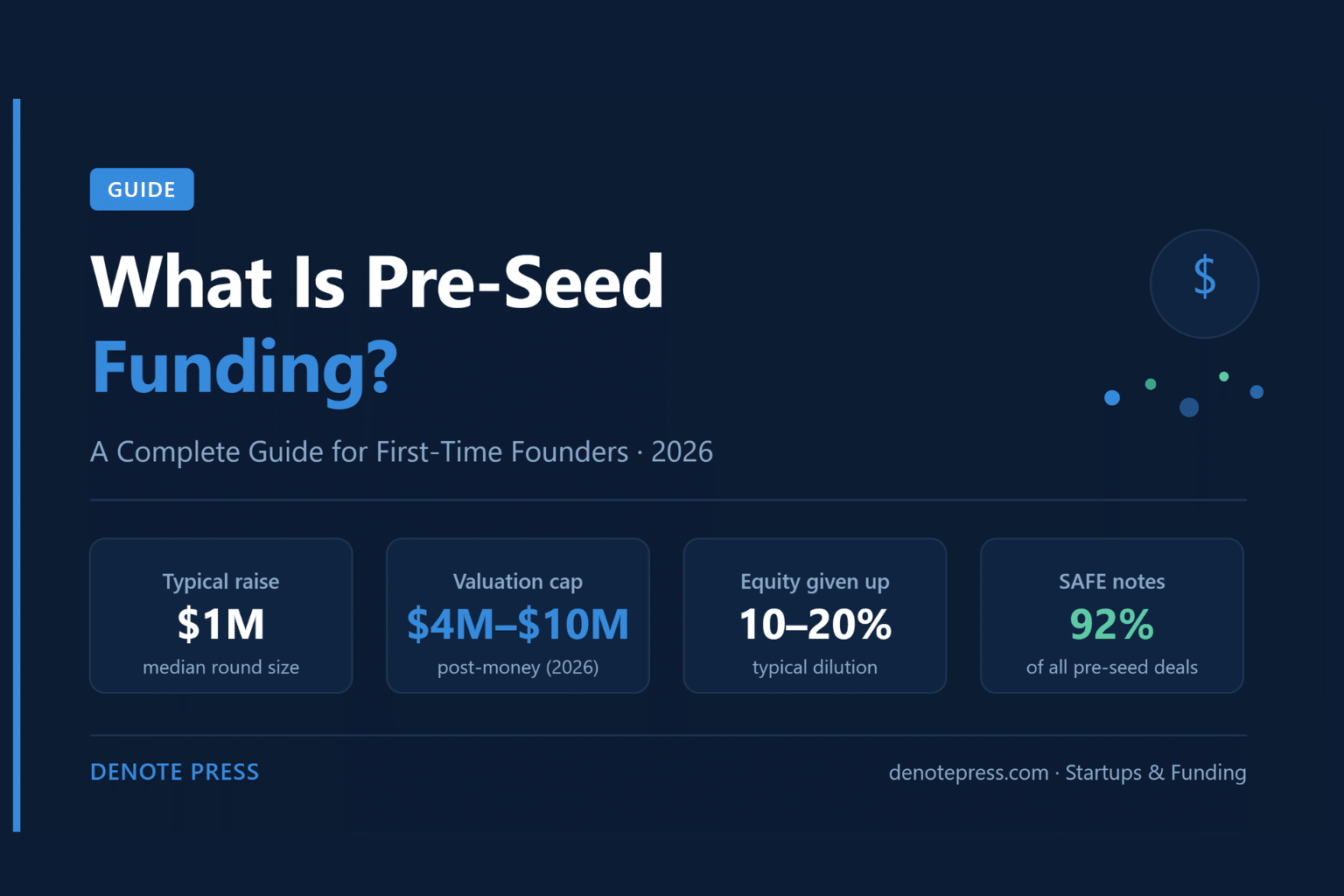
In 2026, the typical pre-seed round ranges from $500,000 to $2.5 million, with a median around $1 million to $1.2 million, based on data from Carta, Capwave, and PitchBook. Valuations at this stage generally fall between $4 million and $10 million post-money, depending on the founding team’s track record, sector, and geography.
Pre-Seed vs. Seed Funding: What’s the Difference?
A lot of first-time founders use the terms interchangeably, but they represent meaningfully different stages.
Pre-seed is for validating your idea, building an MVP, and assembling a founding team. Investors at this stage are betting primarily on you — the founder — and the problem you’re targeting, not a proven product.
Seed funding comes after. By the time you raise a seed round, investors expect a working product with early user traction, and increasingly in 2026, some form of revenue. The median seed round has climbed to $3.1 million to $3.8 million, at valuations between $14 million and $24 million post-money — a significant step up from pre-seed. Read our full breakdown in How to Raise a Seed Round in 2026.
Here’s a quick comparison:
| Pre-Seed | Seed | |
|---|---|---|
| Typical raise | $500K – $2.5M | $1.5M – $6M |
| Median valuation (2026) | $4M – $10M post-money | $14M – $24M post-money |
| Product stage | Idea or prototype | MVP with early traction |
| Revenue expected? | No | Increasingly yes ($300K–$500K ARR for SaaS) |
| Typical dilution | 10–20% | 15–25% |
Who Invests at the Pre-Seed Stage?
Pre-seed rounds are not typically led by major VC firms. The investor landscape at this stage looks quite different.
Angel Investors
Angel investors are high-net-worth individuals who invest their own money into early-stage startups, often in exchange for equity via a SAFE note. At pre-seed, angels commonly write checks between $25,000 and $250,000. Many come with valuable networks, domain expertise, or operational experience that goes beyond just the capital.
For a broader look at how to connect with them, see our guide on How to Find Angel Investors for Your Startup in 2026.
Pre-Seed Micro-Funds
A growing category of institutional investors has emerged that focuses almost exclusively on pre-seed deals. Firms like Precursor Ventures, Hustle Fund, Afore Capital, and Forum Ventures manage funds typically under $100 million and actively lead pre-seed rounds. They tend to move faster than large VC firms and have more appetite for early risk.
Accelerators and Incubators
Programs like Y Combinator, Techstars, Antler, and 500 Global combine capital with structured support — mentorship, networks, and access to investors for demo day. YC, for example, invests $500,000 into each batch company in exchange for 7% equity. If you’re accepted, the signal value alone can meaningfully increase your odds of closing a follow-on seed round.
Friends, Family, and Personal Network
A meaningful share of pre-seed capital — especially below $250,000 — still comes from friends, family, and the founder’s immediate professional network. This is neither uncommon nor embarrassing; it’s simply the reality of early-stage risk.
How Is Pre-Seed Funding Structured?
In 2026, the overwhelming majority of pre-seed rounds close on SAFE notes (Simple Agreements for Future Equity). According to Carta’s Q1 2026 State of Private Markets report, SAFEs now account for 92% of all pre-priced rounds, with convertible notes making up just 7%.
A SAFE is not a loan. It carries no interest rate and no repayment date. Instead, the investor receives the right to convert their investment into equity at a future priced round — typically at a discount or a valuation cap, whichever gives them more shares.
The two most common SAFE structures at pre-seed are:
- Valuation cap with no discount — the investor converts at your pre-seed cap, regardless of where your seed round prices.
- Valuation cap plus 20% discount — the investor gets both protections, converting at the lower of the cap or a discounted version of the next round price.
The valuation cap is the number that deserves the most attention in any SAFE negotiation. If you set it too high at pre-seed, you make your seed round harder to price later. Founders who price conservatively at pre-seed tend to raise smoother seed rounds 12 to 18 months later.
Related: Non-Dilutive Funding for Startups: Grants, Venture Debt & Revenue-Based Financing Explained — if you want to reduce how much equity you give away at this stage, these alternatives are worth understanding first.
What Do Pre-Seed Investors Actually Look For?
This is where a lot of first-time founders get it wrong. They spend weeks polishing their financial model when investors at the pre-seed stage are barely looking at it.
What pre-seed investors are actually evaluating:
Founding Team Quality
At this stage, you are the company. Investors are betting on your ability to figure things out under pressure, recruit talent, and build something people want. Relevant domain expertise, prior startup experience, and technical credibility all meaningfully improve your odds — and your valuation.
Problem Clarity
Can you articulate the specific problem you’re solving, who has it, and why they care? Investors want to see that you understand the space deeply, not just superficially. This is often where strong founders differentiate themselves before a product even exists.
Early Validation Signals
While revenue is rarely expected, some signal of market pull is increasingly important even at pre-seed. This might include:
- A waitlist with genuine signups
- A handful of design partner commitments
- Letters of intent from potential customers
- Strong qualitative interviews with 20+ target users
- An early prototype with real user feedback
A Clear Use of Funds
Investors want to understand exactly what milestone you’re trying to hit with the capital, and why that milestone will make you fundable for a seed round. The simplest formula: raise enough to hit your next major proof point, plus six months of buffer.
How Much Should You Raise at Pre-Seed?
This is one of the most common questions first-time founders get wrong — and it’s usually by raising too little or too much.
The right amount is straightforward to calculate:
Raise = (Monthly burn × months to milestone) + 6 months buffer
For example, if your monthly burn is $60,000 and your key milestone is 14 months away, your target raise is roughly $1.2 million to $1.4 million.
What you’re aiming to achieve before your seed round will vary by company, but common pre-seed milestones in 2026 include:
- Launching an MVP and acquiring the first 10–20 paying customers
- Validating retention with 50–100 daily active users
- Hiring a core founding team and shipping a functional v1 with usage signals
- Completing meaningful customer discovery that de-risks the core assumptions
The danger of raising too much at pre-seed is over-dilution before you’ve proven anything. Founders who give up 20%+ at pre-seed often find themselves in a difficult position by the time Series A negotiations begin. To understand how dilution compounds across rounds, see our full Startup Funding Roadmap: From Idea to Series B in 2026.
The 2026 Pre-Seed Landscape: What’s Changed
The pre-seed market in 2026 is more active than ever — but also more selective.
In Q1 2026 alone, roughly 3,000 U.S. startups raised $2.9 billion in pre-seed funding, according to Carta’s State of Pre-Seed Q1 2026 report. Capital is available. But the bar for what investors want to see has risen meaningfully since 2021.
A few important trends to know:
Investors want early proof, not just a story. Even at pre-seed, founders who bring user interviews, a prototype, or waitlist numbers close faster than those who arrive with a deck and a vision alone.
AI startups command a premium. AI-adjacent companies are regularly seeing valuation cap discussions 20–40% above market norms for comparable non-AI companies, driven by intense investor appetite in the sector. According to CB Insights’ 2025 State of AI report, AI startups commanded a median deal size more than $1 million above the broader market.
Only 45% of pre-seed companies reach seed. This is a sobering statistic worth internalizing. Fewer than half of the startups that raise pre-seed capital will advance to a seed round within 24 months. Having a clear path to seed metrics from day one is not optional — it’s your roadmap.
Geography matters less than it used to. Remote-first teams and distributed investor networks have opened pre-seed funding to founders outside traditional hubs like San Francisco, New York, and Boston. That said, U.S.-based startups still command meaningfully higher valuations than comparable companies in Europe, Africa, or Latin America. We explore this further in Why US Startups Are Dominating Global AI Funding in 2026.
Real-World Examples: Pre-Seed Rounds in Action
To make this concrete, here’s what pre-seed funding often looks like in practice:
Example 1 — Solo technical founder: A former software engineer with no prior startup experience builds a prototype for a B2B workflow tool. She raises $750,000 on a $5 million post-money SAFE cap from two angel investors and a micro-fund. The capital gives her 12 months to acquire 15 paying customers and prove retention before pitching seed investors.
Example 2 — Repeat founder: A second-time founder who previously built and sold a SaaS company raises $2.5 million at a $9 million post-money cap before writing a single line of code. Investors are betting primarily on track record and team credibility.
Example 3 — Accelerator route: A two-person team gets accepted to Y Combinator, receiving $500,000 in exchange for 7% equity. Demo Day attracts investor interest, and they close an additional $1 million SAFE within 30 days of the batch ending.
These scenarios illustrate how different the pre-seed experience can be depending on who you are and what you’ve built — and why there’s no single correct path.
Key Takeaways
- Pre-seed funding is the earliest stage of startup financing, typically ranging from $500,000 to $2.5 million in 2026.
- Most pre-seed rounds close on SAFE notes — 92% of all pre-priced rounds, according to Carta Q1 2026 data.
- Investors at this stage are primarily betting on the founding team and the problem, not a proven product.
- The right raise amount = cost to hit your next milestone + six months of buffer. Don’t overcomplicate it.
- Only 45% of pre-seed startups advance to seed within 24 months, so plan your milestones carefully from day one.
- AI startups are commanding valuation premiums, but the bar for any company to prove early validation has risen significantly since 2021.
Conclusion
Pre-seed funding is not a magic solution. It’s a specific tool for a specific moment — the gap between an idea and enough proof to attract serious seed capital.
If you’re a first-time founder approaching this stage, focus less on perfecting your pitch deck and more on understanding exactly what milestone will make you fundable for the next round. Know what you’re raising, know what you’re spending it on, and know what success looks like 12 to 18 months from now.
The founders who close pre-seed rounds quickly in 2026 are not the ones with the most polished materials. They’re the ones who understand the problem deeply, can articulate a credible path to proving it, and have a founding team investors are willing to bet on.
Ready for the next step? Read our guide on How to Raise a Seed Round in 2026 to understand what comes after your pre-seed.
Frequently Asked Questions
What is the difference between pre-seed and seed funding? Pre-seed is for validating an idea and building an MVP, while seed funding comes after — once you have a working product and early traction. Seed rounds are typically larger ($1.5M–$6M) and require more proof than pre-seed ($500K–$2.5M). See our complete startup funding stages guide for a full breakdown.
Do I need a product to raise pre-seed funding? Not necessarily. Many pre-seed rounds close before a product is built, especially when the founding team has a strong track record. However, in 2026, some form of early validation — even user interviews or a waitlist — significantly improves your chances.
What percentage of my company do I give up at pre-seed? Typical dilution at pre-seed is 10–20%, with the median around 15% according to Carta’s 2026 Founder Ownership Report. Be cautious about giving up more than 20% this early, as it can complicate future rounds.
What is a SAFE note and why is it common at pre-seed? A SAFE (Simple Agreement for Future Equity) is a convertible instrument that gives investors the right to convert their investment into equity at a future priced round. It’s fast, simple, and cheap to execute — which is why 92% of pre-seed deals now use SAFEs. You can read Y Combinator’s original SAFE documentation for the standard template most founders use.
How long does it take to close a pre-seed round? Most pre-seed rounds take between one and three months to close, though rounds with strong founding teams and warm investor relationships can close faster. Accelerator-backed founders often close supplementary pre-seed rounds within 30 days of Demo Day.
What do pre-seed investors look for? Primarily: founding team quality, problem clarity, and early validation signals. Revenue is rarely expected, but some form of market proof — user interviews, a waitlist, design partners, or early prototypes — meaningfully improves your chances in 2026.
What is the average pre-seed valuation in 2026? The median pre-seed post-money valuation for U.S. startups in 2026 sits between $4 million and $10 million, with $5–6 million being the most common range for first-time founders. Repeat founders and AI-adjacent companies can command higher valuations. For more context, see PitchBook’s venture monitor data.
Are there alternatives to pre-seed equity funding? Yes — and they’re often overlooked. Startup grants, revenue-based financing, and venture debt can all provide capital without requiring you to give up equity. Read our full guide on Non-Dilutive Funding for Startups to explore these options.

1 Comment
Pingback: Runlayer Raises $30M Series A to Build the Enterprise AI Governance Layer - denotepress.com