

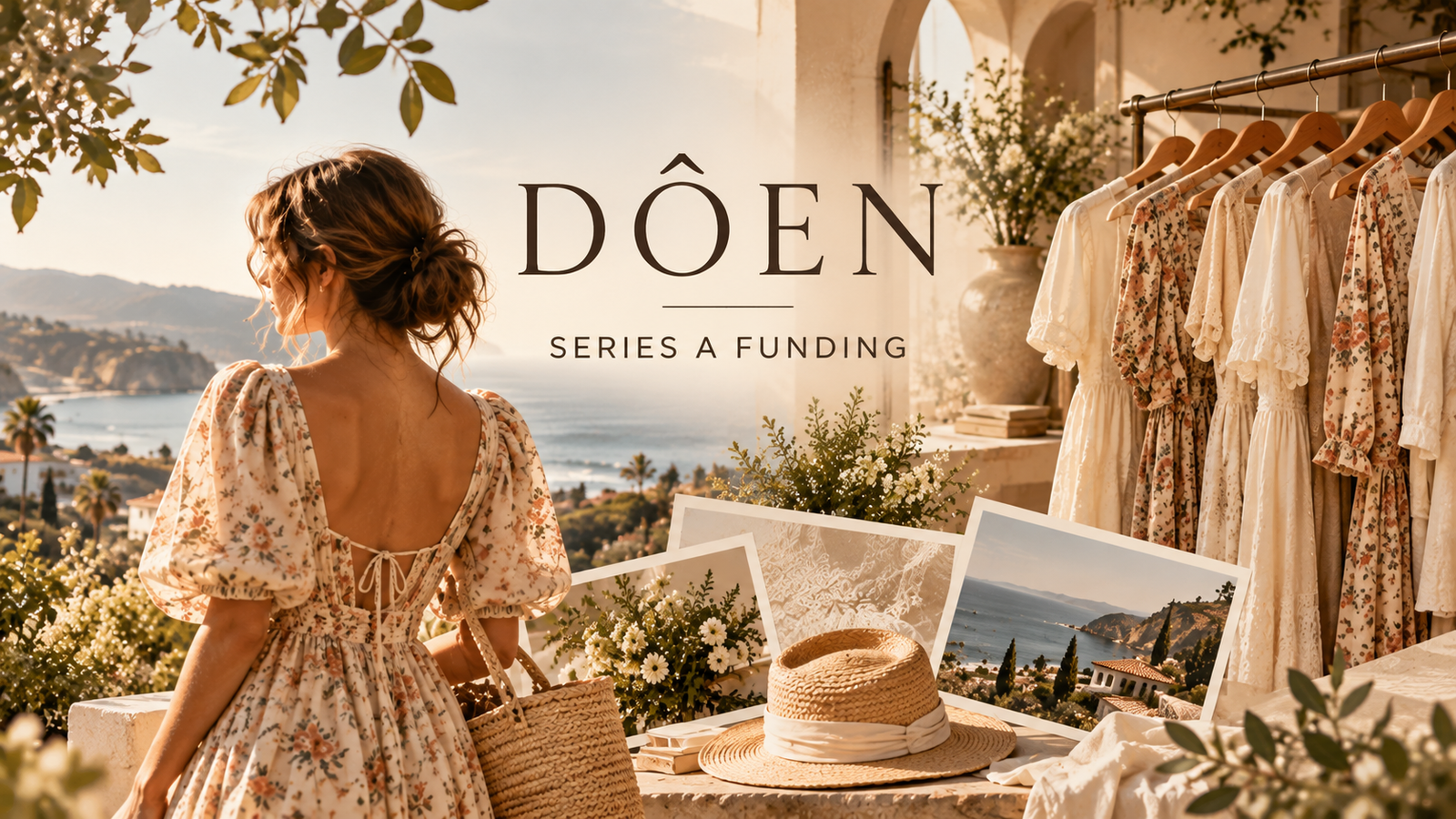
DÔEN has grown from a California-inspired womenswear label into a fashion and lifestyle brand with more than $100 million in revenue. Now, the company is entering a new stage of growth after securing growth equity funding led by Silas Capital.
The DÔEN Series A marks an important moment for a brand that has built its business around strong design, direct customer relationships, and a recognizable California aesthetic.
While DÔEN has not publicly disclosed the exact size of the investment, Vogue Business reported that the round was around $25 million. Silas Capital officially confirmed its growth investment in DÔEN in June 2025.
The new capital is expected to support the company’s retail expansion, e-commerce growth, wholesale strategy, and broader product development.
For more context on how growth-stage funding can reshape consumer businesses, Denote Press has also covered companies such as Runlayer’s $30M Series A and other high-growth startups.
What Is the DÔEN Series A?
The DÔEN Series A is a growth equity investment led by Silas Capital, a consumer-focused investment firm.
Silas Capital announced the investment on June 17, 2025, describing DÔEN as a Los Angeles-based lifestyle apparel company known for thoughtful, meticulously crafted pieces inspired by California’s past.
The investment is significant because DÔEN had already achieved substantial scale before bringing in major outside growth capital.
According to Vogue Business, the company had surpassed $100 million in revenue, while its e-commerce business had continued to grow rapidly.
The reported size of the investment is approximately $25 million, although DÔEN itself did not officially disclose the exact figure.
That distinction matters. Rather than presenting the $25 million figure as a confirmed company announcement, it is more accurate to describe it as the amount reported by Vogue Business.
The investment gives DÔEN additional resources at a point when the company is already proving that its business model can work at scale.
Who Founded DÔEN?
DÔEN was founded in 2016 by California-born sisters Margaret Kleveland and Katherine Kleveland.
The sisters built the company around a clear creative idea: create clothing that feels timeless, feminine, practical, and connected to the nostalgia of California.
That identity became a major part of the company’s competitive advantage.
Instead of chasing every short-term fashion trend, DÔEN developed a recognizable visual language. Its collections are influenced by vintage silhouettes, California culture, relaxed femininity, and classic wardrobe pieces.
The official DÔEN website reflects this positioning through its collections and brand storytelling.
This kind of consistency can be difficult to build in fashion. Customers are not only buying individual products. They are buying into a recognizable aesthetic and lifestyle.
That has helped DÔEN create a loyal customer base while expanding its product assortment.
The company’s founder-led story also fits a broader pattern seen across successful consumer brands. Denote Press has previously explored founder-led growth stories such as Jen Phan and Passionfroot, where a strong founder vision became central to the company’s growth strategy.
Why Silas Capital Invested in DÔEN
Silas Capital focuses on consumer brands that have the potential to become long-term category leaders.
Its portfolio includes companies across fashion, beauty, lifestyle, and consumer products.
On its official website, Silas Capital describes itself as an investment partner for the next generation of consumer brands, with a focus on growth-stage companies.
DÔEN fits that strategy particularly well.
The company already had:
- Strong brand recognition
- Significant revenue scale
- A growing e-commerce business
- Physical retail locations
- A recognizable product identity
- A loyal customer base
- Opportunities for international expansion
Silas Capital also lists DÔEN among its growth investments, placing the fashion company alongside other established consumer brands.
The investment therefore appears less like a rescue round and more like a strategic growth partnership.
That distinction is important.
Fashion companies often raise capital because they need money to survive inventory cycles or operational challenges. DÔEN’s position appears different. The company has already built meaningful revenue and is now using outside capital to accelerate expansion.
This is similar to the pattern seen in other businesses covered by Denote Press, including Hostie’s $12M Series A, where funding is tied to an existing growth story rather than simply proving an initial concept.
DÔEN’s $100M+ Business
One of the most interesting parts of the DÔEN story is the company’s scale.
According to Vogue Business, DÔEN had grown into a business generating more than $100 million in revenue.
That makes the company’s funding story different from a typical early-stage fashion startup.
DÔEN is no longer simply testing whether consumers will buy its products.
The company has already demonstrated significant market demand.
The challenge now is how to scale that demand without weakening the identity that made the brand successful.
This is one of the hardest problems for consumer companies.
A small fashion label can feel exclusive and personal. A larger company needs more inventory, more employees, more stores, more marketing, and more operational infrastructure.
Growth can therefore create pressure on the very qualities that made the brand attractive.
DÔEN’s next phase will likely depend on balancing those two priorities.
The Role of E-Commerce
E-commerce has been an important part of DÔEN’s growth strategy from the beginning.
The company developed a strong direct-to-consumer relationship, allowing it to communicate directly with customers while controlling the presentation of its products.
Vogue Business reported that DÔEN’s e-commerce business was growing by roughly 40% year over year.
That is a significant growth rate for a fashion company that has already reached substantial scale.
Direct-to-consumer commerce also gives DÔEN valuable information about customer behavior.
The company can see which products perform well, where customers are located, what collections generate demand, and how shoppers respond to new launches.
That information can then influence product development and inventory planning.
The model also reduces the company’s dependence on traditional wholesale channels.
However, wholesale remains an important opportunity as DÔEN expands its presence internationally.
This combination of e-commerce, retail, and wholesale gives the company multiple ways to reach customers.
Denote Press has explored similar growth dynamics in other sectors, including Paper’s Series A funding story, where capital is also connected to scaling an already-established business.
Why Physical Retail Matters
Despite the strength of e-commerce, physical stores have become an increasingly important part of DÔEN’s strategy.
The company has established stores in key U.S. markets, including California and New York.
Physical retail gives customers an opportunity to experience the brand in a way that a website cannot fully replicate.
For fashion companies, stores can also serve as marketing channels.
A well-designed store becomes a physical representation of the brand’s identity.
Customers can touch fabrics, try on clothing, discover new products, and experience the company’s aesthetic in person.
According to reporting from Vogue Business, DÔEN’s existing stores have played an important role in customer acquisition and sales growth.
The company has also been considering additional locations in markets such as Texas, Charleston, and Georgetown.
That makes retail expansion one of the most important areas to watch following the DÔEN Series A.
DÔEN’s Expansion Strategy
The company’s expansion strategy appears to have several major components.
1. More Retail Locations
DÔEN has an opportunity to increase its physical presence across major U.S. markets.
More stores could help the company reach new customers while strengthening brand awareness.
2. International Wholesale
International expansion could become another major growth engine.
Wholesale partnerships can introduce DÔEN to customers in markets where opening company-owned stores may not yet make sense.
3. New Product Categories
DÔEN has also shown interest in expanding beyond its traditional apparel categories.
Potential opportunities include denim, footwear, occasionwear, and eventually beauty and fragrance.
Expanding categories can increase customer lifetime value.
A customer who first discovers DÔEN through a dress could eventually purchase shoes, denim, accessories, fragrance, or other lifestyle products.
4. Global Brand Building
The long-term goal appears to be turning DÔEN from a California-born label into a broader American lifestyle brand.
That creates a much larger market opportunity.
But it also creates a major challenge: maintaining the authenticity of the original brand while appealing to a much wider audience.
From Fashion Label to Lifestyle Brand
DÔEN’s evolution is bigger than clothing.
The company increasingly operates as a lifestyle brand built around a specific worldview.
That worldview combines California nostalgia, femininity, craftsmanship, simplicity, and modern practicality.
This is important because lifestyle brands often have more opportunities for expansion than single-category fashion labels.
Once consumers trust the brand, the company can potentially enter adjacent categories without completely changing its identity.
Silas Capital’s investment thesis appears aligned with this type of expansion.
The firm’s portfolio demonstrates a broader interest in consumer brands that can build strong emotional connections with customers.
The Silas Capital portfolio provides additional context on the types of consumer businesses the firm supports.
For DÔEN, the opportunity is to turn a successful apparel company into a broader consumer platform.
What the DÔEN Series A Means for Fashion
The DÔEN Series A also reflects a larger shift in the fashion investment landscape.
Investors are increasingly interested in consumer brands that have already demonstrated strong customer demand.
Instead of investing only in early-stage concepts, growth investors can provide capital to companies that already have proven products, recognizable brands, and significant revenue.
That can be attractive because the investment risk is different.
The company still faces execution risk, but there is already evidence that consumers want the product.
At the same time, scaling a fashion brand remains difficult.
Inventory management, manufacturing, logistics, retail costs, marketing, and international expansion can all put pressure on margins.
That means capital alone will not guarantee success.
The company will need disciplined execution.
Denote Press has covered this broader funding dynamic in its SAFE note dilution guide, which explains why funding structure and ownership can become increasingly important as companies raise more capital.
For DÔEN, the key question is not whether the company can grow.
It is whether the DÔEN Series A can help the company scale while protecting the brand identity that created its success.
What’s Next for DÔEN?
The next phase could be one of the most important periods in DÔEN’s history.
The company already has a strong foundation.
Now it has additional institutional backing and the opportunity to expand across categories, locations, and markets.
Retail expansion is likely to remain a major priority.
International wholesale could provide another path to global growth.
Product expansion could also increase the value of each customer relationship.
Beauty and fragrance may be particularly interesting because they can extend the DÔEN identity beyond clothing.
The company also has an opportunity to strengthen its digital ecosystem.
As more consumers discover brands through social media, search, influencers, and online communities, DÔEN’s distinctive visual identity could help it continue attracting new audiences.
The broader fashion market, however, remains competitive.
Brands must constantly balance creativity with profitability.
DÔEN’s ability to maintain its aesthetic while becoming a larger organization will therefore be critical.
This is one reason the company’s funding story is worth following.
The investment is not simply about raising money.
It is about what happens when an independent fashion identity reaches a scale where institutional capital can accelerate the next chapter.
Why DÔEN’s Growth Story Matters
The DÔEN story offers an important lesson for other consumer startups.
A strong brand can become an economic moat.
Products can be copied.
Trends can change.
Competitors can enter the same market.
But a deeply established brand identity and loyal customer community are much harder to replicate.
DÔEN has spent years building that identity.
The company’s next challenge is to protect it while expanding.
That makes the DÔEN Series A more than another funding announcement.
It is a test of whether a founder-led fashion company can scale into a major lifestyle brand without losing the qualities that made customers care about it in the first place.
That question is increasingly relevant across consumer markets.
From fashion and beauty to wellness and lifestyle products, investors are looking for brands that combine strong creative identities with scalable business models.
DÔEN is now positioned directly inside that trend.
Frequently Asked Questions
What is the DÔEN Series A?
The DÔEN Series A is a growth equity investment led by Silas Capital. The investment was announced in June 2025.
How much did DÔEN raise in its Series A?
The exact amount was not officially disclosed by DÔEN. Vogue Business reported that the investment was around $25 million.
Who invested in DÔEN?
Silas Capital led the growth equity investment in DÔEN. The investor officially lists DÔEN among its growth-stage consumer brand investments.
Who founded DÔEN?
DÔEN was founded in 2016 by sisters Margaret Kleveland and Katherine Kleveland.
How much revenue does DÔEN generate?
Vogue Business reported that DÔEN had surpassed $100 million in revenue.
What does DÔEN sell?
DÔEN is primarily known for womenswear and lifestyle apparel, with its collections influenced by California nostalgia, vintage aesthetics, and timeless femininity.
What will DÔEN use its funding for?
The investment is expected to support areas such as retail expansion, e-commerce growth, wholesale development, international expansion, and broader product categories.
Is DÔEN a startup?
DÔEN began as an independent fashion company in 2016. It has since grown into a large consumer brand with more than $100 million in reported revenue, making it more mature than a typical early-stage startup.
Conclusion
The DÔEN Series A represents a major step in the evolution of one of America’s most recognizable independent fashion brands.
Founded by Margaret and Katherine Kleveland, DÔEN has built a business around a clear creative identity, strong customer loyalty, e-commerce, and an increasingly important physical retail presence.
The investment led by Silas Capital gives the company another opportunity to accelerate that growth.
The reported $25 million figure should be treated as a media-reported estimate rather than an officially confirmed funding amount. What is confirmed is Silas Capital’s growth equity investment and its strategic backing of DÔEN.
The next stage will be about execution.
Can DÔEN expand into new markets without losing its California identity? Can it add new product categories without confusing its customers? And can it turn a highly successful fashion label into a broader global lifestyle brand?
Those questions will define the company’s next chapter.
For now, DÔEN has something many fashion companies spend years trying to build: a recognizable brand, a loyal customer base, meaningful revenue scale, and a clear opportunity for expansion.
The DÔEN Series A gives the company more fuel.
What happens next will determine how far the brand can go.
