

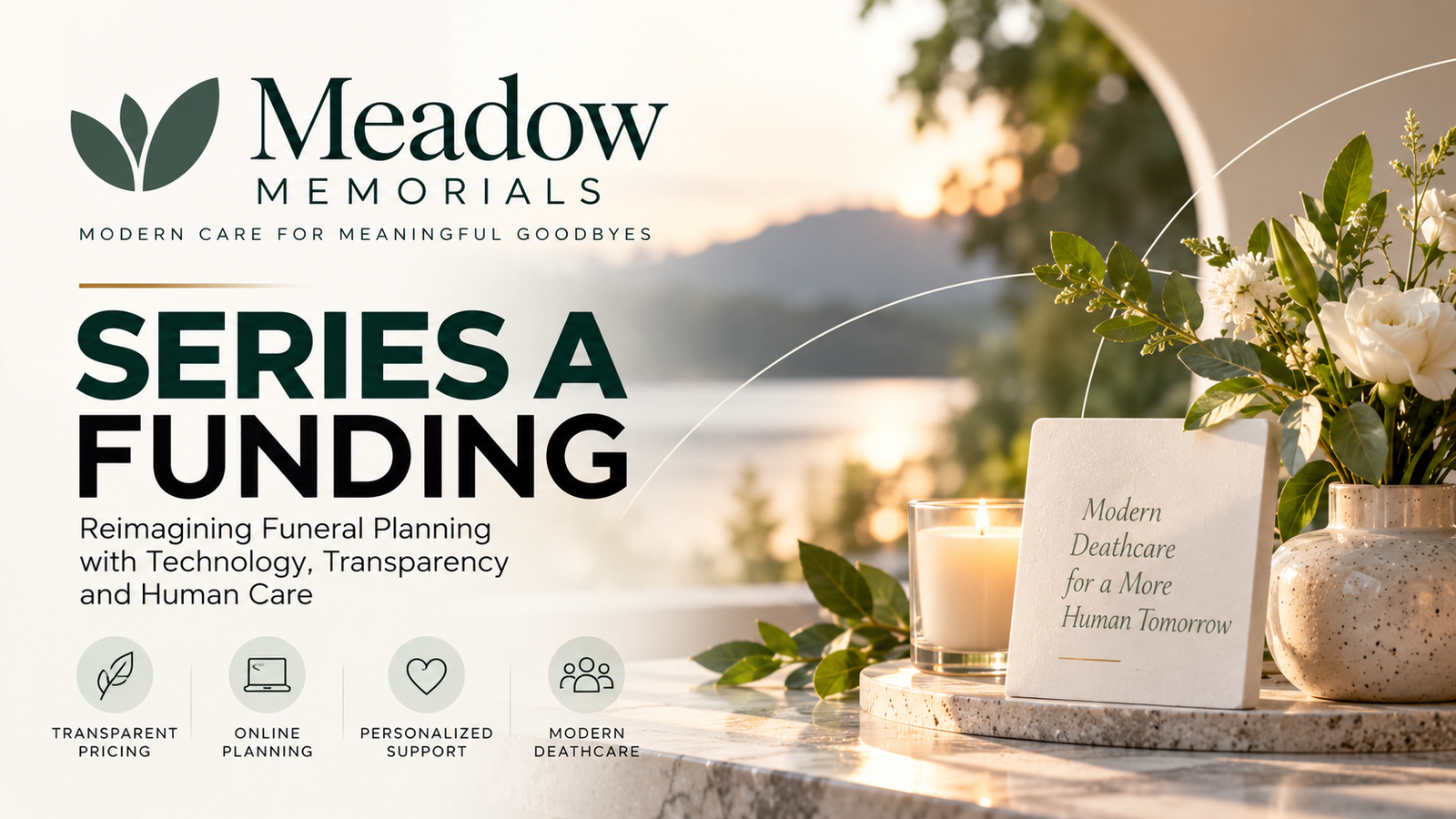
The funeral industry is one of America’s oldest service businesses. It is also an industry where technology, transparent pricing, and consumer-first design can still create meaningful change.
Meadow Memorials is betting that deathcare does not need to look like the traditional funeral home.
The company has built a modern, software-enabled approach to cremation, funeral planning, memorial services, and preplanning. Instead of relying entirely on traditional funeral-home facilities, Meadow combines technology with local partnerships to coordinate care and create more flexible experiences for families.
That model has attracted significant investor attention.
In 2026, Meadow Memorials announced a new Series A funding round led by Lachy Groom and Haystack. Meadow has publicly referenced the round at $11 million, while Crunchbase News reported the financing as $9 million.
But the funding itself is only one part of the story.
Meadow is attempting to answer a much bigger question:
Can deathcare become more transparent, affordable, technology-enabled, and human at the same time?
Here is why the Meadow Memorials Series A matters.
Quick Answer: What Are Meadow Memorials?
Meadow Memorials is a modern deathcare company offering cremation, funeral planning, memorial services, and preplanning through a technology-enabled operating model.
The company was founded by Sam Gerstenzang and Emma Gilsanz. Its approach combines digital tools, transparent pricing, local venues, and human support.
Families can begin arrangements online or over the phone, while Meadow coordinates paperwork, transportation, cremation, communication, and other parts of the process.
The company’s official Meadow Memorials website describes its approach as a modern alternative to traditional funeral services, with an emphasis on transparency, convenience, and personalized support.
Meadow currently serves multiple U.S. markets, including California, Texas, Washington, Oregon, and Arizona.
For readers interested in other startups modernizing established industries, the Bandana Series A story provides a useful comparison of how a startup can use technology and transparency to improve a traditional consumer experience.
Who Is Meadow Memorials?
Meadow Memorials is a deathcare startup focused on making funeral and cremation arrangements easier to understand and manage.
The company describes its approach as a modern alternative to the traditional funeral home.
Its services include direct cremation, funeral planning, memorial arrangements, and preplanning.
The company’s current offering emphasizes transparent pricing, 24/7 support, online planning, and personalized care.
Families can start the arrangement process remotely instead of needing to immediately visit a traditional funeral home.
Meadow’s current service model also uses local facilities and partners rather than requiring every part of the customer experience to happen inside a Meadow-owned funeral home.
That creates an interesting combination of deathcare services, software, logistics, and consumer technology.
The company is not trying to turn grief into a software product.
Instead, it is using technology to remove administrative friction from an experience that traditionally involves a large amount of paperwork and coordination.
That distinction may become one of its biggest competitive advantages.
The Founder Story Behind Meadow
The Meadow story began with a difficult personal experience.
Founder Sam Gerstenzang became frustrated with the traditional funeral experience after his grandfather died.
His family encountered confusing packages, unclear pricing, complicated logistics, and an experience that did not feel particularly personal.
As reported by Crunchbase News, the experience helped push Gerstenzang toward creating a different model for funeral planning.
He later teamed up with Emma Gilsanz to launch Meadow Memorials.
The company officially launched in January 2024.
Gerstenzang’s technology background also influenced the company’s direction. Before Meadow, he had worked at Stripe, giving him experience inside one of the technology industry’s most important payments companies.
Gilsanz brought experience across growth, operations, and work involving older adults.
Together, the founders saw an opportunity to bring modern consumer expectations into an industry that had changed relatively slowly.
The story is important because Meadow was not created simply because the founders saw a large market.
It came from a direct customer pain point.
That is often where strong vertical startups begin.
The Problem With Traditional Funeral Planning
Funeral planning is complicated for a simple reason: people rarely plan for it in advance.
When a death occurs, families may suddenly need to make decisions about transportation, cremation or burial, paperwork, memorial services, venues, urns, scheduling, and costs.
At the same time, they are dealing with grief.
That combination can make comparison shopping extremely difficult.
The financial side of funeral services can also be significant.
According to the National Funeral Directors Association’s funeral cost study, the median cost of a funeral with viewing and burial was $8,300 in 2023, while the median cost of a funeral with viewing and cremation was $6,280.
Those numbers vary by location and by the services selected, but they show why affordability and transparent funeral pricing are important parts of the Meadow Memorials story.
Meadow is approaching that opportunity through a different operating model.
The company says its technology and asset-light approach help reduce overhead and allow it to provide straightforward pricing.
This is where the company’s digital-first approach becomes particularly interesting.
What Meadow Memorials Is Building
At its core, Meadow is building a software-enabled deathcare platform.
The technology helps coordinate the many administrative and logistical steps involved in arranging care.
A family can start the process online or by phone.
Meadow then coordinates transportation, paperwork, cremation, communication, and the return of remains.
The company’s online portal is designed to help families follow the process.
Its service model also includes care specialists, paperwork assistance, transportation, and other operational support.
For memorial services, Meadow can work with local venues.
That creates another important difference from the traditional funeral-home model.
A memorial does not necessarily need to take place inside a standard funeral-home building.
It can happen in a location that has personal meaning to the family.
This approach gives Meadow more flexibility while reducing the need to build a large physical footprint in every market.
That is where technology becomes strategically important.
The customer sees a simple digital and human experience.
Behind the scenes, software and operations coordinate a much more complicated process.
Inside the Meadow Memorials Series A
The Meadow Memorials Series A represents an important step in the company’s growth.
According to Crunchbase News’ funding report, Meadow raised a $9 million Series A led by Lachy Groom and Haystack, following a $2 million seed round.
Meadow has also publicly described the financing as an $11 million Series A.
The difference appears to reflect different reporting or financing descriptions, so the safest editorial approach is to identify the $11 million figure as the company’s reported amount rather than presenting the figures as identical.
Regardless of the exact reported figure, the strategic message is clear.
Investors are backing Meadow’s attempt to modernize an established and highly fragmented industry.
The funding provides capital for expansion, technology, operations, and broader service development.
That is especially important because deathcare cannot be scaled exactly like a conventional SaaS company.
Entering a new state can involve licensing, transportation, crematory relationships, local regulations, facilities, customer-support operations, and market-specific logistics.
The Series A therefore gives Meadow more resources to build the infrastructure required for national expansion.
Who Invested in Meadow Memorials?
The lead investors associated with the Meadow Memorials Series A are Lachy Groom and Haystack.
That investor combination is significant because Meadow sits between several categories.
It is a consumer brand.
It is a technology company.
It is a logistics operation.
And it is a regulated deathcare business.
Investors therefore need to believe that the company can combine software economics with real-world service delivery.
Haystack’s involvement also reinforces the idea that Meadow is being viewed as more than a traditional funeral business.
The company’s potential value comes from creating a repeatable operating system for a fragmented category.
This kind of vertical technology strategy can be seen across other startup sectors.
For example, DenotePress’s Hook Series A coverage shows how a technology company can combine software, consumer behavior, and complex industry relationships into a new platform.
Meadow is attempting something similar in deathcare, although the customer experience and regulatory environment are very different.
Why the Asset-Light Model Matters
One of the most interesting aspects of Meadow’s model is its asset-light approach.
Traditional funeral homes often operate significant physical infrastructure.
That can include chapels, viewing rooms, offices, preparation areas, parking facilities, and other real estate.
Those assets can be expensive to maintain.
Meadow takes a different approach.
Instead of owning every physical component of the funeral experience, the company can work with local venues and partners.
That means a family can potentially choose a location that has meaning to them.
It also creates a more flexible operating model for Meadow.
The company’s technology can coordinate the service while local partners handle parts of the physical experience.
This is similar to a broader trend across modern service businesses: technology coordinates a distributed physical network rather than requiring the company to own everything itself.
But deathcare adds an important requirement.
The system must work reliably.
There is very little room for operational failure when a family is depending on the company during a deeply emotional moment.
Meadow’s Transparent Pricing Strategy
Pricing is one of Meadow’s clearest differentiators.
The company emphasizes transparent pricing and says it avoids hidden fees and unnecessary upsells.
Families can review the company’s current service options through its Meadow Memorials pricing page, where the company provides information about its direct cremation packages and available upgrades.
This makes pricing transparency part of the customer experience rather than an afterthought.
The value proposition is not simply about being cheaper.
It is about making the cost structure easier to understand.
That matters because families may not have the time or emotional capacity to compare complicated packages.
Meadow’s model attempts to turn funeral planning into a more understandable consumer experience.
The company can then use software to guide customers through the required steps.
This is a classic example of technology being used to simplify a complex service rather than replacing the service itself.
Meadow still needs funeral professionals, transportation, cremation facilities, regulatory compliance, and human support.
Technology is the coordination layer.
The Rise of Preplanning
Preplanning may become one of Meadow’s most important long-term opportunities.
Instead of waiting until someone dies, preplanning allows individuals and families to arrange their future services in advance.
This can reduce pressure on relatives later.
It can also give customers more time to understand pricing and make thoughtful decisions.
Meadow has developed a dedicated Plan Ahead service that allows customers to explore future cremation arrangements and planning options.
That makes preplanning strategically valuable for both sides.
For customers, it provides clarity.
For Meadow, it creates a relationship before an urgent deathcare event occurs.
That changes the customer acquisition model.
The company is no longer only waiting for families to search for funeral services after a death.
It can also build awareness around planning ahead.
This could help transform Meadow from a funeral provider into a broader end-of-life planning brand.
Meadow’s Growth and Traction
The funding round came after strong reported growth.
Crunchbase News reported that Meadow had tripled revenue from 2024 to 2025 and was targeting another significant increase in 2026.
The company has also expanded its geographic footprint.
Its current website lists service coverage across Arizona, Southern California, Oregon, Texas, and Washington, showing that the company is already operating across multiple U.S. markets.
That geographic expansion matters because it provides an early test of whether Meadow’s operating model can travel.
A business can prove product-market fit in one city.
A much harder challenge is proving that the same model works across multiple states with different regulations, partners, customers, and operating conditions.
Meadow’s next phase will therefore be less about proving that the concept works.
It will be about proving that the concept scales.
For another example of a startup using funding to expand a new operating model, readers can explore the Fomo Series A story.
What the Series A Funding Could Unlock
The most obvious use of the Meadow Memorials Series A is geographic expansion.
The company wants to become a national deathcare brand.
That means entering additional states, building local relationships, expanding care teams, and creating reliable operational infrastructure.
But geography is only one part of the opportunity.
The company can also invest in its digital customer experience.
A stronger platform could make it easier for families to:
- Start arrangements
- Complete documentation
- Track the process
- Communicate with care teams
- Compare services
- Manage payments
- Plan memorial events
- Prepare for future needs
The company can also continue developing its preplanning business.
This could become a major growth channel because customers can engage with Meadow before they urgently need funeral services.
That creates more time to establish trust.
It also creates opportunities to introduce additional planning products over time.
This is where the Meadow model becomes particularly interesting from a startup perspective.
The company may be building not just a better funeral service, but a broader digital infrastructure layer for end-of-life planning.
Meadow’s Position in Deathcare Technology
Meadow operates in an unusual category.
It is a funeral services provider.
It is a technology company.
It is a consumer brand.
It is also a logistics business.
That combination creates both opportunity and complexity.
Traditional funeral homes have local trust and decades of experience.
Technology startups can build better digital experiences.
Large funeral companies have scale.
Meadow is attempting to combine elements of all three.
Its potential advantage is the ability to build technology around the actual customer journey instead of adding software to an existing traditional structure.
This approach also reflects a wider startup trend.
Founders are increasingly entering industries that have large customer bases but outdated technology and fragmented operations.
DenotePress has covered this pattern across categories, including beauty, employment, music, and finance.
The Blank Beauty Series A story, for example, shows how technology can be used to rethink a traditional consumer category.
Meadow’s challenge is more sensitive because its customers are dealing with grief.
That makes trust a central part of the product.
Risks and Challenges Ahead
The Meadow Memorials Series A creates a new set of expectations.
The company now has to prove that regional success can become national scale.
Regulatory Complexity
Deathcare is regulated.
Licensing requirements and operating rules can vary between states.
Expansion therefore requires more than launching a website in another city.
Maintaining Service Quality
A high-touch customer experience can become difficult to maintain as a company grows.
Meadow’s promise depends heavily on customer support and operational reliability.
Local Relationships
The asset-light model depends on local partners, venues, crematories, transportation providers, and other service relationships.
Those relationships need to operate smoothly.
Brand Trust
Deathcare is an unusually sensitive category.
A company can build excellent software and still fail if customers do not trust the brand during a difficult moment.
National Expansion Economics
The company must also prove that its model remains economically attractive as it enters new markets.
Expansion brings new employees, regulatory costs, partnerships, marketing expenses, and operational complexity.
These challenges do not necessarily weaken the Meadow thesis.
They define the next stage of the company’s test.
Lessons From the Meadow Memorials Story
The Meadow Memorials Series A offers several useful lessons for founders.
1. Start With a Real Customer Problem
Meadow did not invent a new customer need.
People already needed funeral services.
The opportunity was to make the experience better.
2. Technology Should Remove Friction
The strongest technology applications do not always look like futuristic software.
Sometimes they simply make paperwork, communication, scheduling, and logistics easier.
3. Asset-Light Models Can Change Economics
Meadow’s use of local venues and partners demonstrates how a company can rethink the physical structure behind a traditional service.
4. Transparency Can Become a Competitive Advantage
Clear pricing can build trust in categories where customers may feel uncertain.
5. Human Services Still Need Human Support
Software can automate administration.
It cannot replace empathy.
That is especially true in death care.
Meadow’s model works only if technology and human care strengthen each other.
For another example of a startup using technology to simplify a complicated consumer experience, the FanBasis Series A article offers a useful comparison.
What Comes Next for Meadow Memorials?
The next chapter is about scale.
Meadow wants to expand its footprint while continuing to improve its technology and service model.
Its current service areas already span several major U.S. markets, giving the company an early foundation for broader expansion.
The company will need to demonstrate that it can maintain its customer experience while entering more states.
It will also need to continue building its preplanning business.
The larger vision could eventually extend beyond cremation.
Meadow could become a broader platform for end-of-life planning, including preplanning, memorial services, digital documentation, family coordination, and other related needs.
That would make the company more than a modern funeral provider.
It could become a technology-enabled infrastructure layer for modern deathcare.
The opportunity is significant because the underlying need is universal.
Every family eventually faces end-of-life decisions.
The question is how those decisions will be handled.
Meadow is betting that future consumers will expect something more transparent, more digital, and more personalized.
The Series A gives the company capital to test that thesis at greater scale.
Frequently Asked Questions
What are Meadow Memorials?
Meadow Memorials is a technology-enabled deathcare company offering cremation, funeral planning, memorial services, and preplanning.
How much did Meadow Memorials raise in Series A funding?
Meadow Memorials has publicly referenced an $11 million Series A, while Crunchbase News reported the round at $9 million. The difference should be noted when citing the financing.
Who invested in Meadow Memorials?
The Series A was led by Lachy Groom and Haystack.
Who founded Meadow Memorials?
Meadow Memorials was founded by Sam Gerstenzang and Emma Gilsanz.
What do Meadow Memorials do?
Meadow provides cremation, funeral planning, memorial services, and preplanning. Customers can begin arrangements online or by phone.
How is Meadow different from a traditional funeral home?
Meadow uses a technology-enabled and asset-light model that combines digital planning, human care, local partners, and transparent pricing.
Does Meadow offer preplanning?
Yes. Meadow offers preplanning services that allow people to arrange future cremation services in advance through its Plan Ahead offering.
How much does Meadow Memorials cost?
Pricing varies by service and location. Customers should review the company’s current pricing information and confirm the total cost for their specific location and selected services.
Where does Meadow Memorials operate?
Meadow currently lists services in Arizona, Southern California, Oregon, Texas, and Washington.
Why is Meadow Memorials considered a deathcare startup?
Meadow combines traditional funeral and cremation services with software, digital customer experiences, automation, and an asset-light operating model.
What will Meadow use its Series A funding for?
The funding is intended to support growth and expansion of the company’s technology-enabled deathcare model, including geographic expansion and broader service offerings.
Conclusion
The Meadow Memorials Series A is interesting because it is more than another startup funding announcement.
It is a bet that one of America’s oldest service industries can be rebuilt around transparency, technology, and human care.
Meadow is approaching funeral services differently.
Instead of starting with expensive real estate, it starts with the customer experience.
Instead of overwhelming families with complicated choices, it emphasizes clearer pricing.
Instead of trying to automate away the human relationship, it uses technology to reduce administrative friction so its team can focus on people.
The company’s reported Series A gives that strategy room to grow.
The biggest question now is whether Meadow can take what worked in its early markets and reproduce it nationally without losing the empathy, affordability, transparency, and operational quality that make the model compelling.
If it can, Meadow may become more than a modern funeral provider.
It could become one of the companies defining what the next generation of American deathcare looks like.
