

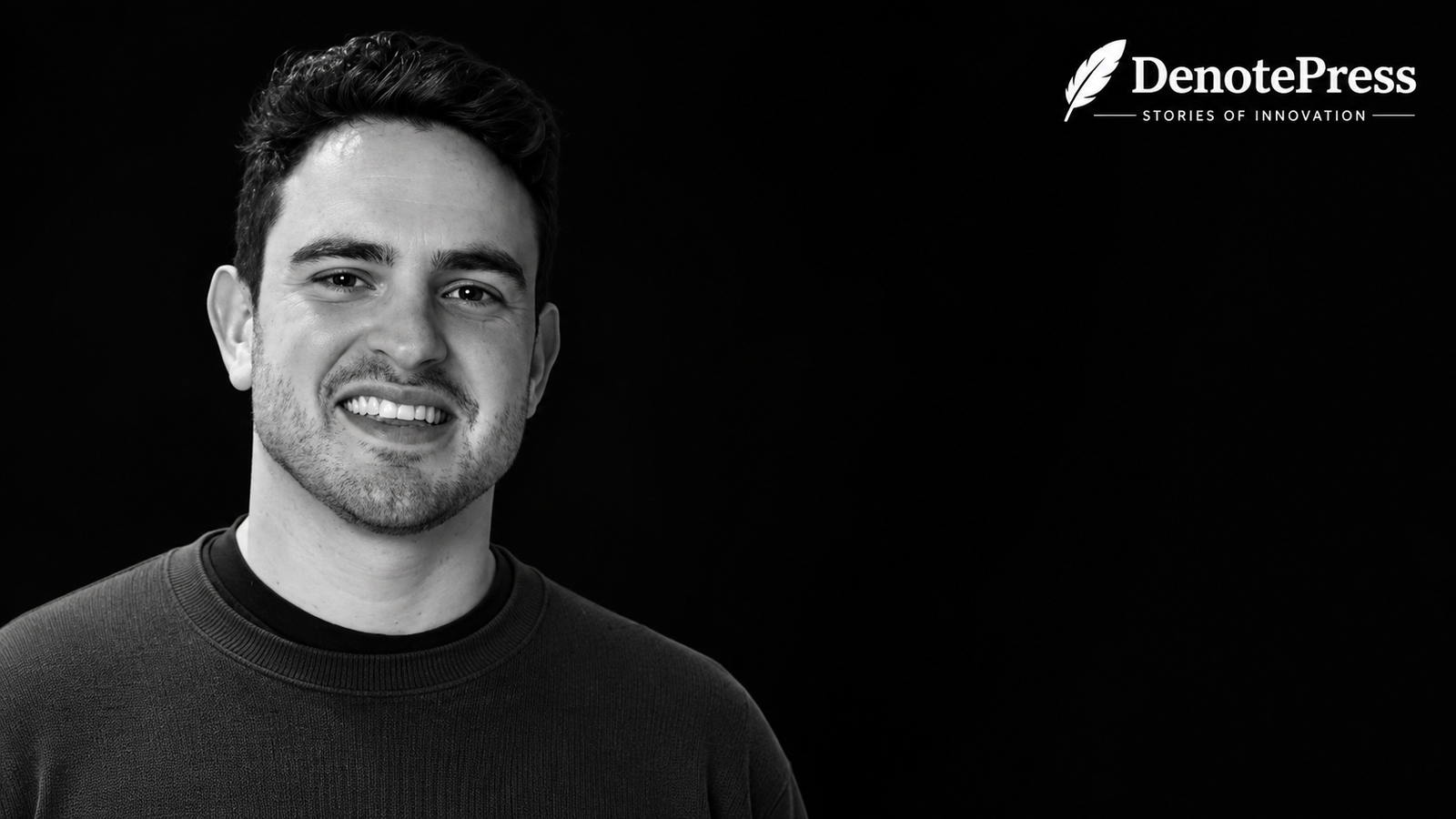
Danyal Akarca Callosum is a founder story built on a question two Cambridge PhD students started asking each other about brains, years before either of them planned to start a company. Akarca is the co-founder and CEO of Callosum, a London-based startup building infrastructure that routes AI workloads across different models and chips rather than assuming every task needs the biggest, most expensive hardware available. In August 2026, Callosum closed a $100 million seed round led by Atomico, marking the first disclosed investment from the UK government’s £500 million Sovereign AI Fund and one of the largest seed rounds ever raised by a British startup.
Here is how two computational neuroscientists took an idea about how the brain’s specialized regions coordinate and turned it into an infrastructure company betting it can reshape how the AI industry thinks about compute.
Who Is Danyal Akarca?
Danyal Akarca is the co-founder and CEO of Callosum, according to his own personal website and Converge Digest’s coverage of the company’s seed round. He originally trained as a medical doctor at the University of Southampton, with a research focus on neurosurgery and neuroanatomy, before completing a PhD in computational neuroscience at the University of Cambridge’s MRC Cognition and Brain Sciences Unit in 2023.
That path from clinical medicine into computational neuroscience research gave Akarca a foundation studying the brain’s actual physical structure before turning to the more abstract, computational question of how that structure gives rise to efficient intelligence, a combination that maps directly onto the problem Callosum now works on for artificial systems.
From Medical School to a Cambridge Neuroscience PhD
Akarca’s doctoral research focused on generative models of brain networks, funded by the UK’s Medical Research Council and a Vice Chancellor’s Award from the Cambridge Trust. In 2024, he was awarded a joint Imperial College Research Fellowship and Schmidt Sciences Fellowship, alongside a research seed grant from ARIA, the UK’s Advanced Research and Invention Agency, and now leads a research group at Imperial College London studying shared principles of efficient computation across natural and artificial systems.
Akarca has published research in journals including Nature Communications, Nature Machine Intelligence, and eLife, giving him an academic publication record that predates Callosum’s founding by several years and lends the company’s technical thesis a level of peer-reviewed credibility uncommon among infrastructure startups at the seed stage.
Jascha Achterberg: The Co-Founder Studying How Brains Compute Efficiently
Callosum’s co-founder and chief technology officer, Jascha Achterberg, met Akarca while both were pursuing PhDs at Cambridge, and the two began working together on shared research around 2021. Achterberg, a Gates Scholar who also worked at Intel during his doctoral studies, focuses on how large-scale, heterogeneous computing systems, both biological and artificial, achieve capabilities no single uniform architecture can replicate on its own.
Achterberg has described his research interest directly: understanding how distinct, specialized components, coordinated through the right connectivity, produce intelligence greater than the sum of their parts, a principle he has said is as evident in the brain’s distributed architecture as in economic systems built on specialization and exchange. That framing, applying an idea from neuroscience and economics to computing architecture, became the founding thesis behind Callosum.
The Problem Callosum Set Out to Solve
The AI industry’s dominant assumption has been that better AI requires ever-larger models running on increasingly expensive, uniform hardware. Callosum’s founders argue that assumption is breaking down, because most real-world AI problems are inherently heterogeneous, requiring different, complementary forms of intelligence and compute rather than one dominant model handling every task identically.
As AI shifts from training toward inference at scale, the company argues the more important question is no longer simply who builds the best model, but how intelligence gets delivered efficiently across an increasingly diverse landscape of models and chips. That framing directly informed Callosum’s core product decision: build software that decides what level of intelligence and compute a given task actually needs, rather than defaulting every request to the most powerful, most expensive option available.
Building Callosum: Heterogeneous Intelligence and Tailored Inference
Callosum’s platform, which it calls Tailored Inference, offers developers a library of APIs that route AI workloads across a global network of silicon partners, continuously profiling combinations of models and hardware to match each task with the most cost-efficient, high-quality option available. According to the company, the approach can complete some inference tasks nearly four times faster than comparable large models, while also reducing infrastructure costs.
The company’s own name reflects its founding metaphor directly: the corpus callosum is the band of nerve fibers connecting the brain’s two hemispheres, allowing specialized regions to coordinate on complex tasks, the same coordination principle Callosum’s software applies to AI models and chips. The company has partnered with Cerebras, the wafer-scale AI chip maker that went public in 2026, among its growing network of specialized silicon partners.
Inside Callosum’s $100 Million Seed Round
Callosum announced a $100 million seed round on August 20, 2026, led by Atomico, with significant participation from Plural, DCVC, and the UK Sovereign AI Fund, bringing the company’s total disclosed funding to roughly $110 million since its 2025 founding. The round followed an earlier $10.25 million pre-seed round led by Plural in February 2026, when Callosum emerged from stealth, alongside a separate $2.9 million research grant from ARIA specifically for heterogeneous computing research.
Callosum has not disclosed its valuation. Niklas Zennström, CEO of Atomico, framed the investment around the shift already underway in the industry. “As AI moves from training to inference, the question is no longer just who builds the best models,” he said. “It’s how we deliver intelligence efficiently, across an increasingly diverse landscape of models and chips.”
The Investors Backing Danyal Akarca
Atomico leading Callosum’s round, alongside the UK Sovereign AI Fund’s first disclosed investment, gives the company a notable mix of experienced deep-tech venture backing and direct government-level conviction in Britain’s AI infrastructure ambitions. The Sovereign AI Fund launched with £500 million specifically to back British AI companies seen as strategically important for both economic growth and national security, making Callosum’s selection as its first disclosed bet a meaningful signal about how the fund views the company’s long-term significance.
That combination of institutional venture capital and sovereign-level government backing is relatively rare at the seed stage, and reflects the scale of both the technical problem Callosum is attempting to solve and the capital-intensive nature of building AI infrastructure that spans multiple hardware partners globally.
Callosum’s Position in the AI Infrastructure Race
Callosum’s approach places it in direct competition with Nvidia’s dominant AI computing ecosystem, particularly its CUDA software platform and GPU infrastructure, while also distinguishing itself from newer specialized chip makers like Etched and SambaNova that are betting on purpose-built hardware for AI inference. Rather than building its own chips, Callosum’s bet is that flexibility across many different chip architectures, rather than dependence on any single supplier, will matter more to customers as AI inference costs scale.
That positioning carries real technical risk: Callosum’s value proposition depends on its software reliably identifying the most efficient model-and-chip combination for a given task across a constantly shifting landscape of hardware options, a genuinely difficult systems problem that competing approaches, including simply using the most powerful available hardware for everything, have so far avoided having to solve directly.
What’s Next for Callosum
With fresh seed capital, Callosum’s near-term priorities center on scaling its heterogeneous compute platform, expanding its global compute partnerships beyond its existing relationship with Cerebras, and further developing its Tailored Inference technology. The company’s research-driven approach, continuing to publish academic work alongside commercial product development, suggests its founders intend to maintain close ties to the academic neuroscience and computing research community that produced Callosum’s founding thesis in the first place.
Given the scale of capital already raised relative to the company’s young age, barely a year old at the time of its seed round, Callosum’s central challenge will likely be demonstrating working technology and real customer adoption at a pace that matches the scale of conviction its investors have already shown.
Lessons for Entrepreneurs From Danyal Akarca’s Journey
Akarca’s path offers a few clear lessons for founders building companies directly out of academic research. First, his and Achterberg’s years of published, peer-reviewed research studying efficient computation in biological systems gave Callosum’s technical thesis a level of credibility that a purely commercial pitch built without that research foundation would have struggled to match. Second, maintaining active academic positions, Akarca at Imperial College London and Achterberg’s continued research affiliations, even while building a well-funded company, shows that founders in genuinely research-intensive categories don’t necessarily need to fully abandon academic work to build a credible startup.
Third, Callosum’s willingness to name its own product directly after the neuroscience concept underlying its technical thesis, rather than choosing a more generic infrastructure-sounding name, reflects a level of confidence in the company’s scientific narrative that appears to have resonated directly with both investors and the broader AI infrastructure conversation.
Frequently Asked Questions
Who is Danyal Akarca? Danyal Akarca is the co-founder and CEO of Callosum, an AI infrastructure company. He trained as a medical doctor before completing a PhD in computational neuroscience at the University of Cambridge, and now leads a research group at Imperial College London.
What does Callosum do? Callosum builds infrastructure that routes AI workloads across different models and computing chips based on cost, speed, and energy efficiency, using a platform called Tailored Inference rather than defaulting every task to the most powerful available hardware.
How much funding has Callosum raised? Callosum has raised roughly $110 million total: a $10.25 million pre-seed round led by Plural in February 2026, and a $100 million seed round announced August 20, 2026, led by Atomico, with participation from Plural, DCVC, and the UK Sovereign AI Fund.
Who co-founded Callosum with Danyal Akarca? Callosum was co-founded by Danyal Akarca and Jascha Achterberg, who serves as chief technology officer. The two met while pursuing PhDs together at the University of Cambridge.
Why is Callosum’s seed round significant for the UK? Callosum’s $100 million seed round is one of the largest ever raised by a British startup, and marks the first disclosed investment from the UK government’s £500 million Sovereign AI Fund.
Where is Callosum based? Callosum is headquartered in London, United Kingdom, and was founded in 2025.
Conclusion
Danyal Akarca Callosum represents a bet that ideas from neuroscience, specifically how the brain’s specialized regions coordinate efficiently rather than relying on one uniform structure for every task, can meaningfully reshape how the AI industry approaches compute infrastructure. With roughly $110 million in total funding, the first disclosed backing from the UK’s Sovereign AI Fund, and a founding team with genuine peer-reviewed research credibility behind its technical thesis, Callosum is testing whether heterogeneous intelligence can become as foundational to AI’s next phase as raw model scale has been to the current one.
For more founder stories in academic spinouts and AI infrastructure, see Nathan Arnold’s Photon Queue, Nadav Grossinger’s Elio, and Vitor Olivier’s Decade on Denote Press.
