

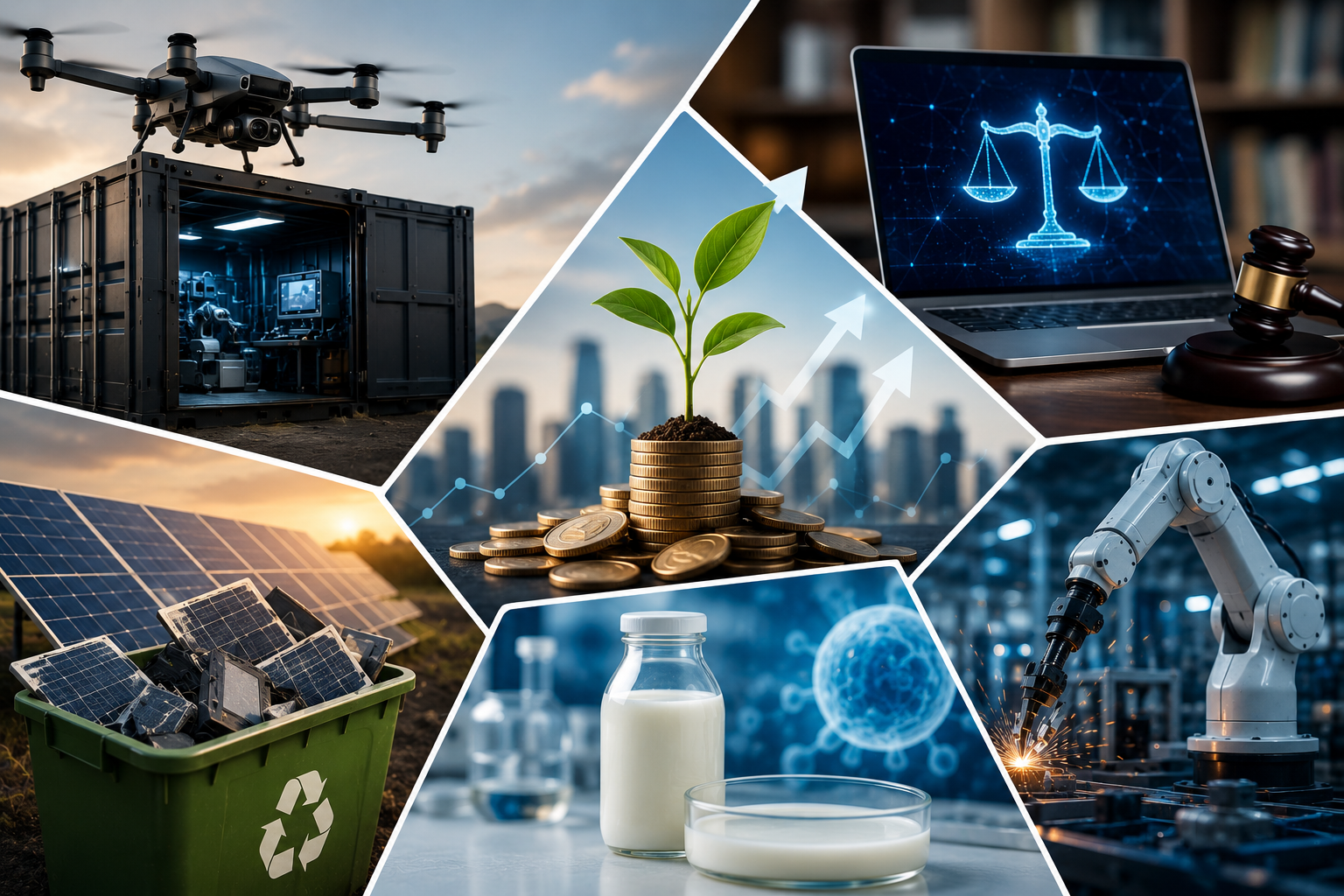
Startup funding stories 2026 are becoming more interesting than ever. While most headlines focus on massive AI companies, many smaller startups are quietly building technologies that could transform industries like defence, legal services, clean energy, manufacturing, and food production.
Every week, startups around the world raise millions of dollars in funding, but most people only hear about the biggest names dominating social media headlines. Behind the scenes, however, many smaller and lesser-known companies are quietly building technologies that could reshape industries over the next decade. Some are solving environmental problems, some are modernising old industries with artificial intelligence, and others are developing entirely new ways of manufacturing products.
What makes these startups interesting is not only the money they raised, but also the real-world problems they are trying to solve. From battlefield manufacturing systems and AI-powered law firms to solar recycling and lab-produced milk, these companies are working on ideas that once sounded futuristic but are now becoming serious businesses.
Here are five startup funding stories from 2026 that deserve more attention.
Firestorm Labs and the Future of Battlefield Manufacturing
Defense technology startups are receiving more investor attention than ever before, and Firestorm Labs is one of the latest examples. The company recently raised significant funding to expand its mobile manufacturing systems and drone technology.
What makes Firestorm different is its focus on portable production systems. Instead of depending on large factories located far away from military operations, the startup is building container-based manufacturing units that can operate closer to conflict zones. These systems can quickly produce drones, replacement parts, and equipment where they are needed most.
Modern military logistics have become increasingly complicated, especially during international conflicts where supply chains can easily break down. Investors believe companies like Firestorm Labs could become very important in future defense operations because speed and adaptability now matter more than ever.
Helpful Resources: Firestorm Labs | Defense Tech News
Manifest OS Wants to Modernize the Legal Industry
Most people still think of law firms as traditional businesses filled with paperwork, long contracts, and hourly billing systems. Manifest OS believes artificial intelligence can significantly improve how legal services operate.
The startup recently raised major funding to develop an AI-powered operating system for modern law firms. Its platform helps automate tasks such as legal research, billing, document drafting, and client communication.
The interesting part is that the company is not simply selling software tools. Instead, it wants to create a completely different workflow where lawyers can spend less time on repetitive administrative tasks and more time focusing on strategy and client outcomes.
AI is already changing industries like customer service, marketing, and software development. The legal industry may now be entering a similar transformation phase.
Helpful Resources: Legal Tech Industry | AI in Legal Services
ROSI Is Solving the Solar Panel Waste Problem
Solar energy is often discussed as part of a cleaner and more sustainable future, but very few people talk about what happens when solar panels stop working. Millions of old solar panels are expected to become industrial waste over the next decade.
French startup ROSI is trying to solve that problem through large-scale solar panel recycling technology. The company extracts valuable materials such as silver, copper, silicon, aluminum, and glass from damaged or expired panels so those materials can be reused instead of discarded.
The company recently secured new funding to expand its recycling operations and build larger facilities. As governments and businesses continue investing heavily in renewable energy, the need for sustainable recycling systems will likely grow rapidly.
This may not generate as much online attention as AI startups, but it represents a very important long-term environmental business opportunity.
Helpful Resources: ROSI Official Website | CleanTech News
Opalia and the Future of Dairy Production
Food technology startups experienced huge investment growth a few years ago, although funding slowed recently. Still, some companies continue working on alternative food production systems that could become important in the future.
Canadian startup Opalia is developing cell-based milk technology that allows milk production without traditional dairy farming. Instead of relying on cows, the company uses mammary cells inside bioreactors to create milk components.
The idea may sound unusual today, but investors are interested because global food demand continues increasing while climate pressure on agriculture becomes more serious every year. Alternative dairy systems could eventually help reduce environmental impact while maintaining production capacity.
Opalia is currently working with industry partners and preparing for future commercial expansion.
Helpful Resources: Food Tech Industry | Alternative Protein News
C-Infinity Is Bringing AI Into Manufacturing
Artificial intelligence is no longer limited to chatbots and software tools. Industrial companies are now exploring how AI can improve manufacturing efficiency and production planning.
C-Infinity recently raised funding to automate one of manufacturing’s biggest bottlenecks: turning digital product designs into actual factory production instructions. Its software helps manufacturers reduce planning time and improve operational efficiency.
Traditionally, engineers spend weeks preparing assembly instructions and production plans. C-Infinity wants AI systems to complete much of that work automatically.
This growing trend is often called physical AI, where artificial intelligence is applied to real-world industrial operations instead of only digital services. Investors believe this could become one of the biggest technology sectors over the next few years.
Helpful Resources: Manufacturing AI News | Industrial AI Insights
Final Thoughts
The startup industry in 2026 is becoming much broader than social media apps or traditional software businesses. Investors are increasingly supporting companies solving industrial, environmental, manufacturing, food production, and infrastructure-related challenges.
Not every startup mentioned here will become a global success story, but the problems they are trying to solve are real and growing. That is exactly why these businesses are attracting attention from investors worldwide.
As technology continues evolving, startups that combine innovation with practical real-world solutions may ultimately become the companies that shape the next generation of global industries.
