

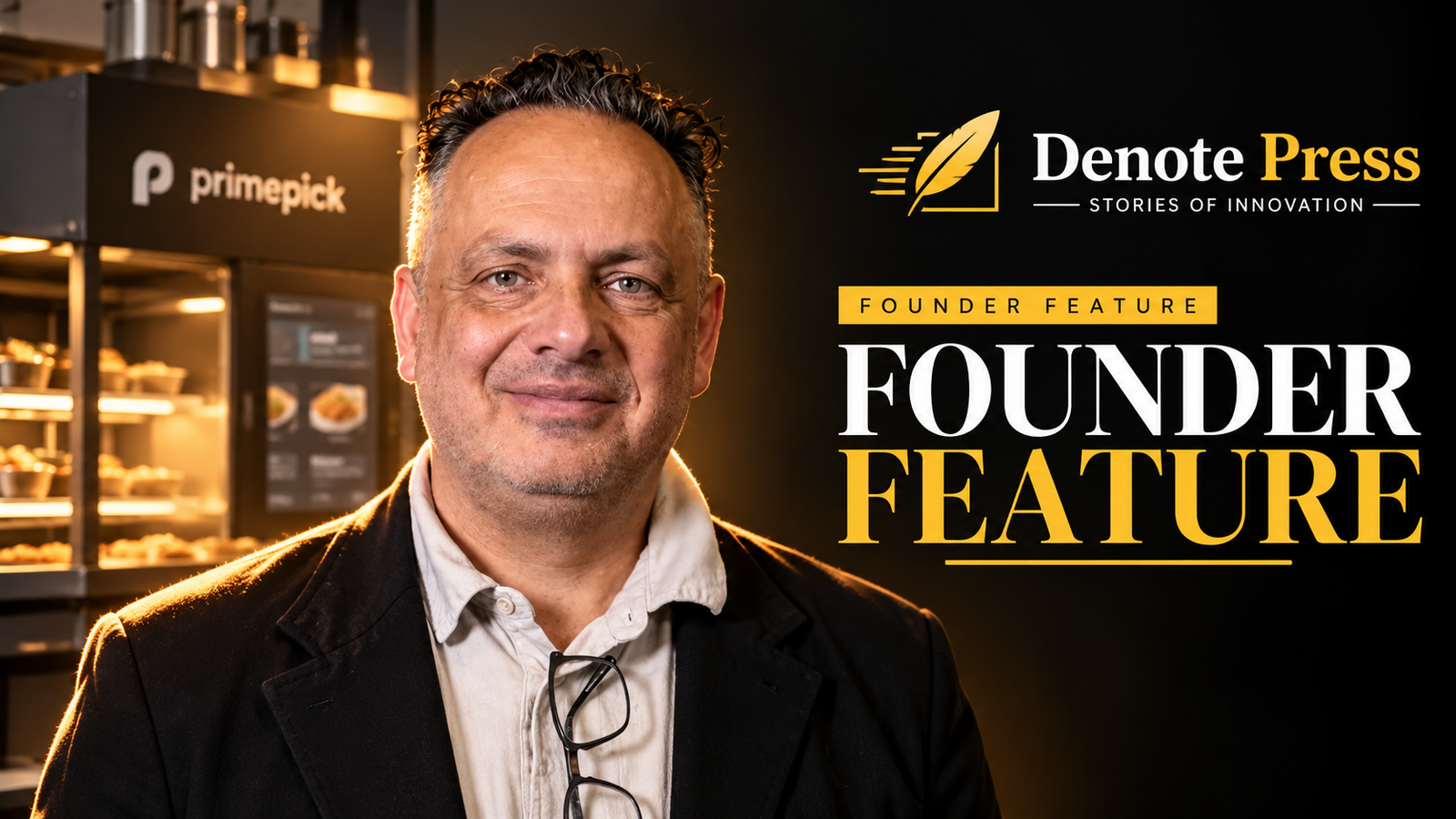
Dmitry Vilbaum Primepick is the story of a founder who heard from his daughter, a nutrition student at Columbia University, that there was no real food available during overnight clinical rotations, and decided a robot could solve it. Vilbaum is the co-founder and CEO of Primepick, a Brooklyn company that designs and builds MealMate, a robotic kiosk that heats and serves a hot meal in about five to seven minutes at any hour. According to Food On Demand, the kiosk holds between 80 and 285 meals at sub-zero temperatures, uses two robotic arms to move meals and takes orders by touchscreen or mobile app. The company raised a $975,000 seed round in March 2026. Here is how Vilbaum got there, how the machine works, where it is installed and what is still unproven.
Dmitry Vilbaum Primepick: Who Are the Founders?
Primepick was founded by three co-founders. Crunchbase lists Dmitry Vilbaum as CEO and co-founder, Anastasia Kalinkina as co-founder and chief operating officer, with a past role as COO of Sizl, and Ilya Sibikin as co-founder and chief product officer. The company is based in Brooklyn, New York, and its website lists an address on Van Dyke Street in Red Hook.
PitchBook dates the company’s founding to 2024 and lists 19 employees, while other directories list 11 to 50. Vilbaum is also the most visible voice of the company. He posts on LinkedIn about installations and has been interviewed in trade outlets such as Vending Times and Food On Demand.
The sources reviewed do not describe Vilbaum’s career before Primepick in detail, so this article does not. What they do show is a founder who speaks about the business as a food company that happens to use robots. That framing is the core of the Dmitry Vilbaum Primepick story.
The Daughter’s Overnight Rotations
The origin story is personal. According to Food On Demand, Vilbaum saw the opportunity when his daughter, studying nutrition at Columbia University, noted a lack of access to “real food” during her overnight clinical rotations. The clinical setting matters: hospital shifts run all night, cafeterias close and the options left are vending machines and delivery.
A daughter who studies nutrition is also a sharp critic of what is on offer. Instead of accepting chips and candy as the default for night-shift workers, Vilbaum asked what a better late-night option would look like.
It is a relatable founding story and an unusually specific customer. The need is not only convenience but food quality at hours when almost nothing is open. That conversation with his daughter is the creative seed of Dmitry Vilbaum Primepick.
The Problem: No Real Food After Hours
The company’s website frames the problem through the places where people get stuck. It describes the office worker who has no time for lunch, the night-shift hospital employee, the college student cramming after the cafeteria closes, the resident who is too tired to cook and the traveler who just arrived at a hotel.
Each setting has the same gap: hot food is not available when people need it, and delivery is slow or expensive. Retail Technology Innovation Hub notes the common thread: hospitals, manufacturing plants and other round-the-clock environments need complete hot meals beyond traditional foodservice hours, without an on-site kitchen or additional staff.
Traditional vending machines offer packaged snacks. Staffed kitchens are expensive to run overnight. A machine that serves restaurant-style meals at any hour could fill the middle. That unmet need is what Dmitry Vilbaum Primepick was built to address.
Building Primepick: The MealMate Hardware
Primepick makes its own machine. Robotics and Automation News reports that the company designs and builds the MealMate platform in-house, and that the kiosk comes in multiple configurations holding between 90 and 285 meals depending on location and demand.
The Primepick website describes the experience in simple terms. Users browse a catalog on the touchscreen or mobile app, place a walk-in order or schedule pickup, and collect with a QR code. The company says a meal takes about five minutes, and trade coverage says five to seven. The meal then waits warm for pickup for up to one hour on the consumer site, while trade coverage cites 30 minutes in the warming cabinet, so the holding time varies by source.
Building hardware is harder than building an app. It requires engineering, certification, manufacturing and service. Doing it in-house gives control, though it also raises costs and risk. The machine is the product backbone of Dmitry Vilbaum Primepick.
How a Meal Gets From Freezer to Hand
The mechanics are visible in the company’s descriptions. According to Food On Demand and Retail Technology Innovation Hub, MealMate has a frozen storage compartment held at about minus 18 degrees Celsius, three industrial-grade microwave ovens and a warming cabinet. Two robotic arms transfer meals between these compartments.
When a customer orders, a robot arm picks a frozen meal, moves it to a microwave, heats it and places it in the warming cabinet or hands it to the customer. The company’s kiosk page describes the large model as having a warming cabinet with 28 ready-to-serve locations at around 143 degrees Fahrenheit, or 60 degrees Celsius.
Primepick’s software also runs the back office. Food On Demand says it manages merchandising, sales analysis, restocking and customer support, and the company reports automated inventory updates and remote stock reporting. The robotic sequence is the technical heart of Dmitry Vilbaum Primepick.
The Marketplace Model: Local Restaurants in a Kiosk
The business model is not only a machine. Retail Technology Innovation Hub says Primepick applies a marketplace model to the vending industry, giving customers access to meals from local restaurants, dark kitchens and eateries from one kiosk. At Molloy University, for example, students can order dishes from local BBQ and Asian restaurants.
The sample menu on the website shows the style: cannelloni in rustic tomato sauce, coffee-crusted skirt steak, beef lo mein, lasagna bolognese and gnocchi alla sorrentina, in portions of roughly 10 to 11.5 ounces and 520 to 630 calories. Tags such as high protein, low carb and energy packed help customers choose.
Vilbaum told Food On Demand that restaurant brands are good partners because they are close to kiosk locations and tech-forward, and that restaurant partners sometimes need to adapt menu items to hold up in frozen storage. The company also supports scheduled pickup and loyalty programs. The marketplace model is the commercial idea behind Dmitry Vilbaum Primepick.
Safety, Serialization and Certifications
Hot food from a machine raises safety questions, and the company addresses them directly. The homepage says every meal is serialized and temperature-tracked. Vilbaum has described this in his own posts as meal tracking and automated safety controls for hot-food vending.
On compliance, Robotics and Automation News reports that MealMate is certified and compliant with the major health, safety and electrical standards required for commercial food equipment in the United States, including NSF/ANSI 25, UL and FCC requirements. The company’s kiosk page also describes ADA-compliant, temperature-tracked dispensers.
These are manufacturer statements, so operators and facilities should ask for the certification documents themselves. Still, certifications are essential for a machine that serves food in hospitals and nursing homes, where oversight is strict. Safety is the trust layer of Dmitry Vilbaum Primepick.
The Kiosk Lineup: Mini, Canteen, V280 and Large
Primepick sells more than one machine. The company’s kiosk page lists a MealMate V280, a Mini, a Canteen model and a Large model, described as automated hot meal kiosks serving 24/7 with 150 to 280 meals of capacity. The Large model is listed at up to 320 meals, with real-time self-inventory and stock reporting, three ovens and a warming cabinet.
Capacity figures differ by source, from 80 to 285 in Food On Demand, 90 to 285 in Robotics and Automation News, 150 to 280 in the page’s summary and up to 320 for the Large unit. The differences likely reflect different models and different dates, so check with the company for the model in question.
Having several sizes lets Primepick serve a small office lobby and a large hospital differently. The model range is the product strategy behind Dmitry Vilbaum Primepick, and it shows that the company is thinking about hardware as a platform, not a single unit.
Launching in October 2025
The company says it has been live and operational in New York and Connecticut since October 2025, according to the website. Food On Demand notes that Primepick launched MealMate the previous year with menu items from local restaurants, offering ordering for pickup online or via touchscreen plus automated inventory updates.
The launch was small and deliberate. As of the sources reviewed, the company had a handful of installations, and its own site describes the plan as bringing Primepick to new venues and communities. The sign-up for hosts and partners is on the website, with a form to host a kiosk.
A hardware startup that launches in a few controlled sites can learn how the machine performs, what customers order and what operators need before scaling. That cautious start is typical of robotics companies. The October 2025 launch is where Dmitry Vilbaum Primepick moved from prototype to real-world use.
Deployments: Campuses, Factories and Hospitals
The installation list is growing. According to Retail Technology Innovation Hub, Primepick is bringing MealMate to a Tri-State hospital and a nursing home, its fourth and fifth sites, following earlier installations at manufacturing sites in New Jersey and Connecticut and at Molloy University. It is also preparing three new deployments in Huntsville, Chicago and Dallas.
The university site is visible on the homepage: the kiosk is located in the campus public square at Molloy University in New York, and has its own Instagram account. At the factories, the kiosk feeds workers on every shift. Vilbaum also posted about an installation at Voyant Beauty, where it will serve employees every day.
The company was also featured at the 2026 NAMA Show in Los Angeles, in Aramark’s refreshments zone, according to its website. NAMA is the vending and foodservice trade association, so the appearance signals interest from the industry’s established players. The deployments are the proof of concept for Dmitry Vilbaum Primepick.
The $975K Seed Round
Primepick’s funding is small. PitchBook lists a seed round of $975,000 on March 10, 2026, and describes the company as venture-capital backed, with the stage listed as generating revenue. VCBacked and Startup Geek list the same amount and date, and Startup Geek shows no lead investor.
The sources reviewed do not name any investors. Crunchbase marks the round with an obfuscated date and a seed label. The company also has not published a press release about the round in the sources reviewed.
For a hardware company that designs and builds robotic kiosks, $975,000 is a modest amount, enough for early production and a few deployments but not for large-scale manufacturing. For comparison with companies that publish their rounds, see our story on Hostie, and for more on how funding shapes young startups, see our Funding News section. The seed round gives Dmitry Vilbaum Primepick limited runway, and the next financing will likely depend on deployment results.
The Team and the Ecosystem
Beyond the founders, the company is building a small team and a local robotics network. A LinkedIn post from New York Robotics congratulated Primepick and Vilbaum on the hospital and nursing home sites, which suggests the company is part of the New York robotics community.
Kalinkina’s past role as COO of Sizl, listed by Crunchbase, is relevant to the operations side, though the sources reviewed do not describe Sizl or her work there in detail. Sibikin’s product role is described only as chief product officer.
For hardware startups, the surrounding ecosystem matters: contract manufacturers, certification labs, host partners and operators. The company’s website invites hosts and partners to install a kiosk, which positions it as a platform for property owners, not a single consumer brand. The team and network are the support structure of Dmitry Vilbaum Primepick.
Where Primepick Stands in Hot-Food Automation
Automated food service is a crowded and uneven category. Traditional vending operators sell packaged snacks and cold food. Robotic kitchens prepare meals from scratch. Smart fridges and micro-markets offer packaged meals that customers heat themselves. Crunchbase lists KitchenMate and generic kiosk operators as possible competitors.
Primepick’s differentiators are clear. It serves restaurant-style hot meals without a kitchen or staff. It uses a marketplace model with local restaurants instead of a single in-house menu. It runs around the clock with automated inventory. And it designs the hardware itself, with commercial food-equipment certifications.
The risks are real. Hardware is expensive to build and service, and every unit needs maintenance and restocking. Meals must be reheated well enough to satisfy customers. Restaurant partners must adapt recipes for freezing. Host sites must be willing to pay for installation space. In a crowded category, Dmitry Vilbaum Primepick competes on meal quality and round-the-clock availability.
Risks and Open Questions
A fair article on an early-stage hardware company should name the open questions.
Scale. The sources reviewed show only a handful of deployments, with three more planned.
Unit economics. Public sources do not describe the cost of a kiosk, the pricing of meals or how revenue is split with hosts and restaurant partners.
Funding. A $975,000 seed with no named investors may not be enough to fund large-scale manufacturing.
Food quality. Frozen-and-reheated meals have a ceiling, and customer reviews are not yet public in the sources reviewed.
Specs vary. Capacity and hold-time figures differ by source and model.
Regulation. Food safety rules differ by state and venue, especially in hospitals and nursing homes.
None of these is unusual for a young robotics company. Naming them is part of an honest look at Dmitry Vilbaum Primepick.
Leadership Style and What’s Next
Vilbaum comes across as a hands-on, operator-minded founder. His public posts walk through new installations, and his trade interviews focus on practical details: how menus are adapted, how safety is tracked and where kiosks make sense. His summary of the mission is food-first: at the end of the day, he says, it all comes down to great food.
The company’s roadmap is visible from its announcements: more installations in hospitals and nursing homes, new deployments in Huntsville, Chicago and Dallas, and continued partnerships with local restaurants. The website also promotes mobile app ordering, loyalty programs and hosting options.
The test will be reliability and repeat use: whether employees, students and patients’ families come back to the kiosk after the novelty fades, and whether hosts see value. That discipline will define the next chapter of Dmitry Vilbaum Primepick.
Lessons From the Dmitry Vilbaum Primepick Journey
The Dmitry Vilbaum Primepick journey offers five practical lessons for founders.
First, start with a person you know. A daughter’s complaint about overnight rotations gave Vilbaum a specific, credible customer.
Second, choose places where the need is constant. Hospitals, factories and campuses run at all hours, which suits an always-on machine.
Third, partner instead of competing. Using meals from local restaurants lets the kiosk offer variety without building a kitchen.
Fourth, certify early. NSF, UL and FCC compliance opens doors in regulated settings like hospitals.
Fifth, grow site by site. A few deployments let a hardware startup learn before it scales.
Frequently Asked Questions
Who is Dmitry Vilbaum?
Dmitry Vilbaum is the co-founder and CEO of Primepick, a Brooklyn company that builds the MealMate robotic hot-meal kiosk.
What is the Dmitry Vilbaum Primepick story?
It is the story of a founder whose daughter, a nutrition student, noticed there was little real food during overnight hospital rotations, leading him to build robotic kiosks that serve hot meals at any hour.
What is Primepick?
Primepick is a New York company that designs and manufactures robotic food kiosks that heat and serve hot meals around the clock.
What is MealMate?
MealMate is Primepick’s kiosk. It has two robot arms, frozen storage, three microwave ovens and a warming cabinet, and serves a hot meal in about five to seven minutes.
How much funding has Primepick raised?
PitchBook lists a $975,000 seed round on March 10, 2026. The sources reviewed do not name the investors.
Who founded Primepick?
Dmitry Vilbaum is CEO, Anastasia Kalinkina is COO and Ilya Sibikin is chief product officer, according to Crunchbase.
Where are MealMate kiosks installed?
Sites include Molloy University, manufacturing facilities in New Jersey and Connecticut, a Tri-State hospital and a nursing home, with new deployments planned in Huntsville, Chicago and Dallas.
How many meals does a MealMate kiosk hold?
Sources vary. Food On Demand cites 80 to 285, Robotics and Automation News cites 90 to 285 and the company’s kiosk page cites 150 to 280, with a Large model up to 320.
Is MealMate certified?
The company says it is compliant with NSF/ANSI 25, UL and FCC requirements and is ADA-compliant. Ask the company for documentation.
How do I order from a MealMate kiosk?
Customers can order on the touchscreen or schedule pickup through the Primepick mobile app, then collect with a QR code.
Conclusion
Dmitry Vilbaum Primepick shows how a simple family conversation can turn into a hardware company. By building a robotic kiosk that stores frozen restaurant meals, heats them on demand and holds them warm for pickup, and by partnering with local restaurants instead of building a kitchen, Vilbaum and his co-founders have put hot food in universities, factories and healthcare sites. The open questions are scale, economics and funding: how many machines can be built and serviced, what each one earns and how a $975,000 seed stretches. If they answer them, Primepick may help answer a question hospitals and factories have long had: what do people eat at 3 a.m.?
For more founder journeys in hospitality and food technology, see Vittorio Gargiulo’s Hotiday, Dorsia’s Series A and Nopalera’s Series A on Denote Press, or browse all Founder Stories.
