

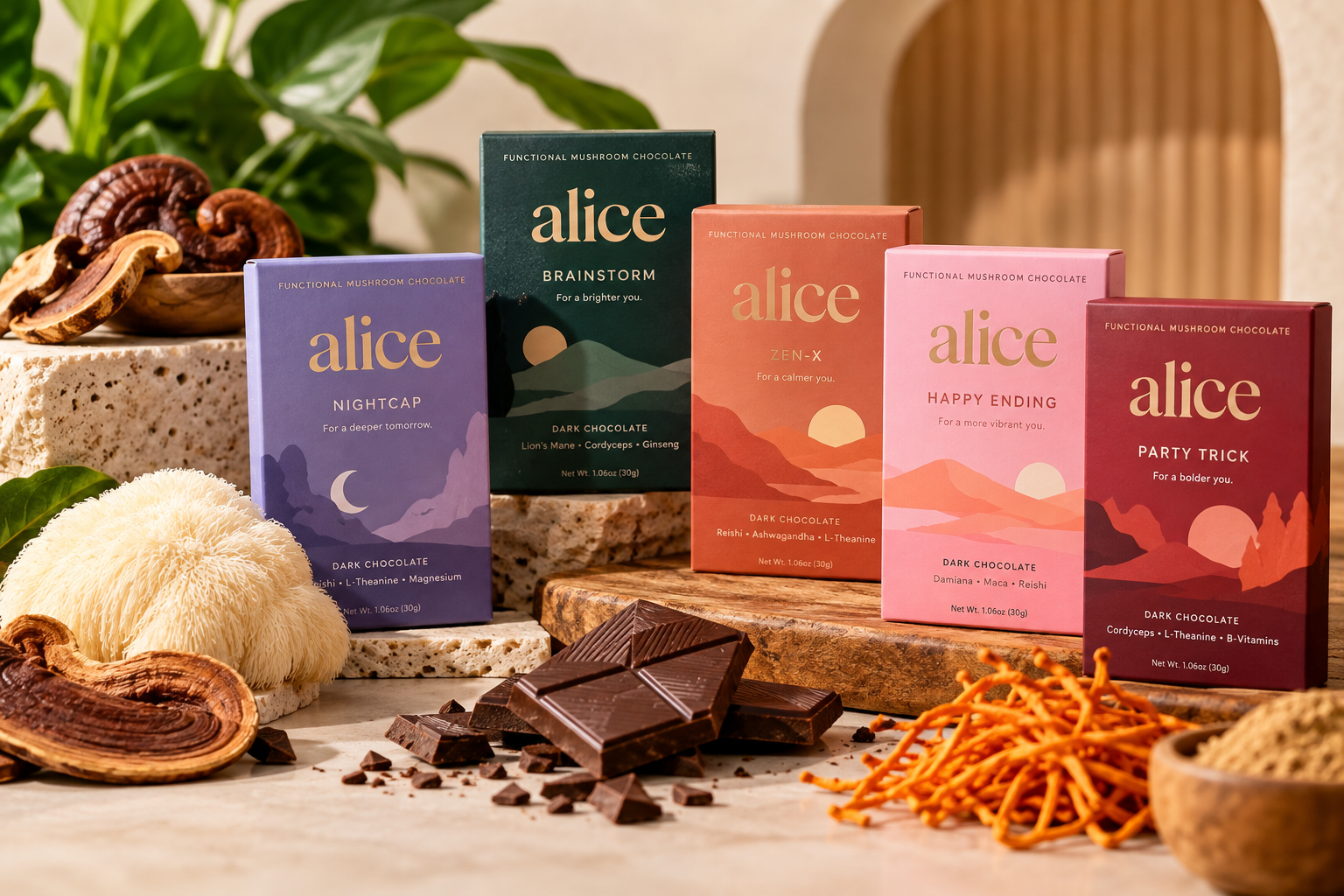
Alice Mushrooms Series A marks a major step forward for the functional chocolate company as it moves from an emerging wellness brand toward broader retail distribution.
The company raised $8 million in Series A funding in September 2025 in an oversubscribed round led by NewBound Venture Capital. Unilever Ventures and DJ and producer Tiësto were among the participants. The new capital is being directed toward product development and a major expansion of the brand’s retail footprint.
Founded by Lindsay Goodstein and Charlotte Cruze, Alice Mushrooms has built its business around a simple but increasingly popular idea: functional wellness products do not have to look or feel like traditional supplements.
Instead of capsules, powders, or conventional supplement formats, the company puts functional mushrooms, botanicals, and other ingredients into dark chocolate products designed around specific consumer needs.
That positioning has helped Alice Mushrooms enter the fast-moving intersection of functional food, wellness, chocolate, and consumer packaged goods.
Quick Answer: What Is the Alice Mushrooms Series A?
Alice Mushrooms raised $8 million in Series A funding in September 2025.
The round was led by NewBound Venture Capital, with participation from Unilever Ventures and Tiësto, among others.
The company said the funding would support new product development and retail expansion, including plans to add its products to approximately 1,300 additional retail doors.
The funding came as Alice Mushrooms was expanding beyond its direct-to-consumer roots and building a larger presence in specialty and mainstream retail.
What Is Alice Mushrooms?
Alice Mushrooms is a functional chocolate company focused on combining chocolate with functional mushrooms, botanicals, and nootropic ingredients.
Its products are designed around different consumer goals rather than being positioned as a single general-purpose supplement.
The company’s current product lineup includes products associated with areas such as energy, sleep, stress, desire, and social experiences. Its website currently highlights products including Brainstorm, Nightcap, Zen-X, Happy Ending and Party Trick.
This approach gives the brand a different position from traditional mushroom supplement companies.
Instead of asking consumers to take a capsule or mix a powder into a drink, Alice Mushrooms makes its functional ingredients part of a familiar food format: chocolate.
The company describes its products as daily dark chocolate squares made with functional mushrooms and nootropics.
That combination of indulgence and functionality has become an important part of the brand’s identity.
Who Founded Alice Mushrooms?
Alice Mushrooms was founded by Lindsay Goodstein and Charlotte Cruze.
The two founders brought different professional perspectives to the company and developed the brand around the idea of making functional wellness more appealing and accessible.
The founders saw an opportunity in a supplement market where many products are presented through pills, powders, tinctures, and other formats that can feel clinical or inconvenient.
Chocolate offered another route.
It could function as both a food and a delivery format for functional ingredients while giving the company more room to build a recognizable consumer brand.
The result was a product category that sits somewhere between traditional chocolate, supplements, and modern wellness products.
That positioning is central to understanding why the Alice Mushrooms funding story is attracting attention beyond the mushroom category itself.
Why Did Alice Mushrooms Raise $8 Million?
The Alice Mushrooms Series A is primarily about scaling the business.
According to reporting around the funding, the company plans to use the capital for two major areas: developing additional products and expanding its retail distribution.
This is an important transition for a consumer brand.
Early-stage funding can help a startup establish its product, test demand and build a customer base. A Series A round can provide the resources needed to turn that early traction into a larger operating business. For example, Runlayer’s $30 million Series A demonstrates how startups can use growth capital to build and expand specialized technology infrastructure.
For Alice Mushrooms, that means increasing product availability while continuing to build the brand.
The company was already selling through specialty retailers before the Series A. The next stage involves reaching a significantly larger number of consumers through retail.
The planned addition of roughly 1,300 retail doors demonstrates the scale of that strategy.
Rather than relying only on online sales, Alice Mushrooms is attempting to make functional mushroom chocolate easier to discover in physical stores.
Who Invested in Alice Mushrooms Series A?
NewBound Venture Capital led the Alice Mushrooms Series A.
Unilever Ventures also participated, alongside Tiësto and other investors.
NewBound’s own news page identifies the round as an oversubscribed $8 million Series A and names Unilever Ventures and L Catterton among the participating investors, alongside celebrity backers.
The investor mix is notable because it combines venture capital, strategic corporate investment and entertainment-industry participation.
For a consumer wellness company, that type of backing can bring more than capital.
Investors connected to consumer brands can potentially provide experience around distribution, retail, branding and scaling. Strategic investors may also bring relationships and knowledge that are useful as a young company moves into larger retail channels.
However, investment participation should not automatically be interpreted as a guarantee of future business performance. The Series A is better understood as a signal that investors saw an opportunity to support the company’s next growth phase.
Alice Mushrooms’ Functional Chocolate Product Strategy
The product strategy is one of the most distinctive elements of the company.
Rather than creating one product and attempting to serve every consumer, Alice Mushrooms organizes its products around different needs.
For example, the company currently markets:
- Brainstorm for productivity and energy
- Nightcap for sleep
- Zen-X for stress relief
- Happy Ending for arousal and intimacy
- Party Trick for social-oriented use
This type of segmentation allows the brand to speak to different consumer occasions.
Someone looking for a functional product to complement a workday may be interested in an energy-focused product. Another customer may be more interested in sleep or relaxation.
The chocolate format also makes the products feel closer to food than conventional supplements.
That distinction matters in the growing functional food market, where consumers increasingly expect wellness products to fit naturally into everyday routines.
Why Functional Mushroom Chocolate Is Gaining Attention
Functional mushrooms have moved from a niche wellness concept toward a much broader consumer conversation.
Ingredients such as Lion’s Mane, Cordyceps, and Reishi are now familiar to many consumers interested in functional foods and supplements.
At the same time, the broader wellness market has been moving toward products that combine convenience, taste and perceived functionality.
This creates an opening for functional chocolate.
Chocolate already has strong consumer familiarity. The challenge for brands is to add functional ingredients without losing the taste, texture and experience that make chocolate appealing.
Alice Mushrooms has built its brand around that balance.
The company uses dark chocolate as the delivery format while incorporating mushrooms, botanicals, and nootropics into products designed for specific occasions.
Its approach also gives the company a visual identity that can work in the premium wellness and specialty food markets.
Alice Mushrooms and the Shift Toward Functional Food
The Alice Mushrooms Series A also reflects a broader shift in consumer packaged goods.
Consumers are increasingly seeing food through more than one lens.
A snack can provide convenience. A beverage can provide hydration and energy. A chocolate product can be positioned as an indulgence while also containing functional ingredients.
This convergence has created a category often described as functional food.
For startups, functional food can be attractive because it allows brands to compete not only in traditional supplements but also in food, beverage, and wellness.
Alice Mushrooms is taking that approach with chocolate.
The company’s positioning makes it possible to talk about mushrooms without requiring consumers to become deeply involved in the traditional supplement category.
The product itself becomes the introduction to the ingredient.
Retail Expansion Is the Next Big Test
The most important part of the Alice Mushrooms funding story may be what happens after the fundraising announcement.
The company planned a substantial retail expansion following the Series A, with approximately 1,300 new retail doors targeted through two undisclosed retail partnerships.
That represents a meaningful change in distribution strategy.
Retail expansion can introduce a consumer brand to people who may never discover it through online advertising or social media.
But physical retail also creates new challenges.
A product needs to compete for limited shelf space, communicate its purpose quickly, and maintain strong sales after the initial launch.
For Alice Mushrooms, packaging and product positioning therefore become especially important.
The brand has deliberately avoided making its identity overly technical or heavily associated with the psychedelic imagery sometimes connected with mushroom products.
Instead, it has created a premium consumer-facing aesthetic designed to make functional mushrooms feel more approachable.
From Direct-to-Consumer Brand to Broader CPG Business
Alice Mushrooms began with a direct-to-consumer model, but its growth strategy increasingly includes physical retail.
That transition is common among consumer packaged goods companies.
A DTC channel gives a brand direct access to customers and valuable feedback. Retail, meanwhile, can dramatically increase physical availability and awareness.
The combination can be powerful when the product has a strong reason for consumers to try it.
For Alice Mushrooms, the combination of chocolate and functional ingredients creates a relatively simple consumer proposition.
The brand does not need to convince someone that they enjoy chocolate.
Instead, the company is asking whether consumers want a chocolate product that also fits a particular wellness occasion.
That distinction could help the brand reach consumers beyond the traditional adaptogenic mushroom audience.
What Makes Alice Mushrooms Different?
Several elements distinguish Alice Mushrooms from a conventional mushroom supplement company.
1. Chocolate-first positioning
The company uses chocolate as the core consumer experience rather than treating it as an afterthought.
2. Need-based products
Its product range is organized around specific consumer occasions, including sleep, energy, stress and social experiences.
3. Premium branding
The packaging and visual identity are designed for modern wellness consumers rather than traditional supplement shoppers.
4. Retail ambitions
The Series A is being used to expand distribution beyond the company’s established direct-to-consumer and specialty retail channels.
5. Consumer-friendly format
Chocolate can be easier to understand and incorporate into a routine than capsules or powders for some consumers.
Together, these elements create a business positioned between functional food, wellness and premium chocolate.
Alice Mushrooms’ Growth Outlook
At the time of the Series A announcement, Alice Mushrooms reported strong early revenue momentum.
Forbes reported that the company generated seven-figure revenue during its first 12 months and expected approximately 40% year-over-year growth in 2025, with projected eight-figure top-line revenue.
The company also expected wholesale retail sales to grow substantially as new retail distribution came online.
Those figures were company projections and should be treated as forecasts rather than guaranteed results.
Still, they help explain why the company was seeking additional capital at this stage.
The Series A provides funding for the company to test whether its early traction can translate into a much larger retail business.
That is the central growth question for Alice Mushrooms going forward.
The Role of New Products
Product development is another important part of the company’s strategy.
Functional food brands need to keep consumers interested while maintaining a clear brand identity.
Alice Mushrooms has already expanded beyond its original core products, including the introduction of Party Trick, which targets social experiences and the growing sober-curious consumer segment.
New products allow the company to reach new occasions without abandoning its core chocolate format.
The challenge will be maintaining consistency.
Too many products can make a young brand difficult to understand. A focused product architecture, on the other hand, can help consumers quickly identify which product is relevant to them.
Alice Mushrooms’ current approach of organizing products around specific needs provides a framework for that expansion.
What the Alice Mushrooms Series A Means for the Functional Food Market
The funding round is also notable because it shows how investors are approaching the intersection of food and wellness.
Functional food companies are competing for consumers who want products that fit into everyday life.
That can include functional beverages, protein snacks, supplements, nootropic products, and mushroom-based foods.
Alice Mushrooms takes a slightly different route by starting with an established indulgence category and adding a functional layer.
If the company successfully scales its retail distribution, the model could demonstrate how mushroom ingredients can be introduced to consumers through mainstream food formats rather than niche supplement products.
The company’s progress will therefore be relevant not only to mushroom enthusiasts but also to investors, retailers and other founders watching the functional food category.
What Comes Next for Alice Mushrooms?
The next phase will likely center on three areas: retail distribution, product development and brand awareness.
Retail expansion will determine how effectively the company can convert its online and specialty-store traction into broader consumer adoption.
New products will help the brand expand into additional wellness occasions.
And marketing will remain important as Alice Mushrooms competes in a crowded consumer wellness environment.
The company’s ability to maintain a clear identity while reaching a wider audience will be an important part of that process.
For now, the $8 million Series A gives Alice Mushrooms additional resources to pursue that expansion.
Frequently Asked Questions About Alice Mushrooms
How much did Alice Mushrooms raise in its Series A?
Alice Mushrooms raised $8 million in Series A funding in September 2025. The round was led by NewBound Venture Capital and included participation from Unilever Ventures and Tiësto.
Who founded Alice Mushrooms?
Alice Mushrooms was founded by Lindsay Goodstein and Charlotte Cruze in 2022.
What does Alice Mushrooms make?
Alice Mushrooms makes functional chocolate products combining dark chocolate with functional mushrooms, botanicals and other ingredients. Its products are marketed around needs such as energy, sleep, stress, intimacy and social experiences.
Who led the Alice Mushrooms Series A?
NewBound Venture Capital led the $8 million Series A funding round.
What will Alice Mushrooms use the funding for?
The company said the capital would support new product development and retail expansion, including a planned expansion into approximately 1,300 additional retail doors.
What makes Alice Mushrooms different from mushroom supplement brands?
Alice Mushrooms uses chocolate as its primary product format and builds products around specific consumer occasions. This places the company at the intersection of functional food, chocolate and wellness rather than traditional supplements alone.
Is Alice Mushrooms a startup?
Yes. Alice Mushrooms is a consumer wellness and functional food startup founded in 2022. Following its $8 million Series A, the company is entering a larger expansion phase.
What products does Alice Mushrooms sell?
The company’s current lineup includes products such as Brainstorm, Nightcap, Zen-X, Happy Ending and Party Trick, each positioned around different consumer needs.
Where can consumers learn more about Alice Mushrooms?
Consumers can learn more about the company, its ingredients and current product lineup through the official Alice Mushrooms website.
Final Takeaway
The Alice Mushrooms Series A is more than another consumer startup funding announcement.
The $8 million round gives the functional chocolate company capital to pursue a larger retail footprint, develop new products and expand its position within the growing functional food and wellness market.
Its core strategy is straightforward: take ingredients associated with functional wellness and put them into a product consumers already understand and enjoy.
The company’s next stage will depend on how effectively it can scale that proposition beyond its early customer base.
With NewBound Venture Capital leading the round and participation from investors including Unilever Ventures and Tiësto, Alice Mushrooms now has additional financial and strategic resources for its next phase.
The bigger question is whether functional mushroom chocolate can move from an emerging wellness niche into a lasting mainstream consumer category.
Alice Mushrooms is positioning itself to find out.
