

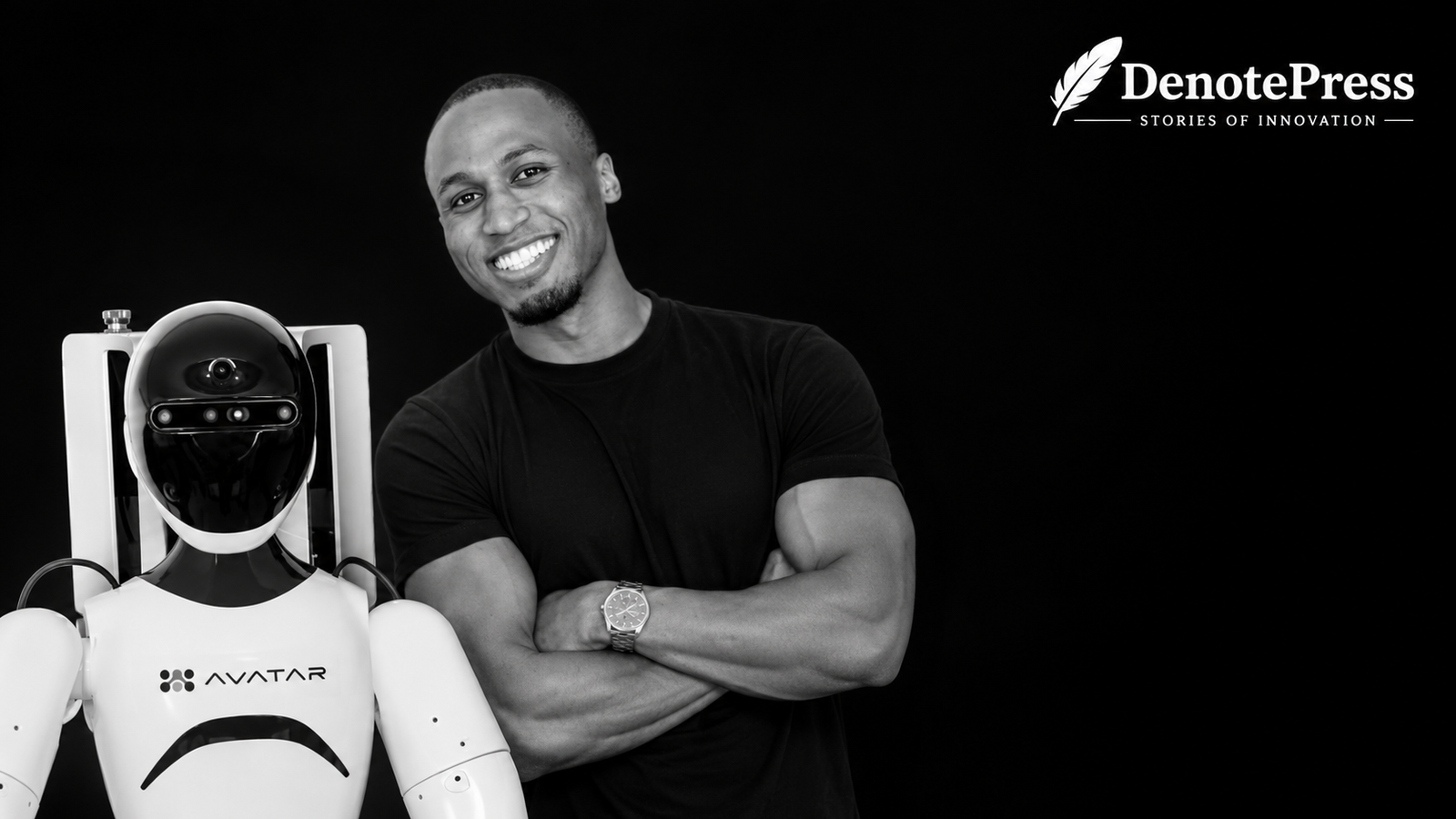
Colin Webb Avatar Robotics is a founder story built on a second attempt at a childhood passion, arriving at exactly the moment America’s manufacturing and logistics industries need it most. Webb is the founder and CEO of Avatar Robotics, a San Francisco startup building semi-humanoid robots, paired with remote human operators and AI-driven autonomy, to help warehouses and factories fill jobs they can’t staff fast enough. In early August 2026, Avatar Robotics closed a $6.5 million seed round led by AlleyCorp, with a notably resonant investor joining the round: Henry Ford III.
Here is how a repeat founder returned to the robotics passion of his childhood to build what he calls an unlimited industrial workforce.
Who Is Colin Webb?
Colin Webb is the founder and CEO of Avatar Robotics, a graduate of the Massachusetts Institute of Technology who delivered his class’s commencement address, according to PRNewswire’s coverage of the company’s seed round. He was named a Ron Brown Scholar in 2014, a prestigious scholarship program, and has since been recognized on the Forbes 30 Under 30 list.
Before founding Avatar Robotics, Webb built and developed a range of autonomous systems, including AI-powered drones and self-driving car technology, giving him hands-on engineering experience across multiple categories of autonomous hardware well before he focused specifically on humanoid robotics.
From Sauce Pricing to Avatar Robotics: A Repeat Partnership
Webb’s first company, Sauce Pricing, built AI automation tools for restaurants and was later acquired. He co-founded that company with Nenye Anagbogu, and the two have teamed up again at Avatar Robotics, where Anagbogu now holds the title of chief screwdriver. Webb has described his path to Avatar Robotics as a return to the technological passion of his childhood and college years, robotics specifically, after his first startup’s exit gave him the opportunity to choose his next problem deliberately rather than out of necessity.
That repeat partnership with Anagbogu, built on a working relationship that already survived one full company lifecycle from founding through acquisition, gave Avatar Robotics a founding team with established trust and communication patterns from day one, rather than two co-founders working together for the first time.
The Problem Avatar Robotics Set Out to Solve
Avatar Robotics addresses one of the largest structural constraints facing the U.S. economy: persistent labor shortages across warehousing, logistics, and manufacturing. As companies reshore operations and consumer demand for faster fulfillment grows, many facilities struggle to hire and retain enough workers for physically demanding, repetitive jobs, a gap that has widened even as automation technology has matured.
Webb has framed the underlying belief driving the company directly: automation doesn’t eliminate jobs, it amplifies human capabilities, extending what a limited available workforce can accomplish rather than replacing the people willing to do the work in the first place.
Building Avatar Robotics: Semi-Humanoid Robots and Remote Operators
Avatar Robotics combines humanoid robots, remote human operators, and AI-driven autonomy into what the company describes as a new category of industrial infrastructure. Its robots are designed to perform high-value warehouse and manufacturing workflows including picking, packing, kitting, sorting, cycle counting, and material movement, delivering flexible labor capacity around the clock.
The company’s team includes engineers and operators with backgrounds from Cruise, Apple, Tesla, Intuitive Surgical, and Unity, alongside research experience from MIT, giving Avatar Robotics technical depth spanning autonomous vehicles, consumer hardware, and surgical robotics. That range of prior experience across very different hardware categories mirrors the same kind of complementary-background pattern seen in other successful physical AI startups, where no single company’s engineering culture dominates the founding team’s approach.
Inside Avatar Robotics’ $6.5 Million Seed Round
Avatar Robotics raised $6.5 million in a seed round announced in early August 2026, led by AlleyCorp, following an earlier pre-seed round led by defy.vc. Additional participants in the seed round included Headline, Henry Ford III, Refashiond, Paul Vogel, Jack Huffard, and Samuel Udotong.
The company said it plans to allocate the new capital toward scaling its robot fleets, expanding customer deployments, advancing its autonomy software, and growing its engineering and operations teams. Since launching in December, Avatar Robotics has moved from an early-stage concept to a funded company with named enterprise-relevant investor backing in a relatively short window.
The Investors Backing Colin Webb
AlleyCorp leading Avatar Robotics’ seed round brings a firm with a track record of backing ambitious, deep-technology companies at the earliest stages. Among the round’s individual investors, Henry Ford III stands out for reasons beyond capital alone: as a descendant of the founder of Ford Motor Company, his personal investment in a startup explicitly trying to solve America’s manufacturing labor shortage carries symbolic weight that a generic venture check would not.
That combination of institutional deep-tech investors and individually meaningful backers suggests a round assembled with attention to both financial support and the kind of narrative credibility that can matter when a young robotics company is trying to win trust from skeptical industrial customers.
Avatar Robotics’ Position in the Humanoid Robotics Race
Avatar Robotics enters a fast-growing and increasingly crowded humanoid and semi-humanoid robotics category, competing for both engineering talent and customer attention against well-funded rivals building general-purpose humanoid robots. Its specific differentiation is combining physical robots with remote human operators rather than pursuing full autonomy from day one, an approach that lets the company deploy commercially useful labor capacity before its AI autonomy layer alone is capable of handling every task independently.
That hybrid model, teleoperated robots supplemented by AI autonomy that presumably expands over time, mirrors a broader pattern among newer physical AI companies choosing to ship a commercially viable product immediately rather than waiting for fully autonomous capability before generating any real-world revenue or deployment data.
What’s Next for Avatar Robotics
With fresh seed capital, Avatar Robotics’ near-term priorities center on scaling its robot fleets, expanding customer deployments across warehousing and manufacturing, and advancing its autonomy software so a growing share of tasks can shift from remote human operation toward independent AI control over time. The company’s stated long-term vision, scaling to millions of robots operating across warehouses, factories, mines, farms, and infrastructure projects, suggests ambitions extending well beyond its current initial deployment categories.
Webb’s framing of the vision, letting workers globally control fleet-scale physical systems virtually, also points toward a labor model where remote human operators themselves become a distributed, potentially global workforce, rather than treating human involvement as a temporary bridge to full autonomy alone.
Lessons for Entrepreneurs From Colin Webb’s Journey
Webb’s path offers a few clear lessons for founders considering a second company after a first exit. First, his decision to return specifically to robotics, the technical passion of his childhood and college years, rather than staying in restaurant technology where Sauce Pricing had already found success, shows how founders with a successful exit can use that freedom to pursue a more personally meaningful problem rather than simply repeating what already worked. Second, reuniting with Anagbogu rather than assembling an entirely new founding team preserved a working relationship and communication style already tested through one full company lifecycle.
Third, recruiting engineers and operators from a genuinely diverse set of prior companies, Cruise, Apple, Tesla, Intuitive Surgical, and Unity, rather than concentrating hires from a single prior employer, gave Avatar Robotics technical range across multiple hardware disciplines relevant to building complex humanoid systems.
Frequently Asked Questions
Who is Colin Webb? Colin Webb is the founder and CEO of Avatar Robotics, an MIT graduate and 2014 Ron Brown Scholar recognized on the Forbes 30 Under 30 list. He previously co-founded Sauce Pricing, an AI automation company for restaurants that was later acquired.
What does Avatar Robotics do? Avatar Robotics builds semi-humanoid robots combined with remote human operators and AI-driven autonomy to perform warehouse and manufacturing tasks including picking, packing, kitting, sorting, cycle counting, and material movement.
How much funding has Avatar Robotics raised? Avatar Robotics raised $6.5 million in a seed round announced in early August 2026, led by AlleyCorp, following an earlier pre-seed round led by defy.vc. Other investors include Headline, Henry Ford III, Refashiond, Paul Vogel, Jack Huffard, and Samuel Udotong.
Who co-founded Avatar Robotics with Colin Webb? Avatar Robotics was co-founded by Colin Webb and Nenye Anagbogu, who also co-founded Webb’s first company, Sauce Pricing, together. Hamid Farzaneh serves as founding engineer.
Where is Avatar Robotics based? Avatar Robotics is based in San Francisco, California, and was founded in 2024.
What problem is Avatar Robotics trying to solve? Avatar Robotics addresses persistent labor shortages in U.S. warehousing, logistics, and manufacturing, as companies reshore operations and struggle to hire enough workers for physically demanding, repetitive jobs.
Conclusion
Colin Webb Avatar Robotics represents a founder returning to his earliest technical passion at a moment when America’s manufacturing and logistics labor shortage has made that passion into a genuinely urgent commercial opportunity. With $6.5 million in seed funding, a founding team combining engineers from Cruise, Apple, Tesla, and Intuitive Surgical, and backing from investors including a descendant of Ford Motor Company’s founder, Avatar Robotics is testing whether pairing robots with remote human operators can deliver useful industrial labor capacity today, while AI autonomy gradually takes on a larger share of the work over time.
For more founder stories in physical AI and industrial robotics, see Puru Rastogi’s Mowito, Jay Li’s Proception, and Dan Summers’s 1872 on Denote Press.
