

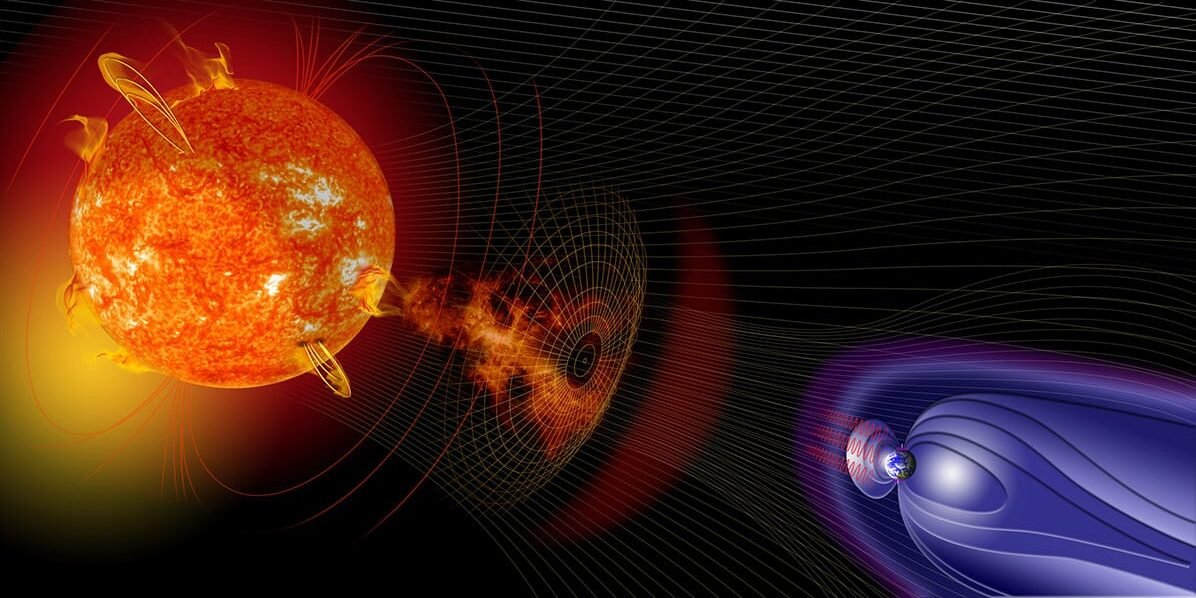
You’ve probably heard the term “geomagnetic storm” on the news. Solar activity causing GPS problems. Northern lights in weird places. Your phone acting weird. But what actually IS a geomagnetic storm? And more importantly – does it affect you? Let me explain what’s actually happening up there in space.
Okay, So What’s a Geomagnetic Storm, Really?
Think about Earth like it has a shield. That shield is called the magnetosphere. It’s an invisible magnetic field that protects us from the Sun’s radiation. Pretty important, right?
A geomagnetic storm happens when the Sun basically throws a tantrum. The Sun releases enormous amounts of energy – billions of tons of plasma – moving at millions of miles per hour. This is called a Coronal Mass Ejection (CME). When it reaches Earth, it slams into our magnetosphere. The impact shakes everything up. Your shield gets distorted. And that’s what causes a geomagnetic storm.
They’re measured on something called the Kp index, which goes from 0 (nothing) to 9 (absolute chaos). Anything 5 or higher is considered a significant geomagnetic storm.
Quick Facts About Geomagnetic Storms:
| Cause | Solar flares and Coronal Mass Ejections (CMEs) from the Sun |
| Travel Time | 24-48 hours from Sun to Earth |
| Measurement | Kp Index (0-9 scale) and G-Scale (G1-G5) |
| Visual Sign | Aurora (Northern & Southern Lights) |
| Peak Activity | During Solar Cycle 25 (we’re in it now – 2024-2026) |
How Does a Geomagnetic Storm Actually Form?
Okay let me walk you through what happens. Imagine the Sun as this massive ball of plasma that’s constantly moving. Sometimes that movement builds up energy in spots called sunspots. When enough energy builds up, BOOM. The Sun releases it all at once.
Step 1: Solar Flare
A solar flare is like a massive explosion on the Sun’s surface. Energy that would power Earth for millions of years is released in seconds. It shoots light and radiation into space in all directions.
Step 2: Coronal Mass Ejection (CME)
Sometimes (not always) a solar flare is followed by a CME. That’s billions of tons of hot plasma being hurled into space. It travels at 3 million miles per hour. That’s unimaginably fast.
Step 3: The Plasma Reaches Earth
After 24-48 hours of traveling through space, the plasma hits Earth’s magnetosphere. It’s like a solar wind crashing into our shield. The impact is violent and immediate.
Step 4: The Storm Happens
Our magnetic field gets compressed and distorted. Energy gets released. Particles get trapped. This disturbance is what we call a geomagnetic storm. It can last from hours to days.
What Actually Happens During a Storm? (Real Effects)
GPS and Navigation Systems
Your phone uses GPS satellites. During a strong geomagnetic storm, these satellites can lose accuracy. Sometimes by a lot. Airlines have to reroute planes because GPS becomes unreliable. Pilots can’t trust it. That’s why we saw delays during the 2024 storms.
Power Grids
Strong geomagnetic storms can induce electrical currents in power lines. Transformers can overheat. Power can go out. In 1989, Quebec lost power for 9 hours because of a geomagnetic storm. The damage cost hundreds of millions of dollars.
Communications and Satellites
Radio communications break down. Cell phone service degrades. Satellite phones stop working. TV signals can drop. During the May 2024 storm, some communications were seriously disrupted across Europe and North America.
Internet
Internet relies on satellites and undersea cables. During extreme storms, internet can slow down significantly. But total outage? That’s rare because of redundancy and backup systems.
Radiation
Astronauts and airline crews at high altitudes receive increased radiation during storms. It’s not instantly dangerous. But long-term, it adds up. This is actually a real occupational hazard for pilots and flight attendants.
Your Phone/Computer
Will your phone break? No. Will your internet be slower? Maybe. GPS accuracy? Sometimes. But devices have shielding. Worst case? A restart fixes it. Your devices won’t be damaged.
Aurora: The Beautiful Side of Geomagnetic Storms
Okay here’s the cool part. When that plasma from the Sun hits our magnetosphere, charged particles get accelerated. They collide with oxygen and nitrogen in our upper atmosphere. That collision releases light.
That’s the Aurora. The Northern Lights (Aurora Borealis) and Southern Lights (Aurora Australis). Normally you only see them near the poles. But during really strong geomagnetic storms? You can see them much farther south.
During the May 2024 G5 storm, people saw auroras from places like New York, London, and Spain. Places that never see auroras. It was incredible. And terrifying for people who didn’t know what it was (some thought aliens).
Green colors? That’s oxygen at lower altitudes. Red and purple? That’s rare but happens during extreme storms. Different gases = different colors. Mother Nature’s light show.
How Strong Can They Get? (The Kp Index Explained)
Scientists use the Kp Index (Planetary K Index) to measure geomagnetic storm strength. It goes from 0 to 9. Higher number = bigger storm = more effects.
- Kp 0-2: Quiet. Nothing happening. No aurora visible.
- Kp 3-4: Minor activity. Aurora visible in far north only.
- Kp 5-6: Moderate storm. Aurora visible from northern US. GPS degradation possible.
- Kp 7-8: Strong storm. Aurora from middle US. Power grid warnings. Airlines reroute.
- Kp 9: Extreme/Severe. Aurora visible everywhere. Possible blackouts. Satellites at risk. This is rare and serious.
What Happened in 2024? (Recent Real Example)
In May 2024, we experienced some of the strongest geomagnetic storms in years. Multiple CMEs hit Earth in rapid succession. Scientists classified it as a G5 – the highest level.
What actually happened? Aurora visible in Europe, UK, and North America at unusually low latitudes. GPS systems became unreliable. Airlines rerouted flights (adding hours and delays). Some radio communications failed. Power grids were monitored closely. Farmers with GPS-guided tractors couldn’t work. It was real impact.
But here’s the important part: it wasn’t catastrophic. No massive blackouts. No permanent damage (mostly). Satellites survived. It showed our technology is pretty fragile though – and that we need better protection.
Why Does 2024-2026 Have So Many Storms?
The Sun goes through cycles. Solar Cycle 25 started in 2019. We’re near the peak right now (2024-2026). During peak, there’s maximum solar activity. More flares. More CMEs. More storms.
By 2027-2028, activity will calm down. Fewer storms. But right now? Expect more. Scientists predict this period will be the most active for the next decade.
Should You Actually Be Worried?
Honest answer: Not really. For you personally? Almost nothing will happen. You might notice GPS being slightly off. Your internet might be a touch slower. That’s probably it.
But infrastructure? That’s another story. Power companies, airlines, satellite operators – they SHOULD be worried. And they are. They have teams monitoring storms 24/7.
A really extreme storm could cause significant economic damage. But total civilization collapse? No. That’s Hollywood stuff. Our systems have redundancy.
How Can You Track Geomagnetic Storms?
Want to know if a storm is coming? Check NOAA’s Space Weather Prediction Center. They forecast storms 3 days in advance. You can see the Kp index in real-time.
- NOAA Space Weather: alerts for serious storms
- 3DCorona: shows CMEs in real-time
- Aurora Forecast apps: tells you if you can see aurora tonight
- KP-Index live websites: real-time data
FAQ: Questions People Actually Ask
Q: Can geomagnetic storms kill you?
A: No. Even extreme storms won’t hurt you on Earth. You’re protected by the atmosphere and magnetosphere. Astronauts in space? That’s different. They take shelter.
Q: Will my smartphone break?
A: No. Your phone is shielded. It might reset or lose signal temporarily. But it won’t break. Electronics are tougher than you think.
Q: When is the next big storm?
A: No way to predict exactly. But we’re near Solar Cycle peak. Expect 2-3 more big storms before 2027. Could be tomorrow, could be next month.
Q: Why don’t we stop the storms?
A: Ha. We can’t control the Sun. We can only prepare and monitor. Technology is getting better at predicting them though.
Q: Is this climate change?
A: No. Geomagnetic storms are solar activity. Completely separate from Earth’s climate. Both are important problems, but different.
Real Talk: The Bottom Line
Geomagnetic storms are real. They happen. They have real effects on technology. But they’re not the end of the world. Humanity survived without electricity for thousands of years. We’ll survive storms too.
What IS important: Scientists monitoring them. Engineers making systems more resilient. Governments taking it seriously. And people understanding what’s happening instead of panicking.
Next time you hear about a geomagnetic storm, you’ll know exactly what it means. You’ll know it’s not aliens. Not climate change. Not the apocalypse. Just the Sun doing what the Sun does – throwing energy around. And Earth’s magnetic field absorbing the hit.
Pretty cool, actually.
