

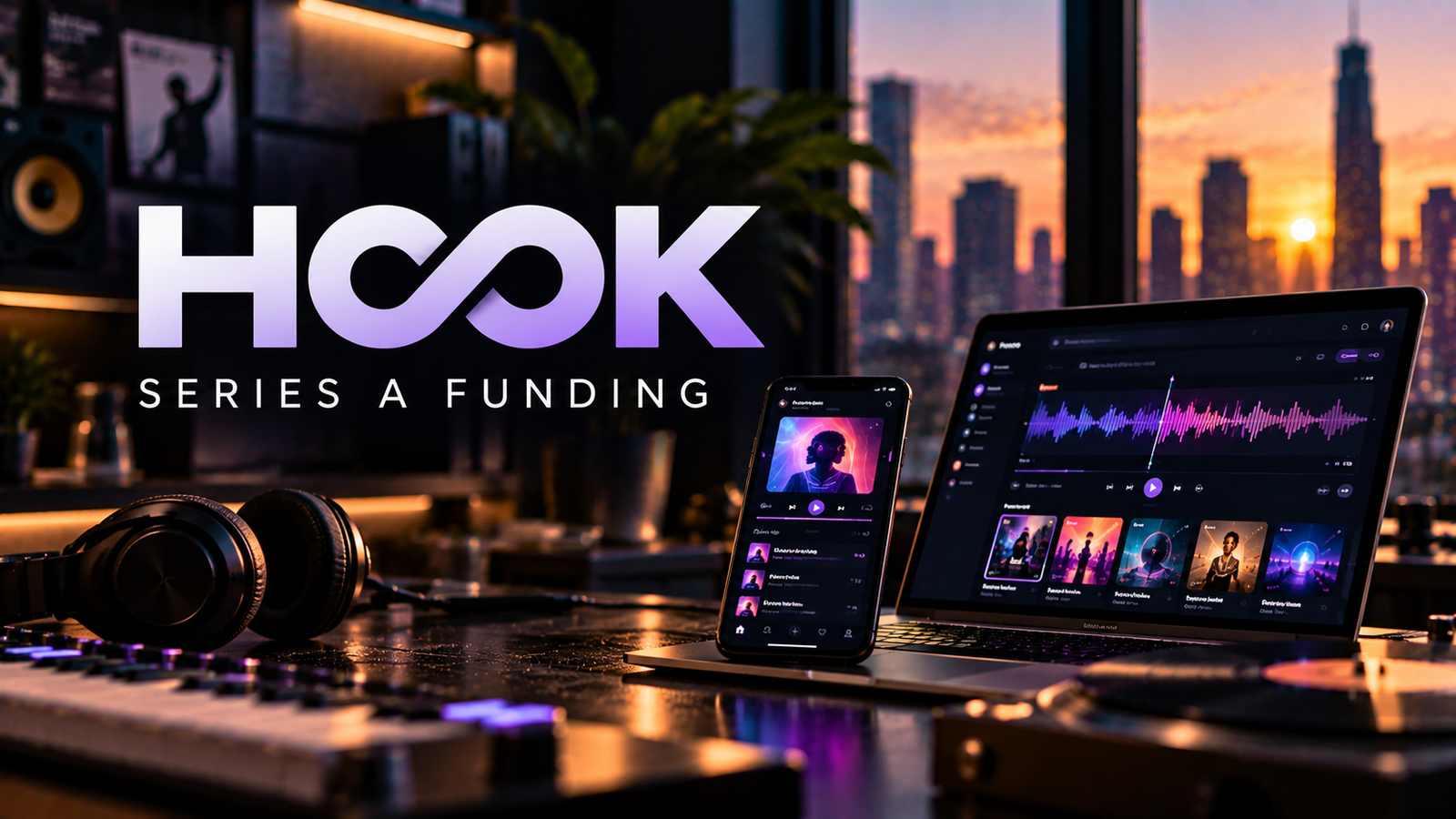
Hook Series A marks a major step for a startup trying to change how people interact with music online.
In February 2026, Hook announced a $10 million Series A led by Khosla Ventures, bringing its total funding to $16 million. The round also included existing investors Point72 Ventures, Imaginary Ventures, and Waverley Capital, alongside other strategic names from the music ecosystem.
The company is building more than an AI music editor. Hook wants fans to become active participants in music culture by letting them legally remix licensed songs, personalize sounds, create short-form content, and share those creations across social platforms.
That positioning puts Hook at the intersection of AI music, creator tools, social media, music licensing, and the growing creator economy.
For Denote Press readers, the interesting part is the business model.
Hook is not simply betting that generative AI will produce more songs. It is betting that fans want to create with the songs and artists they already love—and that rights holders can share in the value.
The company’s official announcement explains that its Series A capital will support product development, user growth, new creation formats, Android expansion, community features, and deeper integrations across the music ecosystem.
Hook’s official Series A announcement
Quick Answer: What Is Hook?
Hook is an AI-powered social music platform that lets fans and creators remix licensed songs using simple creative tools, then share those remixes through social and streaming platforms.
Its artist-first model is designed to give rights holders control, attribution, and monetization while making music creation easier for everyday users.
According to Hook, the platform has access to more than 20 million licensed songs through partnerships with companies including Universal Music Group, Downtown Music/FUGA, Too Lost, Primary Wave, and Avex. The company also says its active users increased more than 45X over the previous 12 months before the Series A announcement.
What Is Hook Building?
Hook describes itself as a social music platform built around fan-powered music creation.
Instead of treating listeners as passive consumers, the company gives them tools to reshape music into something personal and shareable.
The basic experience is intentionally simple.
A user selects a licensed song and can apply creative transformations such as genre changes, mood effects, mashups, sped-up or slowed-down treatments, and other remix formats. The result can then be shared as social content.
That makes Hook different from a traditional digital audio workstation.
The goal is not to teach users professional music production. The goal is to remove the technical barrier between “I love this song” and “I want to make something with this song.”
This is also why the company fits naturally into the social music category.
A remix is not the final product. The remix becomes a piece of social content that can travel through TikTok, Instagram, Snapchat, SoundCloud, and other communities.
The broader opportunity resembles what creator-focused platforms have done in other industries: turn audiences into participants.
Denote Press has covered a similar shift in creator infrastructure through our story on Passionfroot and its AI-native creator platform—but Hook applies the participation model directly to music and fandom.
Inside the Hook Series A
The Hook Series A was announced on February 18, 2026, with $10 million in new funding led by Khosla Ventures.
Existing investors Point72 Ventures, Imaginary Ventures, and Waverley Capital also participated.
The round brought Hook’s total funding to $16 million.
Other investors associated with Hook include Kygo’s Palm Tree Crew, Three Six Zero, Avex, The Raine Group, and DJ KSHMR.
That investor mix matters because it is unusually connected to the music business rather than being made up only of traditional software investors.
Hook’s earlier funding history also shows a progression from a $3 million seed round led by Point72 Ventures and Waverley Capital to additional capital as the platform expanded its licensing and creator ecosystem.
The company’s own announcement says the capital will support user growth, product and technology development, an Android app, new community features, richer creation formats, native video and recording capabilities, and deeper music-industry integrations.
The funding also came with an expanded leadership role for Simmi Singh, who became Chief Operating Officer and Chief Product Officer.
Singh had previously led product, design, and engineering at Hook and earlier worked in strategy and operations for podcasts at Spotify and JioSaavn.
The structure of the round tells a clear story: Hook has moved from proving that licensed AI remixing can work to scaling it as a consumer social product.
Why Khosla Ventures Invested
Khosla Ventures is the lead investor in the Hook Series A, and its thesis highlights one of the hardest parts of the company’s business.
Hook is attempting to make remixing and social distribution work for rights holders at scale.
That means solving several problems at once: licensing, attribution, reporting, consumer experience, creator participation, and monetization.
Khosla Ventures managing partner Samir Kaul described Hook as combining a consumer-native experience with licensing, attribution, and reporting infrastructure that the music ecosystem can rely on.
That is important because AI music has created a major tension between product speed and rights management.
Many AI music companies focus on generating new audio.
Hook takes a different path.
It starts with existing, licensed recordings and gives fans controlled ways to transform and express themselves through those recordings.
That may sound narrower, but it could be commercially powerful.
If Hook can make rights-cleared fan creativity easy enough for mass-market users, the company could sit between music labels, artists, creators, social platforms, and audiences.
The Problem Hook Is Solving
Social media has already changed music discovery.
A song can become culturally important because of a short video, meme, remix, dance, challenge, or creator trend.
But the legal and economic infrastructure around those activities has often been harder to manage.
Hook’s earlier funding announcement pointed to the scale of unlicensed remix and mashup activity on social platforms. The company argues that a significant amount of music consumed through social media comes from remixes and mashups, often without a clear rights or monetization framework.
Hook’s earlier funding and music-rights announcement
That creates a difficult choice.
Artists and labels want control over how their recordings are used.
Fans want freedom to participate in music culture.
Platforms want engaging content.
Creators want tools that help them make content quickly.
Hook is trying to create a system where those incentives can coexist.
This is the strongest part of the Hook Series A story.
The company is not simply adding AI to an existing editing workflow. It is trying to build infrastructure for a more interactive relationship between music and fandom.
How Hook’s AI Music Platform Works
Hook’s product philosophy is based on low friction.
A typical consumer does not want to learn audio engineering before making a remix for Instagram.
Hook therefore packages complex processing into simple creative controls.
Users can work with licensed music moments and transform them through effects and remix formats. The company has also built features around short-form video and social distribution.
Its earlier product materials described tools for mashups, genre and mood changes, and other transformations that can be applied with only a few taps.
The result is closer to a creative playground than a professional studio.
That distinction is important for user acquisition.
Professional music software competes for serious creators who may spend hours learning a workflow.
Hook is competing for a much larger group: music fans who may spend seconds making something because a particular song fits a mood, meme, trend, or personal moment.
That is a classic consumer-product tradeoff.
Simplicity can create scale.
For more context on how AI-native software is changing traditional creative workflows, Denote Press has also examined Paper and its AI-native design platform.
The Artist-First Licensing Model
Hook’s biggest strategic differentiator may be its licensing model.
The company says it works directly with artists and rights holders so creators can remix music legally while artists retain ownership, control, attribution, and monetization.
That philosophy separates Hook from many generative music startups.
Hook has repeatedly emphasized that it does not train its AI systems on artists’ music. Instead, the platform uses licensed music and provides creative transformation tools around those recordings.
The company has built partnerships across the music ecosystem, including Universal Music Group, Downtown Music/FUGA, Too Lost, Primary Wave, and Avex.
This approach also creates a potentially valuable business moat.
If Hook can secure more catalogs, it can give users more reasons to return.
If users create more content, artists and labels gain another channel for discovery.
If artists see measurable engagement and monetization, they have more reasons to participate.
That creates the possibility of a flywheel between rights holders, creators, fans, and distribution.
Hook’s Traction Before Series A
Investors rarely fund a consumer platform on product vision alone.
Hook entered its Series A with evidence that users were responding to the concept.
The company reported that active users had increased more than 45X over the previous 12 months.
It also said campaigns involving major artists and labels had generated more than 250 million views across social platforms.
Those numbers are meaningful because Hook’s business depends on a network effect between music, creators, and audiences.
More licensed music creates more reasons to use the product.
More creators create more remix content.
More content creates more discovery.
More discovery can increase demand from artists and rights holders.
That loop can become powerful if the company can maintain quality and rights compliance as it scales.
Hook’s earlier partnerships also show a deliberate distribution strategy.
In 2025, the company expanded its catalog through a partnership with Too Lost, while also working with SoundCloud to help remixes move beyond short-form social content.
This makes Hook less like a standalone editing app and more like a distribution layer for fan-created music culture.
Gaurav Sharma and the Team Behind Hook
Hook was founded by Gaurav Sharma, who serves as founder and CEO.
Sharma brings experience from JioSaavn, where he previously served as Chief Operating Officer.
That background matters because Hook’s challenge is not purely technical.
It sits inside the complex commercial structure of the music industry.
Building a music technology company requires an understanding of product, distribution, rights, labels, artists, and consumer behavior.
The company’s leadership also includes Simmi Singh, who has experience at Spotify and JioSaavn.
Her expanded COO and CPO role after the funding round reflects the importance of combining product development with operational scaling.
That combination of consumer-product experience and music-industry knowledge gives Hook a different profile from an AI startup built primarily around model development.
What the Series A Funding Will Finance
The Hook Series A capital is intended to move the company into its next stage of growth.
One priority is user acquisition.
Hook wants to expand how fans create, connect, and participate with music.
That requires not only better product features but also stronger community dynamics.
The company has also identified several concrete product priorities:
- Android expansion
- New community-driven features
- More creation formats
- Native video capabilities
- Native recording tools
- Deeper integrations with music partners
- Continued investment in its brand and platform
This roadmap suggests Hook is trying to become a broader social music ecosystem rather than remaining a single-purpose remix tool.
The strategy resembles what successful consumer platforms often do after reaching product-market fit: make the core action easier, then build adjacent behaviors around it.
For founders thinking about how venture funding translates into product expansion, Denote Press’s Runlayer Series A story offers another useful example of how a company turns institutional capital into a larger product and go-to-market strategy.
Hook’s Competitive Position
Hook operates in a crowded AI music environment.
Generative music platforms such as Suno and Udio have attracted attention by allowing users to create new songs.
Traditional editing platforms provide increasingly sophisticated tools for manipulating audio and video.
Social networks already provide enormous distribution.
Hook therefore needs a clear reason to exist.
Its answer is the combination of four elements:
- Licensed music
- Simple AI-powered remixing
- Social-first distribution
- Artist and rights-holder participation
That combination is harder to replicate than a basic AI audio feature.
The licensing layer can become a moat if Hook continues building relationships with major rights holders.
The social layer can become a moat if creators build communities and habits around the product.
And the consumer interface can become a moat if Hook makes remixing significantly easier than alternatives.
Third-party startup databases classify Hook as a private Series A company in New York and describe its product as an AI-assisted social music platform for authorized remixes and mashups.
Crunchbase company profile for Hook
But each layer also creates risk.
Licensing is expensive and complicated.
Social engagement can be unpredictable.
Consumer apps have high churn.
AI features can be copied by larger platforms.
Hook must therefore keep improving faster than competitors while maintaining trust with the music industry.
What Happened After the Series A?
The company’s progress after the funding round is one reason the Hook Series A story remains relevant.
In August 2026, Hook and Universal Music Group announced a broader collaboration focused on fan-created content using UMG’s official recordings.
The companies said the framework allows fans to create and share content using UMG recordings while giving artists and rights holders more control over how those experiences are enabled and monetized.
Hook and Universal Music Group partnership announcement
This is a significant post-Series A milestone because it moves the company’s licensing strategy toward a broader operating framework.
Hook also emphasizes that it is not a generative AI music company in the conventional sense.
Its model is centered on helping fans create user-generated content with licensed music rather than generating entirely new tracks.
That distinction could become increasingly important as regulators, labels, artists, and technology companies debate the future of AI and copyright.
For investors, the question is now bigger than whether Hook can build a good remix app.
The question is whether Hook can become infrastructure for a new form of licensed fan participation.
The company’s post-Series A development suggests it is pursuing exactly that opportunity.
Risks and Challenges Ahead
The opportunity is large, but Hook has several difficult problems ahead.
Rights Complexity
Music rights vary by territory, recording, composition, artist, label, and use case.
Scaling a licensing system globally is operationally difficult.
A platform may have permission for one recording but not another. It may have different rules for different countries, distribution channels, or creative formats.
That means Hook’s licensing infrastructure must remain as strong as its consumer experience.
Consumer Retention
A novelty-based music app can attract users quickly.
Keeping them active requires community, discovery, creator incentives, and a steady flow of fresh experiences.
The company will need to prove that remixing becomes a repeat behavior rather than a one-time experiment.
Competition
Large social platforms and AI companies have enormous distribution and technical resources.
They could introduce similar remixing features or integrate AI music tools directly into existing creator products.
Hook therefore needs to build differentiation that goes beyond individual AI effects.
Monetization
User growth is valuable, but Hook still needs to build a durable economic model connecting users, creators, artists, labels, and potentially advertisers or other paying customers.
The stronger its licensing and attribution infrastructure becomes, the more options it may have for monetization.
AI Perception
Even when AI is used responsibly, public concerns around copyright and artist consent can create reputational risk.
Hook’s artist-first positioning helps, but the company must keep proving that its model creates value for rights holders.
The challenge is not simply building better AI.
It is building a system that every stakeholder has a reason to support.
What Founders Can Learn From Hook
There are several lessons in the Hook Series A for founders building at the intersection of AI and legacy industries.
1. Solve the industry’s hardest constraint
Hook could have built another AI music generator.
Instead, it focused on the difficult relationship between fan creativity and music rights.
That creates a stronger strategic position because licensing is not simply an add-on. It is part of the company’s core product.
2. Make the consumer experience dramatically simpler
The technology behind remixing can be complex.
The product does not need to feel complex.
Hook packages advanced audio transformation into a consumer-friendly experience where users can experiment quickly.
That reduction in friction can be a powerful growth mechanism.
3. Build partnerships into the product strategy
Hook’s relationships with labels, distributors, artists, and platforms are not side deals.
They are part of the product itself.
The more useful the licensed catalog becomes, the more valuable the platform can become to fans.
4. Align incentives
If artists, rights holders, creators, and fans can all benefit, Hook has a stronger chance of becoming a long-term platform.
This is especially important in industries where technology can easily be viewed as disruptive or threatening.
5. Use funding to accelerate a proven behavior
The company entered its Series A after reporting major user growth and extensive ecosystem partnerships.
The capital is being used to expand what was already working rather than invent an entirely different business.
That is a useful distinction for any startup preparing for a major funding round.
Denote Press has explored the other side of this equation in SAFE Note Dilution, where the focus is not how much capital a startup raises but how fundraising affects founder ownership.
For another example of an operator using firsthand industry experience to build vertical AI software, see Denote Press’s Hostie founder story.
Frequently Asked Questions
What is Hook?
Hook is an AI-powered social music platform that lets fans and creators legally remix licensed songs and share the results across social platforms.
How much did Hook raise in its Series A?
Hook raised $10 million in Series A funding in February 2026.
Khosla Ventures led the round, and the financing brought Hook’s total funding to $16 million.
Who led the Hook Series A?
Khosla Ventures led the round.
Point72 Ventures, Imaginary Ventures, and Waverley Capital also participated, alongside other investors connected to the music ecosystem.
Who founded Hook?
Hook was founded by Gaurav Sharma, who serves as founder and CEO.
Sharma previously worked at JioSaavn, where he served as Chief Operating Officer.
Is Hook a generative AI music company?
Not in the conventional sense.
Hook uses AI-powered tools to help users remix and transform licensed recordings.
The company says it does not generate entirely new tracks in the way some generative music platforms do.
How does Hook work with artists?
Hook works with artists, labels, distributors, and rights holders to license music and create controlled remix experiences.
Its model is designed so rights holders retain ownership, control, attribution, and monetization opportunities.
What will Hook use its funding for?
The company says it will invest in user growth, product and technology, Android, community features, new creation formats, native video and recording tools, and deeper music-industry integrations.
What makes Hook different from other AI music platforms?
Hook focuses on fan expression through licensed music, social distribution, and artist participation.
Rather than asking users to generate an entirely new song, it lets them creatively interact with music they already know.
Did Hook sign a deal with Universal Music Group?
Yes.
In August 2026, Hook and Universal Music Group announced a broader collaboration enabling fan-created content using UMG’s official recordings, with controls for artists and rights holders.
Does Hook own the music users remix?
No.
Hook’s model is based on licensed music and partnerships with rights holders. The company’s stated approach is to ensure artists and rights owners retain control and participate in the value created through fan activity.
Conclusion
The Hook Series A is a bet on a different future for music technology.
Instead of replacing artists with AI, Hook is trying to make artists and their fans more connected.
Instead of treating remixing as an underground activity that sits outside the formal music economy, the company is building licensed infrastructure around it.
The $10 million Series A led by Khosla Ventures gives Hook the capital to scale that thesis.
More importantly, the company entered the round with a growing user base, major music partnerships, and a clear product philosophy.
Its biggest opportunity is to turn fan creativity into a legitimate part of the music business.
Its biggest challenge is proving that this model can scale while keeping artists, rights holders, creators, and users aligned.
The Universal Music Group partnership announced after the funding round is an important signal that Hook is continuing to build toward that larger vision.
If Hook succeeds, the next generation of music apps may not ask fans only to listen.
They may ask fans to participate.
