

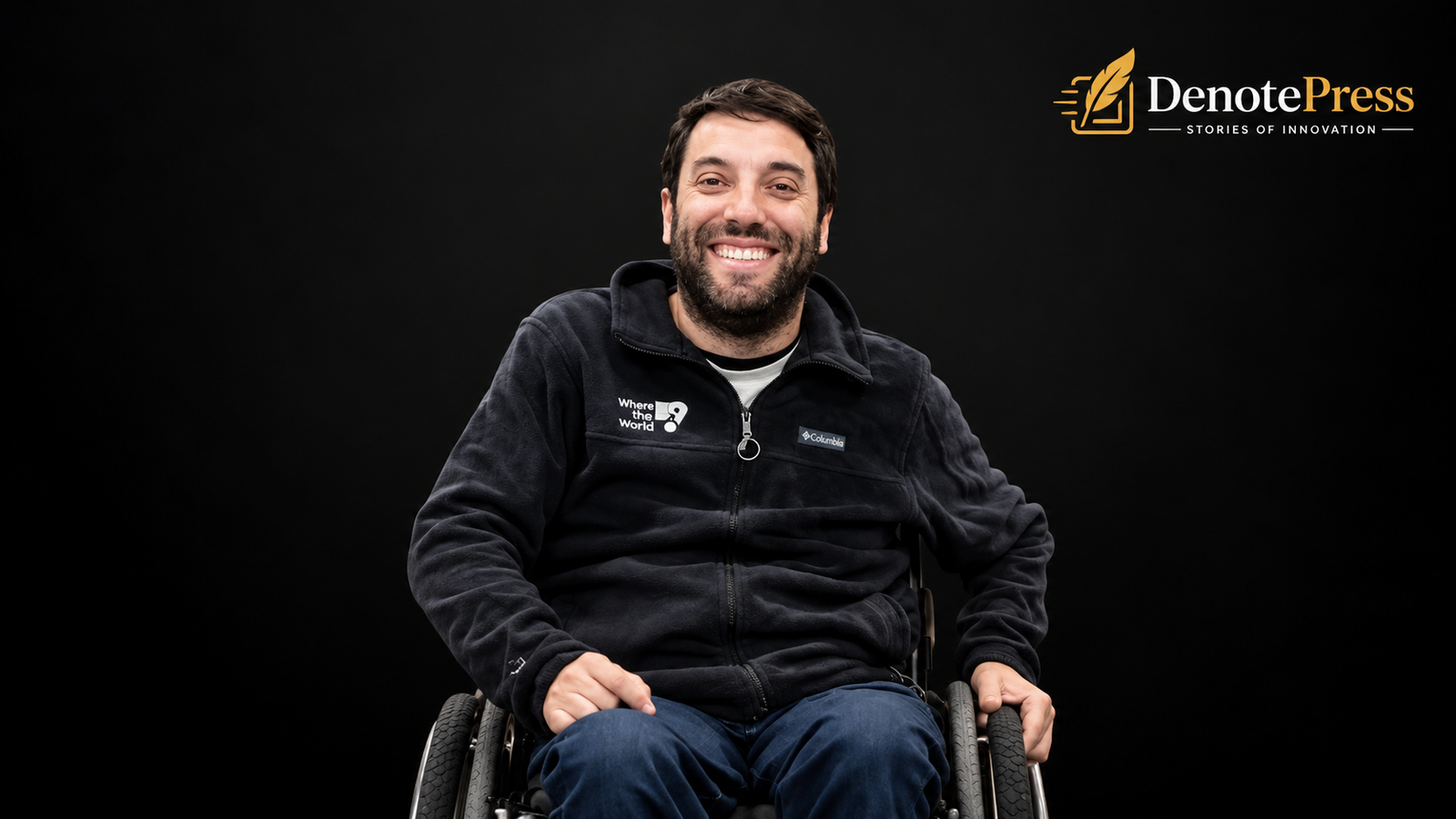
Alvaro Silberstein Wheel the World is the story of a founder who completed one of Patagonia’s toughest treks in a wheelchair, then discovered that the hardest part of travel for people with disabilities was not the terrain but the missing information. Silberstein is the co-founder and CEO of Wheel the World, a San Francisco-based platform where travelers with disabilities and seniors can find and book hotels, experiences and trips backed by verified accessibility data. In February 2026, the company closed an $11 million Series A co-led by Enable Ventures and Kayyak Ventures. Here is how Silberstein got there, how the company collects its data and why investors now describe it as infrastructure for the future of travel.
Alvaro Silberstein Wheel the World: Who Is the Founder?
Alvaro Silberstein is a Chilean entrepreneur, public speaker and disability advocate who co-founded Wheel the World and serves as its CEO. According to his Phocuswright conference profile, he created the company in 2018 to help millions of people with disabilities explore the world without limits. Crunchbase lists Camilo Navarro Bustos and Federico Carossino among the founders, and Navarro serves as chief operating officer.
Silberstein and Navarro are childhood friends and both Chilean. Contxto reported, citing an interview with TechCrunch, that the idea grew out of a car accident Silberstein had at 18 that left him with limited use of much of his body. That experience, combined with a love of travel, shaped the company’s mission from the start. That origin is the core of the Alvaro Silberstein Wheel the World story.
The company is Chilean in origin and Californian in address. Silberstein has worked from Santiago, where New Mobility described him bouncing between meetings with colleagues around the globe, with the snow-capped Andes behind him.
From Torres del Paine to a Startup
The company’s name comes from a trek. Silberstein became the first person with quadriplegia to complete the W Trek through Torres del Paine National Park in Chile, using a specialized wheelchair and with the help of friends. The company’s own blog dates that achievement to 2017, while other profiles refer to a 2016 trip, so the exact year varies by source.
What matters is what happened next. According to New Mobility, Silberstein and Navarro produced a short documentary called Wheel the World, which Silberstein used to gain media attention and international recognition. The attention revealed something: other people with disabilities wanted to do similar adventures. When Silberstein decided to start an accessible travel business, he sought out more adventurers for a second trip in 2018 to test the model, then established the company and invited Navarro to be chief operating officer.
TechCrunch reported that the two decided to launch while in graduate school at UC Berkeley, so that others in situations like Silberstein’s could find accessible travel experiences. For Alvaro Silberstein Wheel the World, a single trek became a business model.
The Problem: An Information Gap, Not Just Infrastructure
The founders’ key insight was that the barrier was information, not only buildings. During the trips, Silberstein saw a huge shortage of reliable accessibility information about the places they planned to visit. A hotel might say it had an accessible room, but travelers could not tell whether the bed height worked for a transfer, whether the shower was roll-in or whether the entrance had steps.
In the company’s Series A announcement, Silberstein put it simply. Accessibility in travel, he said, has never been just an infrastructure problem; it has been “an information problem.” The company’s blog adds that the travel industry has long treated accessibility as a compliance checkbox, even though millions of hotels, attractions and experiences are genuinely accessible and travelers have no reliable way to find them in advance.
The result is uncertainty and last-minute cancellations, which in turn leaves a large travel market underserved. That gap is what Alvaro Silberstein Wheel the World was built to close.
Building Wheel the World: Mapping, Data and Booking
Wheel the World’s core asset is data. According to the company’s blog, it built a proprietary Accessibility Mapping System, a mobile app used by trained mappers who collect more than 200 data points at each property. The measurements include bed height, door width, entrance type, roll-in shower dimensions and restroom details. An earlier company profile cited more than 150 data points, which suggests the system has grown more detailed over time.
By early 2026, that system had produced verified data across more than 200 destinations and 8,000 travel services worldwide, including more than 150 Accessibility Verified partnerships with destination marketing organizations across 21 states.
On the consumer side, travelers build an accessibility profile and the platform recommends listings that match. In its early years, the company’s model was a commission on each booking, according to the Phocuswright profile. The company also offers pre-planned group trips with accessible itineraries, per Crunchbase.
The service is built on a promise. When the company raised its pre-Series A, PhocusWire reported that it began guaranteeing that every hotel room booked on its platform would be accessible, with a full refund if an accessible room was not provided at check-in, and it started matching prices on other booking sites. The mapping system is the technical backbone of Alvaro Silberstein Wheel the World.
Early Funding: Seed Round and Pre-Series A
The company’s funding came in stages. In August 2021, TechCrunch reported a $2 million seed round, at a time when the company had 23 employees and planned to double that within a year. According to the Phocuswright profile, the seed was accompanied by a $300,000 grant from Booking.com. Silberstein told TechCrunch that tapping the disability travel market meant tapping more than $100 billion globally.
Recognition followed. PhocusWire reported that Wheel the World won the first Phocuswright/WebinTravel Global Startup Pitch in 2022, took the People’s Choice award and was named to its Hot 25 Startups list.
In early 2023, the company announced a $6 million pre-Series A, led by Chilean venture firm Kayyak Ventures. Former Booking.com CEO Gillian Tans was among the investors and said that Silberstein and Navarro were an example of truly executing on the mission. The founders told TechCrunch the money would go to customer retention, new user acquisition and new products for booking travel, accommodation and group trips, with a goal of 12,000 travelers on the platform by the end of 2024.
By the time New Mobility profiled him, Silberstein was leading a company of around 40 people. He acknowledged that the job was a heavy lift, and noted a change in strategy: early on, the company leaned into adventure travel that might feel risky for many people, but he realized that most travelers with disabilities want a safe, accessible and comfortable situation.
Inside the $11 Million Series A
On February 25, 2026, Wheel the World announced that it had closed an $11 million Series A. According to the company, the round includes $3.5 million in new capital, along with the conversion of earlier simple agreements for future equity. PhocusWire corrected an earlier report that had misstated the total as $13 million.
The round was co-led by Enable Ventures, a venture firm focused on disability technology, and Kayyak Ventures. Vulcano, Weboost, Samaritan Partners, ImpactaVC and Miles Partnership also participated, along with existing investors and travel industry leaders.
According to the company, the funds will do three things:
Expand Accessibility Verified. Grow the verification program with destination marketing organizations across the United States and Europe.
Develop AI capabilities. Build tools that let travelers plan trips in a personalized way.
Scale distribution of verified data. Make accessibility information available across travel platforms, destination channels and emerging AI tools.
The company’s long-term goal is to make accessibility as standard and expected as price, availability and location. The round gives Alvaro Silberstein Wheel the World the capital to turn a data advantage into distribution. For more on how rounds like this reshape startups, see our Funding News section.
The Investors Backing Alvaro Silberstein
The investor list mixes disability-tech specialists, regional venture firms and travel industry veterans. Enable Ventures is a disability-focused fund, and its founder and managing partner Regina Kline said the company is building foundational AI infrastructure for the future of travel. Kayyak Ventures has backed the company since the pre-Series A.
Crunchbase also lists Samaritan Partners, Fondo Vulcano, ImpactaVC, Miles Partnership, Google for Startups Latino Founders Fund and angel investors including Erik Blachford and Gillian Tans, the former CEOs of Expedia and Booking.com respectively. Having two former heads of the biggest online travel agencies on the cap table is a rare form of credibility for a startup in this space.
That blend of mission-driven capital and industry insight strengthens Alvaro Silberstein Wheel the World. The investors understand both the social opportunity and how online travel distribution actually works.
Accessibility Verified and Destination Partnerships
The Accessibility Verified program is the company’s second business line, and arguably its most important one. Instead of selling only to travelers, Wheel the World sells verification to destinations, so that cities and states can show accessibility data to visitors.
The company says it has more than 150 such partnerships across 21 states. Its blog describes Oregon as the first Accessibility Verified travel destination in the United States, and it points to Colorado, where the Colorado Tourism Office partnered with Wheel the World on an Accessible Travel Program, with Durango earning verified status. The program gives destinations and hotels a measurable way to market accessibility and reach travelers whose needs they actually meet.
This two-sided model matters. Travelers get trustworthy information, and destinations get a way to attract a loyal and often underserved audience. It also gives the company a distribution channel: each partnership puts verified data in front of visitors planning trips to that destination.
AI Tools: Grand Rapids and Accessibility Match
The company’s AI work is already live. According to its blog, Wheel the World partnered with Experience Grand Rapids and Disability Advocates of Kent County to launch what it calls the first AI-powered accessibility travel tool of its kind. Travelers can ask specific questions, such as which hotels have roll-in showers, which restaurants have step-free entry and what the surfaces are like at local parks, and get answers drawn from verified assessments, reviews and traveler submissions. The tool covers mobility, vision, hearing and sensory needs.
A second tool, Accessibility Match, lets travelers define their needs once in a profile. The platform then compares those requirements against more than 200 verified data points for each property and shows the best matches with compatibility scores. It currently works for hotels, with plans to expand to experiences and trips.
The logic is simple, and Navarro summed it up at the Phocuswright conference: AI without data is worthless. If a traveler asks a general-purpose chatbot whether a specific hotel bed is the right height for a transfer, the answer will not exist unless someone measured it. Wheel the World has spent years measuring. In travel, where AI assistants are a growing planning tool, Bookit N Go’s recent Series A shows how much investor interest is moving in the same direction. The AI tools show how Alvaro Silberstein Wheel the World plans to turn its dataset into a product advantage.
The Market Wheel the World Is Chasing
The company’s blog estimates that travelers with disabilities and seniors represent a travel market of about $120 billion, which it says the industry largely leaves untapped. TechCrunch’s 2021 report cited a figure of more than $100 billion. These are company estimates, and market sizing in this area varies, but the direction is consistent.
The company also points out that more than one billion people worldwide live with a disability, and that the number grows over time because everyone is likely to need accessibility at some point in life. Seniors are one of the fastest-growing travel segments, and many do not identify as disabled but need step-free access, grab bars or roll-in showers.
That is why the company frames accessibility as a growth opportunity rather than an obligation. For hotels and destinations, a verified accessible room is a reason to be chosen. The market opportunity is a major reason investors keep backing Alvaro Silberstein Wheel the World.
Where Wheel the World Stands in Travel Tech
Online travel is dominated by giants, none of which was built around accessibility. Large booking platforms list thousands of properties, but they tend to rely on a few amenity checkboxes. Wheel the World’s position is as a specialist with deeper, verified data and a service built around trust.
Its differentiators are clear. The company collects its own data instead of relying on property self-reporting. It sells to both travelers and destinations. And it positions the data as infrastructure that other platforms and AI tools can use, not just a closed marketplace.
The risks are real. Collecting data property by property is slow and expensive, and keeping it current takes continuous work. Hotels change, renovate and staff turn over. Larger platforms could add accessibility filters of their own. And the company has to prove that its data translates into bookings and repeat travelers. Still, a verified dataset is hard to copy quickly, which gives the company a defensible position in a growing niche.
Leadership Style and What’s Next
Silberstein leads as a mission-driven founder who speaks from lived experience. He is open about the shift from adventure-heavy origins to a focus on comfortable, reliable travel. His public comments consistently frame accessibility as information, which keeps the company’s strategy centered on data, verification and distribution.
The company’s roadmap is clear from the Series A announcement: expand destination partnerships in the US and Europe, deepen AI-powered planning and push verified data out to more travel channels. The test will be adoption. Verified data is only valuable if travelers use it and destinations keep paying for it. That discipline will define the next chapter of Alvaro Silberstein Wheel the World.
Lessons From the Alvaro Silberstein Wheel the World Journey
The Alvaro Silberstein Wheel the World journey offers five practical lessons for founders.
First, start with a lived problem. Silberstein built the company from his own experience as a traveler, which gave him unusual insight into what information was missing.
Second, define the real problem. The team realized the issue was not only buildings but information, which shaped a data-first strategy instead of a pure marketplace.
Third, build a data asset competitors cannot copy quickly. Hundreds of verified data points per property, collected on the ground, are slow to replicate.
Fourth, serve both sides of the market. Selling to travelers and to destinations created two revenue paths and a distribution channel.
Fifth, bring in industry insiders. Having former Expedia and Booking.com CEOs as investors added credibility and distribution know-how.
Frequently Asked Questions
Who is Alvaro Silberstein?
Alvaro Silberstein is the co-founder and CEO of Wheel the World, an accessible travel platform. He is a Chilean entrepreneur and disability advocate who became the first person with quadriplegia to complete the W Trek in Torres del Paine.
What is the Alvaro Silberstein Wheel the World story?
It is the story of a founder who turned a Patagonia trek into a company that collects verified accessibility data and uses it to help travelers with disabilities and seniors book trips with confidence.
What is Wheel the World?
Wheel the World is a San Francisco-based travel platform for people with disabilities, seniors and their families, offering accessible hotels, experiences and trips with verified accessibility information.
How much funding has Wheel the World raised?
The company closed an $11 million Series A in February 2026, which includes $3.5 million in new capital and converted SAFEs. Earlier funding included a $2 million seed round in 2021 and a $6 million pre-Series A in early 2023.
Who invests in Wheel the World?
Investors include Enable Ventures, Kayyak Ventures, Vulcano, Weboost, Samaritan Partners, ImpactaVC and Miles Partnership, along with former Expedia CEO Erik Blachford and former Booking.com CEO Gillian Tans.
What is Accessibility Verified?
Accessibility Verified is Wheel the World’s program with destination marketing organizations. Trained mappers collect verified accessibility data, and destinations use it to show visitors what to expect.
How many data points does Wheel the World collect?
The company says its mapping system collects more than 200 data points at each property, including bed height, door width, entrance type and roll-in shower dimensions.
Does Wheel the World guarantee accessible rooms?
In 2023, the company said it guaranteed every hotel room booked on its platform would be accessible, with a full refund if an accessible room was not provided at check-in. Check current terms on its website.
What is Accessibility Match?
It is a tool that compares a traveler’s saved accessibility needs against verified data for each hotel and shows compatibility scores.
Where is Wheel the World based?
The company lists San Francisco as its headquarters, and its founders are Chilean, with Silberstein working from Santiago.
Conclusion
Alvaro Silberstein Wheel the World shows how a founder’s lived experience can become a company’s core advantage. By turning measurements such as bed height and door width into verified data, selling that data to destinations and layering AI tools on top, Silberstein built a platform that investors now see as infrastructure for travel. With an $11 million Series A, more than 200 destinations mapped and backing from the former heads of Expedia and Booking.com, Wheel the World has moved from a documentary and a trek to a growing travel-tech business. The open question is whether verified accessibility data becomes as standard as price and location. If it does, the company may help change how the whole industry works.
For more founder journeys in travel and hospitality, see Dorsia’s Series A, Randall Hom’s Hostie and Vittorio Gargiulo’s Hotiday on Denote Press, or browse all Founder Stories.
