

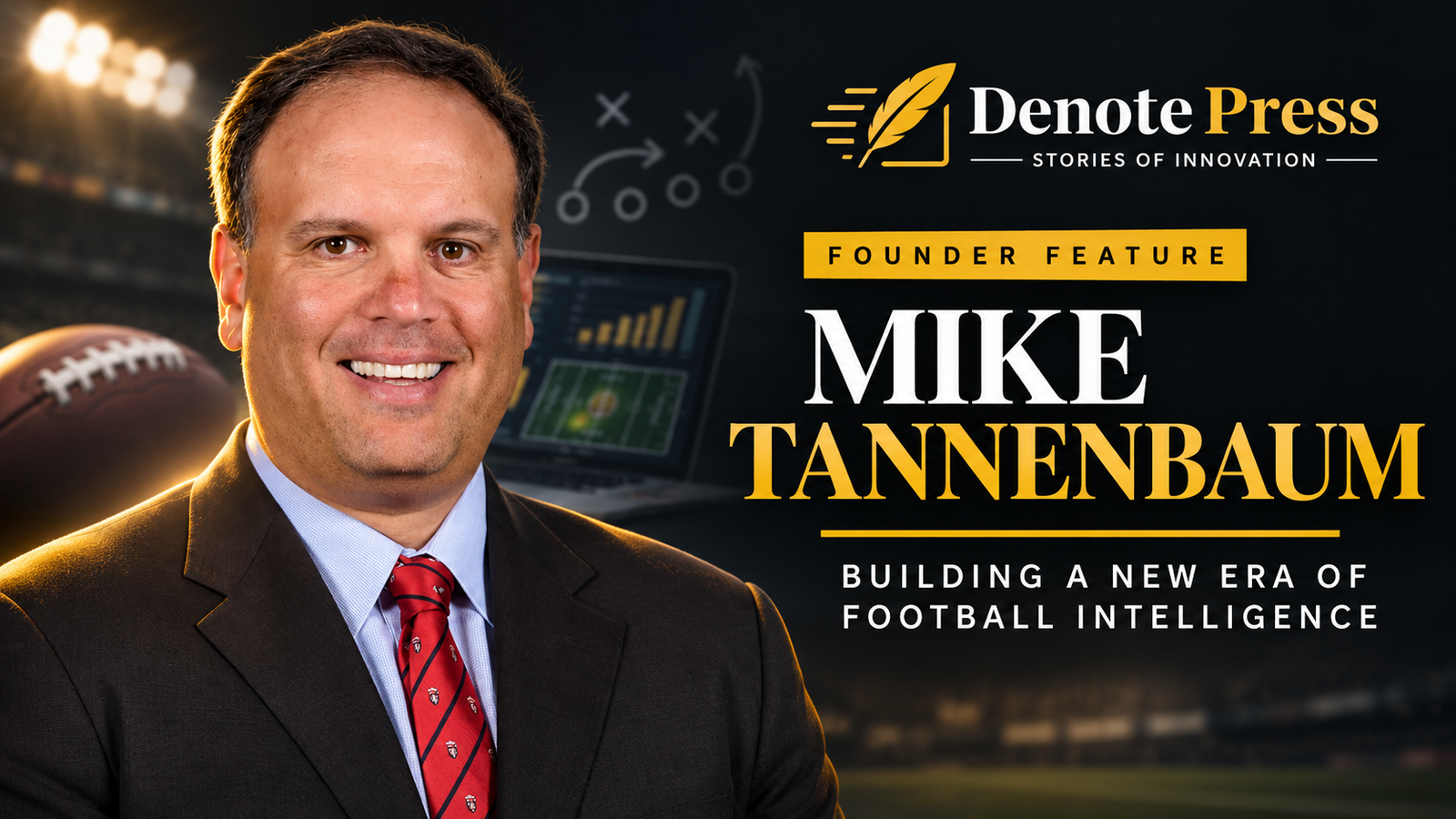
Mike Tannenbaum The 33rd Team is the story of a former NFL general manager who left team facilities, joined ESPN as a front-office analyst and then built a company that now sells data and advice back to the teams he once worked for. Tannenbaum is the founder and CEO of The 33rd Team, a football intelligence and technology company whose main product, Zenith, collects on-field data for NFL clubs. After starting as a media and think-tank venture in 2019, the company shifted toward technology in early 2024 and, in January 2026, announced an eight-figure Series B round.
This guide to Mike Tannenbaum The 33rd Team covers the founder’s career, the company’s pivot from media to technology, how Zenith and the consulting business work, the funding history and the lessons other founders can take from it. Every claim comes from the company’s own pages or published coverage, and where a number is company-reported, undisclosed or different across sources, we say so. The 33rd Team is a B2B company with confidential clients, so some details are not public.
Mike Tannenbaum The 33rd Team: Who Is the Founder?
Mike Tannenbaum is the founder and CEO of The 33rd Team. Press coverage of the company’s Series B round consistently describes him as a former NFL executive who founded the company, and CB Insights and Tracxn both list him as the founder. In a New York Post interview, he is identified as the former Jets general manager from 2006 to 2012.
What stands out about the Mike Tannenbaum The 33rd Team story is the direction of travel. Many former executives move into broadcasting or consulting and stay there. Tannenbaum did both, then built a technology product. The company’s own wording describes it as combining decades of on-field experience with cutting-edge technology to give football teams a winning edge, under the tagline “See More. Know More. Win More.”
An NFL Front-Office Career
Tannenbaum spent most of his career inside NFL organizations. According to his Wikipedia entry, he held a range of administrative roles with the New York Jets, including senior vice president of football operations and assistant general manager, before serving as general manager. News reports confirm that he left the Jets after the 2012 season.
He later returned to the league’s front offices. NFL.com reported that the Miami Dolphins hired him as executive vice president of football operations, effective February 1, 2015, after he had acted as a consultant to the team during the 2014 season. Fox Business adds that he joined ESPN in 2019 as a front-office insider after his time with the Dolphins, and he currently works as an NFL analyst for the network.
That experience matters for the company. Executive search, contract negotiation and roster decisions are the kind of work he did for years, and he knows many of the people who make those decisions. For Mike Tannenbaum The 33rd Team, a front-office career is the foundation of its credibility with clients.
Founding The 33rd Team in 2019
Tannenbaum founded The 33rd Team in 2019, according to Fox Business, CB Insights and Tracxn. The name refers to the NFL’s 32 teams: the 33rd team is an outside group that studies and advises the league. Fox Business described the original idea as bringing in-depth analysis, expert insights and reaction to the latest news from around the league. Wikipedia notes that the company describes itself as a football “think tank.”
The founding came at a transition point. After working in team facilities, Tannenbaum still wanted to be involved in the game, and ESPN gave him a platform as an insider. The new venture gave him a way to gather other former executives, coaches and analysts under one banner and put their knowledge to work.
CB Insights lists the company’s headquarters in Boca Raton, Florida, while its Series B press release was datelined New York. The 33rd Team was therefore an expert network and media brand before it was a software company. That origin is central to Mike Tannenbaum The 33rd Team, because it gave the later product a large bench of football experts to draw on.
The Media Years and the Think-Tank Model
For its first several years, the company operated mainly as a media organization. CB Insights describes it as providing analysis and commentary on American football, particularly the NFL, with former players, coaches and executives covering topics such as rankings, free agency, fantasy football and the draft. The website still lists a Media Network and a team roster of experts.
Tannenbaum told the New York Post that the company was a media company for a while and still has a very robust podcast offering. In practice, the media business built an audience and a brand with credibility among football people, and it created a flow of contacts across the league.
It also revealed a limit. Media revenue depends on advertising and audience, while teams pay for information that helps them win. The Mike Tannenbaum The 33rd Team story therefore turns on a decision to move toward customers who pay for decision support instead of content.
The 2024 Pivot to Technology
According to coverage of the Series B, the company initiated a strategic pivot in early 2024, moving away from content and media and toward building technology products for teams. Dealroom’s summary describes the same shift from a media organization and self-described think tank to a technology provider.
Tannenbaum was direct about the change. He said the company still has media and coaching work, but that where it spends almost all its time, and what it was raising money for, is the future in data and technology. The release describes the company as being at the intersection of on-field knowledge, advanced data and technology.
Pivots are risky, because they ask a company to build new capabilities while keeping the old business alive. In this case, the expert network and relationships gave the company a head start, since it could design the product with football professionals in the room. The pivot is the turning point in Mike Tannenbaum The 33rd Team.
Inside Zenith: The Platform Behind Mike Tannenbaum The 33rd Team
Zenith is the company’s data and analytics platform. According to the products page, it delivers football teams the fastest, most accurate and most functional set of ground-truth data possible, designed for football professionals by football professionals. Dealroom describes it as providing advanced on-field metrics and analytics, including pre-snap data on huddles, motions, substitutions and formations for game planning and in-game management.
The product page lists three kinds of use: pre-snap dashboards for analyzing game-operations tendencies, detailed offensive and defensive movement reports for opponent preparation, and huddle information for tempo and play-calling insights. It also says the analytics frameworks are meant to help teams evaluate players, optimize roster construction and uncover opponent tendencies more quickly.
Tannenbaum described the output to the New York Post in practical terms: it is information collected after games and delivered to teams as reports that he calls very actionable, accurate and timely. These are company claims about its own product. For Mike Tannenbaum The 33rd Team, Zenith turns football expertise into a repeatable data service.
How the Data Is Collected
The homepage says the company’s approach takes advantage of the growing on-field data ecosystem to capture and tag information, and the products page says it uses proprietary machine learning models developed hand in hand with NFL experts. The page says the models are fast, consistent and agile, that historic data can be updated instantly with new critical data points and that NFL expertise lets the company provide a breadth of information that resonates with coaching staffs and front offices.
In his interview, Tannenbaum said the company collects data on the team’s behalf and gives them reports after games. He described the NFL workflow as formulaic: when a game ends, a team has about 24 hours, win or lose, to do the autopsy and then moves to the next opponent. That cycle is why speed matters.
The company’s role, he said, is to gather information based on what happened in the game and leave the decisions to the teams. The design principle behind Mike Tannenbaum The 33rd Team is to support coaches and executives, not replace them.
Consulting: NCAA Advisory, Executive Search and Negotiation
Alongside Zenith, the company runs a consulting business. The services page says The 33rd Team works with owners, general managers, athletic directors and head coaches to design custom solutions, drawing on former NFL general managers, executives, coaches and analysts. It lists three main offerings.
NCAA advisory. The company helps universities and conferences navigate name, image and likeness rules, revenue sharing and shifting regulations, with strategies for recruiting, roster management and compliance. Tannenbaum told the New York Post that consulting is most frequently for colleges.
Executive search. The company partners with NFL teams, college athletic departments and conferences on searches for roles such as head coach, general manager and athletic director, using data-backed evaluations and its industry network.
Negotiation. The company supports contracts, sponsorships and partnerships, drawing on NFL contract negotiation and NCAA operations experience.
This consulting arm keeps revenue flowing while the product matures and keeps the company close to its customers. For Mike Tannenbaum The 33rd Team, services and software reinforce each other.
The Jets Search and Front-Office Advisory
The most visible consulting work was for the New York Jets. According to the services page, the company was retained by the Jets to support their 2025 head coach and general manager search process, providing data-backed evaluations and strategic guidance. The New York Post reports that the Jets contracted The 33rd Team as a front-office advisor while they hired Darren Mougey as general manager and Aaron Glenn as head coach.
Tannenbaum said it was great to work with the Jets and help with the search, adding that he knows a lot of people in the building. It is worth noting the potential sensitivity: he is a former Jets general manager, so the relationship was publicly known, and the New York Post says it was publicized.
For a young company, a high-profile engagement is both proof of capability and a marketing asset. It also shows how Mike Tannenbaum The 33rd Team uses its network in practical ways: the same relationships that once supported a general manager’s career now support the company’s advisory work.
Four NFL Teams and Confidential Clients
According to the company’s funding release, in fewer than 17 months The 33rd Team took Zenith from concept to market adoption, secured deals with four NFL teams ahead of the 2025–26 season and captured more than 10% of the league. These figures are company-reported.
The client list is mostly private. The New York Post reports that the Jets partnership was publicized, but that Tannenbaum says most organizations prefer confidentiality because of the competitiveness of the NFL. That is typical in sports analytics, where a competitive edge loses value if opponents know about it.
Confidentiality is a trade-off. It protects clients but means outside observers cannot independently verify adoption. For Mike Tannenbaum The 33rd Team, the four-team figure is best read as the company’s claim, supported by investor confidence rather than a public client roster.
Funding: The Eight-Figure Series B
On January 13, 2026, The 33rd Team announced the close of an eight-figure Series B round, according to its PR Newswire release. The exact amount was not disclosed. Pulse 2.0 and Dealroom report that Liberty Media, which first invested in 2022, participated alongside new backers including Bruin Sports Capital founder George Pyne, Gary Vaynerchuk and the family office of former NASCAR CEO Brian France, Silver Falcon Capital. Fox Business also names entrepreneur John Low, and the company added football industry participants such as NFL alumnus Justin Pugh and former head coach Matt Patricia to its cap table.
Tannenbaum called it a transformational moment for the company. The release says the funding will help build the engine for a market-changing platform and allow innovation at the intersection of on-field knowledge, advanced data and technology to enhance team performance, fan engagement and beyond.
Public data trackers do not match the “eight-figure” description. CB Insights lists $5.81 million raised in total and Tracxn lists $4.29 million over four rounds, so those aggregator totals are likely incomplete and should not be used as the company’s funding amount. For comparison with other startups raising capital, see our Funding News section. How Mike Tannenbaum The 33rd Team deploys its Series B will determine how fast Zenith can expand beyond its first four clients.
Where Mike Tannenbaum The 33rd Team Fits in Football Analytics
Football analytics is a competitive field. NFL teams already use in-house analytics departments, league-provided data and outside vendors, and colleges are building similar operations. The 33rd Team’s position is unusual: it combines a data platform with a consulting arm staffed by former executives and coaches.
The company’s pitch is credibility. A platform designed by football professionals for football professionals, as the products page puts it, should produce outputs that coaching staffs trust and use. Its leadership and expert roster come from the sport, which may help the data resonate with the people who read it.
The opportunity extends beyond the NFL. The services page includes college advisory, and the company’s funding language mentions fan engagement and team performance. In practical terms, Mike Tannenbaum The 33rd Team competes by turning front-office experience into decision support, and the test is whether teams will pay for it year after year.
What Could Slow Mike Tannenbaum The 33rd Team Down
Every young sports-tech company faces predictable hurdles. This section is analysis, not reporting.
A small customer universe. The NFL has 32 teams, so each client matters, and losing one is a large share of revenue.
Confidential adoption. Without public client lists, proving traction to new buyers can be harder.
Data competition. League-provided data and other vendors can overlap with Zenith’s metrics, so the product must stay differentiated.
Pivot execution. Moving from media to software requires engineering talent and product discipline that a media company may not have started with.
Founder dependence. The brand is closely tied to Tannenbaum’s network and reputation, so scaling beyond one person’s relationships is a challenge. These risks are normal for a company at this stage, and the Series B gives Mike Tannenbaum The 33rd Team resources to hire and build.
Leadership Style and What’s Next
Tannenbaum leads as an operator who knows the customer. His interview comments show a practical, process-driven view of the NFL, including how little time teams have after each game. He also frames the company as being in the information-gathering business, with teams making their own decisions.
The visible roadmap is clear: expand Zenith across more teams, grow college and professional consulting, and build the technology platform. The company’s careers page and newsletter signup suggest growth in hiring and audience, and the website still points to a podcast-driven media network.
How Mike Tannenbaum The 33rd Team balances product development with consulting and media will define its next chapter, along with whether it can turn four NFL clients into a larger share of the league.
Lessons From the Mike Tannenbaum The 33rd Team Journey
The Mike Tannenbaum The 33rd Team journey offers practical lessons for founders, especially in B2B and sports technology.
1. Build on domain expertise. A front-office career gave Tannenbaum credibility that outsiders cannot easily copy.
2. Use media to build a network. The early content business created relationships and brand recognition.
3. Be willing to pivot. Moving from media to technology aligned the company with customers who pay for results.
4. Pair software with services. Consulting kept the company close to clients while the product matured.
5. Design with the user in the room. Models developed with NFL experts aim to produce outputs coaches trust.
6. Respect client confidentiality. In competitive industries, privacy is part of the service, even if it limits marketing.
7. Raise from strategic investors. Media, sports and entrepreneurial backers add distribution and credibility as well as capital.
Frequently Asked Questions
Who founded The 33rd Team? The 33rd Team was founded by Mike Tannenbaum, a former New York Jets general manager and Miami Dolphins executive who also works as an ESPN NFL analyst.
What is the Mike Tannenbaum The 33rd Team story? It is the story of a former NFL executive who founded a football think tank and media company in 2019, then pivoted in 2024 to build Zenith, a data and analytics platform for football teams.
What is Zenith? Zenith is The 33rd Team’s data and analytics platform, which provides on-field metrics such as pre-snap data on huddles, motions, substitutions and formations, plus dashboards and reports for game planning.
How many NFL teams use Zenith? The company says it secured deals with four NFL teams ahead of the 2025–26 season, more than 10% of the league. The client list is confidential.
When did The 33rd Team raise its Series B? The company announced an eight-figure Series B round on January 13, 2026. The exact amount was not disclosed.
Who invested in The 33rd Team? Reported investors include Liberty Media, Bruin Sports Capital’s George Pyne, Gary Vaynerchuk, Silver Falcon Capital, John Low, Justin Pugh and Matt Patricia.
What consulting does The 33rd Team offer? NCAA advisory on name, image and likeness and revenue sharing, executive search for teams and athletic departments, and negotiation support.
Did the Jets hire The 33rd Team? The company says it was retained by the New York Jets to support their 2025 head coach and general manager search, and the New York Post reported the same.
When did The 33rd Team pivot to technology? According to coverage of its Series B, the company began the pivot in early 2024.
Where is The 33rd Team based? CB Insights and Tracxn list Boca Raton, Florida. The Series B press release was datelined New York.
Conclusion
Mike Tannenbaum The 33rd Team shows how deep domain experience can become a technology company. From an NFL front-office career and an ESPN analyst role to a football think tank, a 2024 pivot to data and a 2026 Series B backed by Liberty Media and other investors, Tannenbaum has built a company that sells football knowledge as software and advice. His story is a useful case study in turning an expert network into a product.
The open question for Mike Tannenbaum The 33rd Team is whether Zenith can grow from four NFL clients to a much larger share of the league while keeping its football credibility. If it can, The 33rd Team may become a standard name in football decision support.
For more founder journeys, read Michael Fedele’s Throne Sport Coffee, Molly Sims’ YSE Beauty and Alvaro Silberstein’s Wheel the World on Denote Press, or browse more Founder Stories.
This article is for information only. Company figures are self-reported or from published coverage. Client lists and funding amounts are not fully public.
Sources and further reading: The 33rd Team, Zenith product page, Services page, New York Post via Yahoo Sports, Fox Business on the Series B, Pulse 2.0, Dealroom, SGB Online, CB Insights, Tracxn, Wikipedia on Mike Tannenbaum.
