

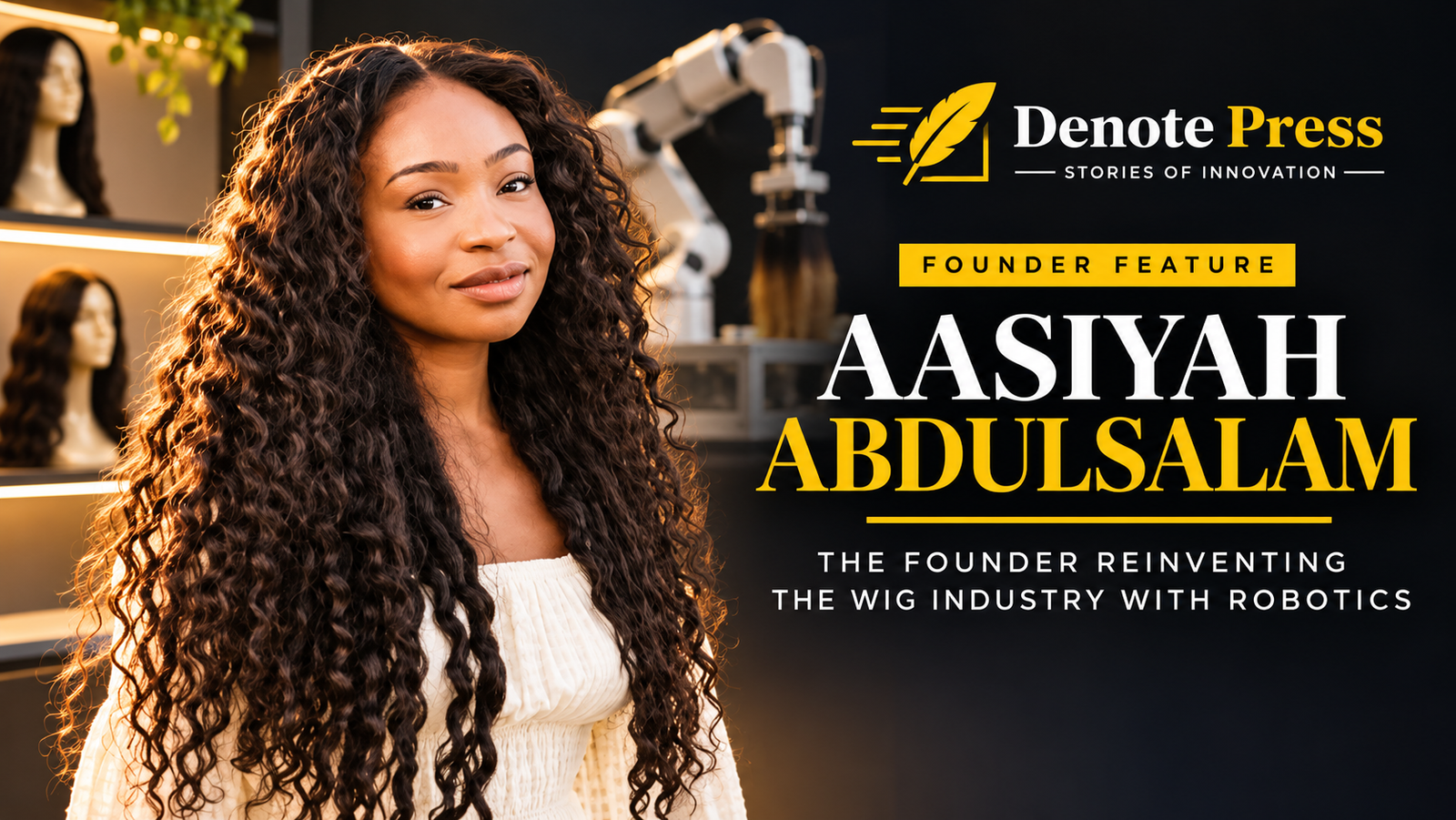
Aasiyah Abdulsalam The Renatural is the story of a founder who began wearing wigs as a child, spent six months inside a wig factory in South Korea as an undergraduate and then built two products the industry had not seen: a patented silicone wig grip and a lace-free wig made with proprietary robots. Abdulsalam is the founder and CEO of The Renatural, a Brooklyn startup that started with The Wig Fix in 2020, reached seven figures within two years and in October 2025 launched its first robot-made Signature wigs. The company says its accessories have been worn by more than 70,000 people in 33 countries, and published coverage reports about $6 million raised from investors including Mark Cuban.
This guide to Aasiyah Abdulsalam The Renatural covers the founder’s background, the Wig Fix, the move into robotics, the funding history, the market and the lessons other founders can take from it. Every claim comes from the company’s own pages or published coverage, and where a number is company-reported or sources differ, we say so.
Aasiyah Abdulsalam The Renatural: Who Is the Founder?
Aasiyah Abdulsalam is the founder and CEO of The Renatural. Inc. profiles her as the first-time founder behind a Brooklyn startup using patented robotics and biomaterials to rewrite how wigs are made, and Redbud VC, an early investor, describes her as having the highest level of founder-market fit. Redbud also reports that she was named to the Forbes 30 Under 30 list in retail and e-commerce.
What stands out about the Aasiyah Abdulsalam The Renatural story is the depth of the research behind it. She did not arrive in the wig industry as a general beauty entrepreneur. She studied it as an academic, worked in a factory, interviewed wearers and designed her first product herself. The Renatural’s website describes the brand as a luxury wig company built around hyper-realism, undetectable hairlines and wigs that need no glues, sprays or adhesives.
From London and Rural Ireland to Wigs
Abdulsalam’s personal history shapes the company. She told Inc. that she was born in London but raised in a rural part of Ireland, and that her parents emigrated from Nigeria. Glossy adds that she grew up with little access to textured hair-care products.
By her own account, she began wearing wigs and extensions at 12, after being diagnosed with scalp psoriasis that caused hair loss. Wearing wigs introduced her to a network of hair brokers, stylists and specialty product makers, and she learned how the industry works from the customer’s side. She also made her own wigs and learned how they are professionally installed.
That experience gave her an unusual vantage point. She understood both the emotional importance of wigs and the practical frustrations: cost, comfort and the sense that something so personal still felt detectable. This personal starting point is the foundation of Aasiyah Abdulsalam The Renatural, and she has described it publicly in interviews rather than as part of the brand’s marketing.
Six Months in a Korean Wig Factory
The business began as a school project. Inc. reports that while studying geography at the University of Leicester, Abdulsalam had to choose a consumer product for her dissertation and explore its manufacturing geopolitical ties. She chose the global wig industry, valued at more than $8 billion, and became so absorbed that she moved to South Korea for six months to work at a wig factory. Redbud notes that the dissertation earned first-class honors.
In the Dumbo Office Space Q&A, she explained that she could never understand why something so intimate still felt uncomfortable and disconnected from the person wearing it, and that the factory stint showed her that premium wigs are still largely made by hand, limiting consistency.
During that time, she interviewed wig wearers. They complained about the recurring cost of installation, hundreds or thousands of dollars a year, and the discomfort and hair loss linked to glue, tape, tight bands and combs sewn into caps. She did not intend to start a business, but those conversations exposed major opportunities. This research phase is why Aasiyah Abdulsalam The Renatural began with a problem statement rather than a product idea.
Launching The Wig Fix in 2020
The first product was The Wig Fix. According to Inc., Abdulsalam developed it a few years after earning a master’s degree from the London School of Economics. She taught herself AutoCAD to design it, had it 3D printed in hard plastic and then worked with a medical silicone manufacturer to create a prototype. In 2020, she patented it.
The Wig Fix is a transparent, hypoallergenic silicone wig grip that holds a wig with friction instead of adhesive. The company’s website calls it the world’s first patented hypoallergenic silicone wig grip, with a patented node pattern, and says it works without glue, adhesive or damage to the edges. It retails at $29, and a second-generation version, Wig Fix 2.0, is described as twice as thin, softer and one continuous strip with an even better grip.
Glossy reports that Abdulsalam funded the early company partly with money from the sale of her earlier clothing company, Alerojasmine, in 2019. Several outlets describe the Wig Fix as designed to protect the hairline. Claims that it promotes hair growth appear in some coverage, but they are not a medical claim we can verify, so readers with scalp or hair-loss conditions should consult a professional. For Aasiyah Abdulsalam The Renatural, the Wig Fix is the product that built the customer base.
How Aasiyah Abdulsalam The Renatural Grew on Influencers
Early sales were driven by social media. According to Inc., in her first six months the company logged 4,000 orders of the Wig Fix at $29 each, enough that she brought in a third-party fulfillment partner. Growth came largely from influencer partnerships, including a collaboration with British YouTuber Patricia Bright that moved nearly 2,000 units in 24 hours.
Abdulsalam said her first order was from Ohio, and that although American customers paid about $30 in shipping, 80% of orders still came from the United States. That meant the company was effectively an American business launched from a London bedroom.
By the third year, Inc. reports, she had bootstrapped the business to $3 million in annual revenue, and AfroTech reports that the company generated $3 million in revenue within its first three years with 80,000 units sold, citing a company press release. The company’s website now says 70,000+ wig wearers in 33 countries, while a Q&A quotes more than 100,000 people, so the counts differ by source and date. The early growth of Aasiyah Abdulsalam The Renatural shows how a single accessory can carry a company.
The 600th Email: Deciding to Build Wigs
The move into wigs came from customers. Abdulsalam told Inc. that it was the 600th email asking for a wig that convinced her she had to launch one. She said she wanted a wig herself, and clearly her customers did too. At the end of 2023, she began researching how to innovate within the category.
Customer pull is a powerful signal. The Wig Fix had given the company an audience of wearers who trusted the brand, and their questions pointed to the next product. It also aligned with the founder’s research, which had shown that the core problems were in the wig itself: how it looks, how it fits and how it is made.
Abdulsalam has said she wants The Renatural to feel like a beauty brand, a wig beauty brand, and not a traditional wig supplier. That framing explains why Aasiyah Abdulsalam The Renatural moved from accessories to a full wig line.
Replacing Lace: The Scalp-Mimicking Base
The first technical problem was lace. Most wigs use a lace front, a fine mesh into which hair is knotted. Abdulsalam told Inc. she always had a gripe with lace because it never looked real, no matter how much it was plucked, bleached, glued or tinted. She told Glossy that lace comes in a limited range of skin tones and must be adapted to the wearer.
Her answer was a different base. Inc. reports that she began with a biomaterial used as a skin replacement for burn victims, which she describes as ten times thinner than some of the lace, and developed what she calls a first-of-its-kind bamboo polymer hybrid. Glossy describes the material as three times thinner than a typical lace front, and the two articles use different comparisons, so the exact figure depends on the source.
The wigs use 100% human hair attached to this proprietary material. The pitch is a more realistic hairline without bleaching or plucking. These are company claims, and independent reviews will matter as more customers receive wigs. The new base is the technical core of Aasiyah Abdulsalam The Renatural.
Inside the Robotics at the Dumbo Factory
Traditional wig making is slow because each strand is typically knotted by hand, and artisans spend years mastering the technique. Abdulsalam asked how to repeat a precise, monotonous action at consistent quality while keeping costs down. The answer, she told Inc., was robots.
She hacked together an embroidery machine and a 3D printer as her first production prototype, then worked with engineers to formalize the design. According to Inc., The Renatural now manufactures the Signature Collection end to end at its Dumbo warehouse in Brooklyn with two patented robots and a staff of seven overseeing production, quality and shipping. Customers are welcome to visit.
Glossy reports that the process can make a human-hair wig in as little as 45 minutes, compared with hundreds of hours for hand-stitched lace-front wigs. Black Enterprise describes the system as automating ventilation, the labor-intensive process of hand-tying individual strands, and positions the company as deep tech more than a traditional beauty brand. Abdulsalam has also argued that the wig industry has long relied on cheap manual labor, and that automation can reduce the human-rights concerns linked to the global hair supply chain. For Aasiyah Abdulsalam The Renatural, robotics is the competitive moat.
The Signature Wigs and the October 2025 Launch
The Renatural launched its debut Signature Collection in October 2025. Glossy reported on October 22, 2025, that it launched with three styles sold direct to consumers, priced from $950 to $1,950 each, and described the audience as ranging from casual wig wearers to drag queens. Inc. later described four wigs in the Signature Collection, and AfroTech listed a range of $900 to $1,500, so the lineup and prices have evolved since launch. Check the current store for details.
The company uses a try-before-you-build approach. The homepage offers a free measuring tape, a measuring guide that walks through circumference, front-to-nape and ear-to-ear measurements, a one-on-one consultation with a stylist, and a “reserve your wig” flow. It also offers a kit to try up to two hair textures before building a wig.
Demand has outrun supply. Abdulsalam told Glossy that the site had 40,000 waitlist sign-ups before launch, and Inc. reported in March 2026 that the company had built a 40,000-person waitlist over 18 months and aimed to produce 100 to 150 wigs per month by the end of February. Glossy had said current machinery could produce 500 wigs a month, so capacity statements differ across articles and dates. The launch made Aasiyah Abdulsalam The Renatural a manufacturer as well as an accessory brand.
Accessories: Bamboo Caps, Mirror Comb and Pony Cuff
The accessory line remains central. The homepage lists The Wig Fix 2.0 at $29, a Bamboo Wig Cap with a breathable bamboo-infused blend in six shades, a Mirror Comb for styling and checking, and a Pony Cuff for half-up and ponytail styles. A Wig Essentials Set, which pairs the Wig Fix 2.0 with six bamboo caps in the wearer’s shade, is listed at $39.
Accessories do two jobs. They generate steady revenue between wig purchases, and they keep the company close to its customers. The company’s Q&A says it wants to reinvent every product around the experience of wearing a wig, not only the hair itself.
Abdulsalam told Glossy she does not plan to enter the wet hair-care category, such as shampoo and styling creams, but expects brand partnerships because wig wearers often care for four to six wigs. For Aasiyah Abdulsalam The Renatural, accessories and partnerships extend the brand without diluting its focus.
Funding: About $6 Million Raised
Funding came in small, deliberate steps. Inc. reports that The Renatural has raised $6.15 million from major investors including Mark Cuban, and AfroTech reports $6.2 million. Glossy says she raised $2 million in 2024 and closed an additional $4.2 million seed round in August 2025. CB Insights lists a lower total of $4.25 million, which is likely incomplete.
Earlier, Abdulsalam entered pitch competitions to fund research and development. Inc. says she won a Harvard Business School competition and took home $65,000 in non-dilutive funding in 2023, then participated in Black Ambition by Pharrell Williams and received a $100,000 investment. Glossy says The Renatural was a 2023 winner of the Black Ambition Prize and that Abdulsalam was part of the 2024 Glossier Grant Program class.
Named investors include Watchfire Ventures, Mark Cuban and Ingeborg Investments, along with Topicals founder Olamide Olowe, who invested in 2023 and advises Abdulsalam. Ingeborg’s Mira Kaufman told Glossy that building precision robotics that never existed before to reinvent how a product is made is remarkable. Inc. also notes that less than 1% of venture capital funding goes to Black women. For comparison with other startups raising capital, see our Funding News section. The funding story of Aasiyah Abdulsalam The Renatural shows how grants, competitions and a profitable accessory business funded a deep-tech build.
Where Aasiyah Abdulsalam The Renatural Fits in the Wig Market
The wig market is large but traditional. Inc. cites a global wig industry valued at more than $8 billion, and Glossy cites Market Research Intellect’s forecast that human-hair wigs and extensions will reach $9.3 billion by 2031, at a compound annual growth rate of 6.2%. McKinsey’s 2025 report predicts the broader beauty sector will grow about 5% annually from 2025 to 2030.
Despite that growth, Glossy notes the wig sector has seen few major launches compared with hair care and hair tools. Competitors in manufacturing are established suppliers that rely on hand-knotted lace and low-cost labor. Abdulsalam argues that these incumbents have used labor advantages to push out other innovation.
The Renatural’s position is a premium, technology-led brand that sells direct, offers personalization and publicly shows its factory. In practical terms, Aasiyah Abdulsalam The Renatural competes by offering a different base material, faster production and an accessories ecosystem. Ingeborg’s Kaufman said wig wearers buy many wigs over a lifetime and lack a go-to brand because the experience has been frustrating, which suggests room for loyalty if the experience improves.
What Could Slow Aasiyah Abdulsalam The Renatural Down
Every young hardware and beauty company faces predictable hurdles. This section is analysis, not reporting.
Scaling robotics. Moving from prototypes to steady output requires reliable machines, trained staff and quality control. Inc. notes every team member must be trained in-house because the technology is proprietary.
Price and proof. At nearly a thousand dollars or more per wig, customers will want to see independent reviews and results over time.
Capacity versus demand. A 40,000-person waitlist is only valuable if the company can deliver wigs on time.
Category habits. Wig wearers are used to lace fronts and stylist installs, so a new base needs education.
Founder concentration. The brand’s story is closely tied to Abdulsalam, which can make scaling a team and brand beyond one person a challenge. These risks are normal for a company at this stage, and the combination of grants, investors and a profitable accessory line gives Aasiyah Abdulsalam The Renatural resources to manage them.
Leadership Style and What’s Next
Abdulsalam leads as a researcher-founder with a clear point of view. Inc. quotes her describing her mindset as “pronoia,” the opposite of paranoia, a deliberate optimism that everything is working in her favor. She also emphasizes transparency, since customers can visit the factory and see how wigs are made.
Her plans for 2026, as described to Glossy, include launching an insurance program for customers and hosting a brand awareness event, along with partnerships. Her focus for the first wave of customers is simple: give a few hundred people an incredible experience, because word of mouth is everything in this industry.
She also frames the company’s mission broadly. In the Q&A, she says The Renatural is building a beauty technology company dedicated to improving the entire experience of wearing wigs. How Aasiyah Abdulsalam The Renatural balances scaling production with that experience will define its next chapter.
Lessons From the Aasiyah Abdulsalam The Renatural Journey
The Aasiyah Abdulsalam The Renatural journey offers practical lessons for founders, especially in beauty and hardware.
1. Start with research. A dissertation, a factory stint and customer interviews gave her a deep understanding before she built anything.
2. Solve a narrow problem first. A $29 grip built an audience and revenue.
3. Listen to customer demand. The 600th email asking for a wig signaled the next product.
4. Rethink the material. Replacing lace with a new base attacked the industry’s central compromise.
5. Automate repetitive work. Robots addressed the cost and consistency of hand knotting.
6. Stack non-dilutive funding. Competitions and grants financed development without giving up control.
7. Be transparent. Inviting customers to the factory turns the process into a selling point.
Frequently Asked Questions
Who founded The Renatural? The Renatural was founded by Aasiyah Abdulsalam, who is Founder and CEO. She is based in Brooklyn, New York.
What is the Aasiyah Abdulsalam The Renatural story? It is the story of a founder who began wearing wigs at 12, studied the wig industry at university, launched the patented Wig Fix grip in 2020 and later built robot-made, lace-free wigs in Brooklyn.
What is The Wig Fix? The Wig Fix is a transparent, hypoallergenic silicone wig grip that holds a wig with friction instead of glue or adhesive. The company says it is the world’s first patented hypoallergenic silicone wig grip, and it retails at $29.
How are Renatural wigs made? The company says its Signature wigs are made in Brooklyn with two patented robots, using 100% human hair attached to a proprietary polymer base instead of lace. Glossy reported production in as little as 45 minutes.
How much do Renatural wigs cost? Glossy reported prices of $950 to $1,950 at the October 2025 launch, while AfroTech listed $900 to $1,500. Check the website for current prices.
How much has Aasiyah Abdulsalam The Renatural raised? Inc. reports $6.15 million and AfroTech reports $6.2 million, including a $4.2 million seed round in August 2025. CB Insights lists a lower total of $4.25 million.
Who invested in The Renatural? Named investors include Mark Cuban, Watchfire Ventures, Ingeborg Investments and Topicals founder Olamide Olowe, and the company was a 2023 Black Ambition Prize winner and part of the Glossier Grant Program in 2024.
Where is The Renatural based? In Dumbo, Brooklyn, New York.
Can customers visit the factory? Inc. reports that customers are free to visit and see how the process works.
Is The Wig Fix a medical product? No. It is a wig accessory. People with scalp or hair-loss conditions should consult a professional.
Conclusion
Aasiyah Abdulsalam The Renatural shows how deep customer research and a willingness to rebuild a manufacturing process can open a stagnant category. From a dissertation and a Korean wig factory to a patented grip, a bootstrapped $3 million business, a seed round and robot-made wigs in Brooklyn, Abdulsalam has built a company that treats the wig as a technology problem as well as a beauty one. Her story is a useful case study in product-led growth, materials innovation and automation.
The open question for Aasiyah Abdulsalam The Renatural is whether the company can scale production to meet a large waitlist while keeping the quality and realism its brand promises. If it can, The Renatural may help redefine what a premium wig looks and feels like.
For more founder journeys, read Michael Fedele’s Throne Sport Coffee, Molly Sims’ YSE Beauty and Alvaro Silberstein’s Wheel the World on Denote Press, or browse more Female Founders and Founder Stories.
This article is for information only and is not medical advice. Company claims, prices and production figures are as reported and may change. People with scalp or hair-loss conditions should consult a qualified professional.
Sources and further reading: The Renatural, The Wig Fix, Inc., Glossy, AfroTech, Black Enterprise, Redbud VC, Dumbo Office Space Q&A, CB Insights.
