

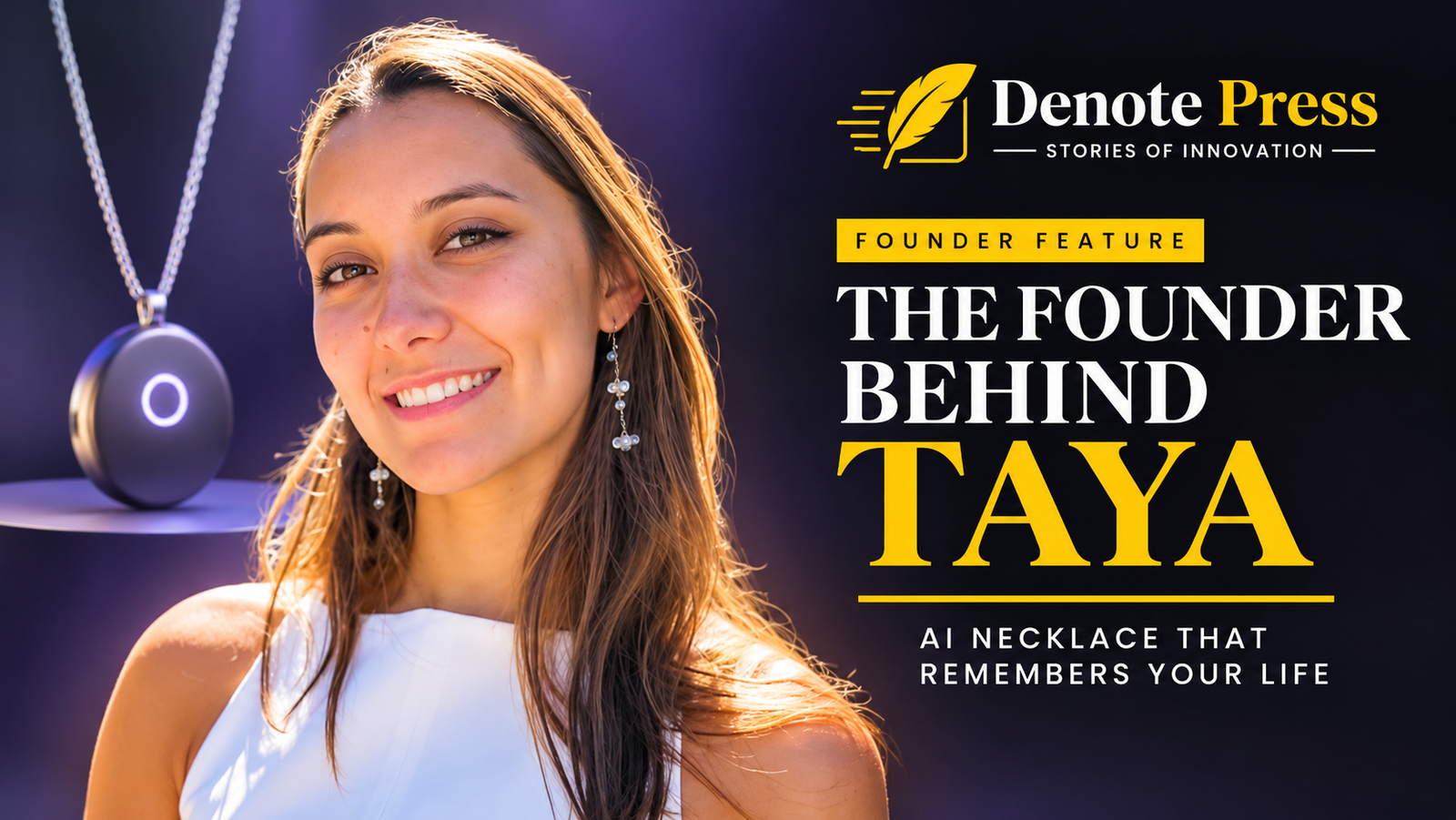
Elena Wagenmans Taya is the story of a Stanford-trained hardware designer who looked at the wave of AI wearables that record everything around them and decided to build the opposite: a piece of jewelry that captures only your own voice, only when you choose. Wagenmans is the founder and CEO of Taya, a San Francisco startup that makes the Taya Necklace, a stainless steel pendant on a 14K gold-plated chain with a button, a microphone and a companion app. In March 2026, Taya announced a $5 million seed round led by MaC Venture Capital and Female Founders Fund, with participation from a16z speedrun.
This guide to Elena Wagenmans Taya covers the founder’s background, the privacy-first idea, how the necklace works, the preorder and shipping status, the funding picture and the lessons other founders can take from it. Every claim comes from Taya’s own pages or published coverage, and where a detail is company-reported or still unclear, we say so. Taya is still an early-stage hardware company, and its first production units were expected to ship later in 2026, so readers should check the current status on the site.
Elena Wagenmans Taya: Who Is the Founder?
Elena Wagenmans is the founder and CEO of Taya. The company’s About page describes her as a product designer and mechanical engineer trained at Stanford who began her career building hardware at Apple. TechCrunch identifies her as a former Apple design engineer, and the company’s funding announcement calls her a Stanford-trained product designer and mechanical engineer who previously worked at Apple.
What stands out about the Elena Wagenmans Taya story is the match between founder and product. Taya is a hardware product that depends on industrial design, miniaturization and materials, and Wagenmans comes from the part of the industry where those skills are central. The company describes itself today as a small team of designers and engineers in San Francisco, and TechCrunch reported in March 2026 that it had five full-time employees plus a few contractors, working in person from a San Francisco office.
From Stanford to Apple Hardware
The public record on Wagenmans’ career is short but consistent. Taya’s own materials say she studied at Stanford as a product designer and mechanical engineer and began her career building hardware at Apple. Different outlets describe the role as hardware designer or design engineer, and the sources do not specify which products she worked on, so we do not guess.
That background matters in two ways. First, hardware startups have a long record of failing at manufacturing, and experience inside a company known for tightly controlled hardware supply chains gives a founder a realistic view of what it takes to build something people will carry every day. Second, Apple-style design thinking, where the object is meant to feel natural to wear and use, shapes how Taya positions itself.
For Elena Wagenmans Taya, the Apple experience is less a credential than a design philosophy. The company says it believes great technology begins with what matters to the user, not with asking people to organize their lives around a device.
The Problem: Wearables People Will Not Wear
Taya’s origin idea is a critique of a trend. TechCrunch notes that note-taking and transcription have become a prime use case for wearable gadgets as AI voice-to-text improves, with companies such as Plaud and Pocket focusing on meeting summaries and others such as Friend, Omi and Amazon-owned Bee exploring pendants and wristbands to record daily life.
That last category has run into controversy. People understandably do not want to be recorded without consent, and the devices that make them feel watched are hard to wear in social settings. Wagenmans told TechCrunch that she wanted to build a good-looking wearable that works only for the user, because people often do not use these devices owing to concerns about social image and privacy.
The company’s launch release puts it simply: people want intelligence, but they do not want to wear something that makes everyone around them uncomfortable. That is the commercial gap behind Elena Wagenmans Taya, a wearable that solves the social problem as well as the technical one.
The Jewelry-First Idea
Taya’s answer is to start with jewelry. Instead of a plastic gadget with a logo, the Taya Necklace is a pendant that the company says should look good even if the technology were switched off. A Wareable report describes it as a jewelry-first accessory, and Gearbrain notes that it is positioned against the plastic look of many AI pins.
The brand voice reflects this. The homepage tagline is “Jewelry that remembers,” and the About page says that as technology moves closer to our bodies, how it looks, feels and fits into the way we express ourselves matters as much as what it can do. It lists the kinds of moments the necklace is meant to catch: the idea that arrived when your hands were full, the gift you thought of in March for a birthday in June and the person you said you would call.
This framing changes who the product is for. Instead of targeting only gadget enthusiasts, Elena Wagenmans Taya targets people who already wear jewelry and might accept a quiet layer of technology inside it.
How the Elena Wagenmans Taya Necklace Works
The interaction is intentionally simple. According to Wareable and TechCrunch, the necklace works through a button: tap the pendant to start recording a thought or reminder and tap again to stop. The microphone is off by default. The company’s homepage describes the idea in its own words: press the button, speak naturally and revisit the note in the app when you are ready.
Voice notes are processed and organized in an iOS companion app, which TechCrunch says saves your notes and lets you ask questions about them through an AI-based chat feature. Wareable reports that the app also supports AI-based search across notes. The site’s examples range from shower thoughts and creative ideas to shopping lists and personal reflections.
Wagenmans told TechCrunch that the team is experimenting with ways to make note-taking easier and to give feedback from the pendant that a note was saved. The design goal is a quick, frictionless action that lets the wearer keep moving, which is the heart of how Elena Wagenmans Taya approaches daily use.
Privacy as an Architectural Decision
Privacy is the main selling point, and the company describes it as a design choice. In the funding announcement, Wagenmans said that “privacy isn’t a feature, it’s an architectural decision.” The product aims to capture a single speaker, not the room.
Technically, TechCrunch reports that during onboarding the app asks the wearer to record a voice sample, which it uses during recording to prioritize the user’s voice and minimize everything else, and that the company is experimenting with directional microphones to help. Wareable describes a speaker-verification system trained on the user’s voice during setup, together with directional microphones that prioritize the wearer’s speech and filter out bystanders.
Wagenmans summarized the idea to TechCrunch: the aim is to capture your voice, “not the room that you’re in.” These are company descriptions of an early product, and independent testing of how well it filters other voices will matter once units ship. MaC Venture Capital’s Adrian Fenty told TechCrunch that he would place Taya outside the notetaker category, since notetakers are ambient recorders while Taya’s capture is intentional and focused on one person. For Elena Wagenmans Taya, that distinction is the core of the pitch.
Design, Materials and Battery
The physical design follows the jewelry positioning. The homepage says the pendant is made of stainless steel and hangs from a 14K gold-plated chain, and that it is water-resistant for everyday life, including rain, sweat and sun. It describes the battery as charging fast and lasting all day. The audio system is described as engineered to hear you, not the crowd.
Some third-party listings give more specific battery numbers, such as 12 to 18 hours of active use and 3 to 5 days of standby, but we could not confirm them against a company source, so readers should check the technical specifications page before relying on them. The website’s FAQ also covers materials, weight, hypoallergenic questions, wearing the pendant on your own chain, charging time and languages. The answers were not visible when we reviewed the page, so we do not report them here.
Design choices like these show why Elena Wagenmans Taya is a hardware story as much as an AI story. Materials, comfort and water resistance decide whether people wear the product every day, and daily wear is what the product needs.
The App and Everyday Use
The software side is built around retrieval. The goal is not to record meetings but to collect short captures throughout the day and let the wearer return to them later. The company’s launch release says Taya is focused on brief, frequent voice captures: moments of insight, reminders and creative thoughts that would otherwise disappear. It is not positioned as a meeting notetaker or always-on recorder.
The homepage says the necklace turns on only when the wearer chooses and captures only what the wearer decides is important. The data is described as fully intentional, fully yours and available in the companion app. The website also features short quotes from early users, including an executive, a startup founder and a photographer, though the product had not shipped broadly at the time of writing, so these appear to come from limited early access, and we do not repeat them as independent reviews.
Software details such as subscription requirements and data storage are covered in the FAQ, and readers should read them before buying. The everyday-use pitch for Elena Wagenmans Taya is straightforward: capture the thought now and deal with it later.
Preorders and the Road to Shipping
Taya opened public preorders after an initial limited run offered to early supporters. Impulse Gamer and Gearbrain report that customers can reserve a unit by paying $89 toward the final purchase price, and TechCrunch notes the $89 figure is the preorder price, not the final retail price. The company’s website offers a “Preorder now” button and a deposit structure explained in its FAQ.
A feature in Fashion Mannuscript says Taya’s initial launch generated more than 3 million organic views across platforms and that the first preorder batch sold out without a traditional advertising campaign, with a second preorder round open and first production units expected to ship later in 2026. Those figures come from the company and have not been independently verified.
Shipping timing is the key milestone. Hardware startups often face delays between preorders and delivery, so the arrival of the first units and the quality of the experience will test everything the marketing promises. Readers should check the website for the current shipping status. For Elena Wagenmans Taya, delivering on time and at quality is as important as the story.
Funding: The $5 Million Seed Round
On March 12, 2026, Taya announced a $5 million seed round. According to the company’s PR Newswire release, the round was led by MaC Venture Capital and Female Founders Fund, with participation from a16z speedrun. TechCrunch reported the news a day earlier in an exclusive. Wareable adds that the money is intended to finish production.
TechCrunch reports that Wagenmans founded the startup in 2024 with Cinnamon Sipper and Amy Zhou, who also previously worked at Apple, and that Sipper and Zhou have since left the company. This is a meaningful detail for a young team, and it means the company now runs under Wagenmans’ leadership.
The investor mix has a clear logic. MaC is known for consumer and culture-focused investments, Female Founders Fund backs women-led companies and a16z speedrun is an accelerator program. For comparison with other startups raising capital, see our Funding News section. How Elena Wagenmans Taya uses the seed money to reach production will show whether the idea can become a real product.
Where Elena Wagenmans Taya Fits in AI Wearables
The AI wearable market is crowded and unsettled. TechCrunch lists meeting recorders such as Plaud and Pocket, companion pendants such as Friend and Omi, the Amazon-owned Bee, and other personal note-taking devices, including Sandbar’s ring, which had raised a $23 million Series A, and Pebble’s $75 smart ring.
Taya’s positioning is different from most of them. It is not a meeting recorder or an ambient companion. It is a private, on-demand voice capture device designed as jewelry. MaC’s Fenty argued that this intentional, single-player approach could appeal beyond early adopters, particularly if the device does not look like a gadget.
The opportunity is in a consumer segment that the company says the tech industry has underestimated: people who care about style and privacy. In practice, Elena Wagenmans Taya competes on trust and design as much as on features. If shoppers believe the necklace will not record the room, and like the way it looks, they may be willing to wear it.
What Could Slow Elena Wagenmans Taya Down
Every early hardware company faces predictable hurdles. This section is analysis, not reporting.
Manufacturing and delivery. Moving from preorders to reliable production is the hardest step for hardware startups, and delays can damage trust.
Proof of privacy. The claim that the device captures only the wearer’s voice needs to hold up in noisy real-world settings. Independent testing will matter.
Category risk. Several AI wearables have struggled to find lasting demand, and a note-capture device must prove people will keep using it after the novelty fades.
Competition. Larger companies and better-funded startups are building voice and AI wearables, and smartphones and watches can already record voice notes.
Small team. With five full-time employees reported in March 2026 and two co-founders departed, execution depends on a lean group. These risks are normal for a company at this stage, and a founder with hands-on hardware experience gives Elena Wagenmans Taya an advantage in managing them.
Leadership Style and What’s Next
Wagenmans leads as a designer-founder with a clear philosophy. Her public statements emphasize intention: a device you choose to wear and choose when to activate. The company’s language, including “live in the moment instead of managing it,” describes technology that stays out of the way.
The visible roadmap is concrete: fulfill the first preorder batch, expand availability and improve the app. TechCrunch says Taya is experimenting with different ways to make note-taking easier and to confirm that a note has been saved. The funding announcement says broader availability will follow the initial batch.
The company’s Journal section on its website suggests plans for ongoing storytelling. How Elena Wagenmans Taya balances a small team, a hardware launch and a growing waitlist will define its next chapter.
Lessons From the Elena Wagenmans Taya Journey
The Elena Wagenmans Taya journey offers practical lessons for founders, especially in consumer hardware.
1. Solve the social problem, not just the technical one. Privacy and appearance were the barriers, so the product addresses both.
2. Start with design people want to wear. Jewelry-first positioning aims for daily use instead of drawer time.
3. Make privacy structural. Off-by-default recording and voice-only capture make the promise credible.
4. Use preorders to test demand. A deposit model and sold-out first batch provided early evidence before shipping.
5. Pick investors who understand the category. Consumer-focused and women-led funds matched the product’s positioning.
6. Stay small while learning. A five-person team keeps decisions quick, though it raises delivery risk.
7. Be honest about timelines. Hardware takes time, and clear updates protect trust.
Frequently Asked Questions
Who founded Taya? Taya was founded by Elena Wagenmans, a Stanford-trained product designer and mechanical engineer who began her career building hardware at Apple. TechCrunch reports she founded it in 2024 with Cinnamon Sipper and Amy Zhou, who have since left.
What is the Elena Wagenmans Taya story? It is the story of a former Apple hardware designer who built an AI necklace that records only the wearer’s voice, only when activated, and designed it as jewelry people would wear every day.
What is the Taya Necklace? The Taya Necklace is a pendant with a button and microphone that captures voice notes on demand and sends them to a companion app for transcription, organization and AI-based search.
How does Taya protect privacy? The microphone is off by default and activates with a tap. The company says it uses directional microphones and a speaker-verification system trained on the wearer’s voice to prioritize their speech and filter out others.
How much does the Taya Necklace cost? Public coverage lists $89 as the preorder price, paid toward the final purchase price. TechCrunch notes that this is the preorder price, not the final retail price.
When will Taya ship? The company said first production units were expected to ship later in 2026. Check tayanecklace.com for the current status.
Has Elena Wagenmans Taya raised funding? Yes. Taya announced a $5 million seed round on March 12, 2026, led by MaC Venture Capital and Female Founders Fund, with participation from a16z speedrun.
What is the necklace made of? The company says the pendant is stainless steel on a 14K gold-plated chain and is water-resistant.
Where is Taya based? San Francisco, California.
Is Taya always listening? Taya says no. It describes the device as off by default and activated only when the wearer chooses.
Conclusion
Elena Wagenmans Taya shows how a clear critique of an industry trend can become a company. From a Stanford and Apple hardware background to a necklace that captures only your voice, a sold-out first preorder batch and a $5 million seed round, Wagenmans has built a startup around a simple promise: technology that is private, intentional and beautiful enough to wear. Her story is a useful case study in jewelry-first design and privacy as architecture.
The open question for Elena Wagenmans Taya is whether the company can deliver its first production units on time and prove that people will keep wearing and using the necklace every day. If it can, Taya may help define a new category of AI jewelry.
For more founder journeys, read Michael Fedele’s Throne Sport Coffee, Molly Sims’ YSE Beauty and Alvaro Silberstein’s Wheel the World on Denote Press, or browse more Female Founders and Founder Stories.
This article is for information only and is not purchasing or financial advice. Product claims, preorder terms and shipping dates are the company’s and may change. Check tayanecklace.com for current details.
Sources and further reading: Taya, Taya About page, TechCrunch, Taya funding release on Yahoo Finance, Wareable, Gearbrain, Impulse Gamer, FoundersToday, Fashion Mannuscript.
