

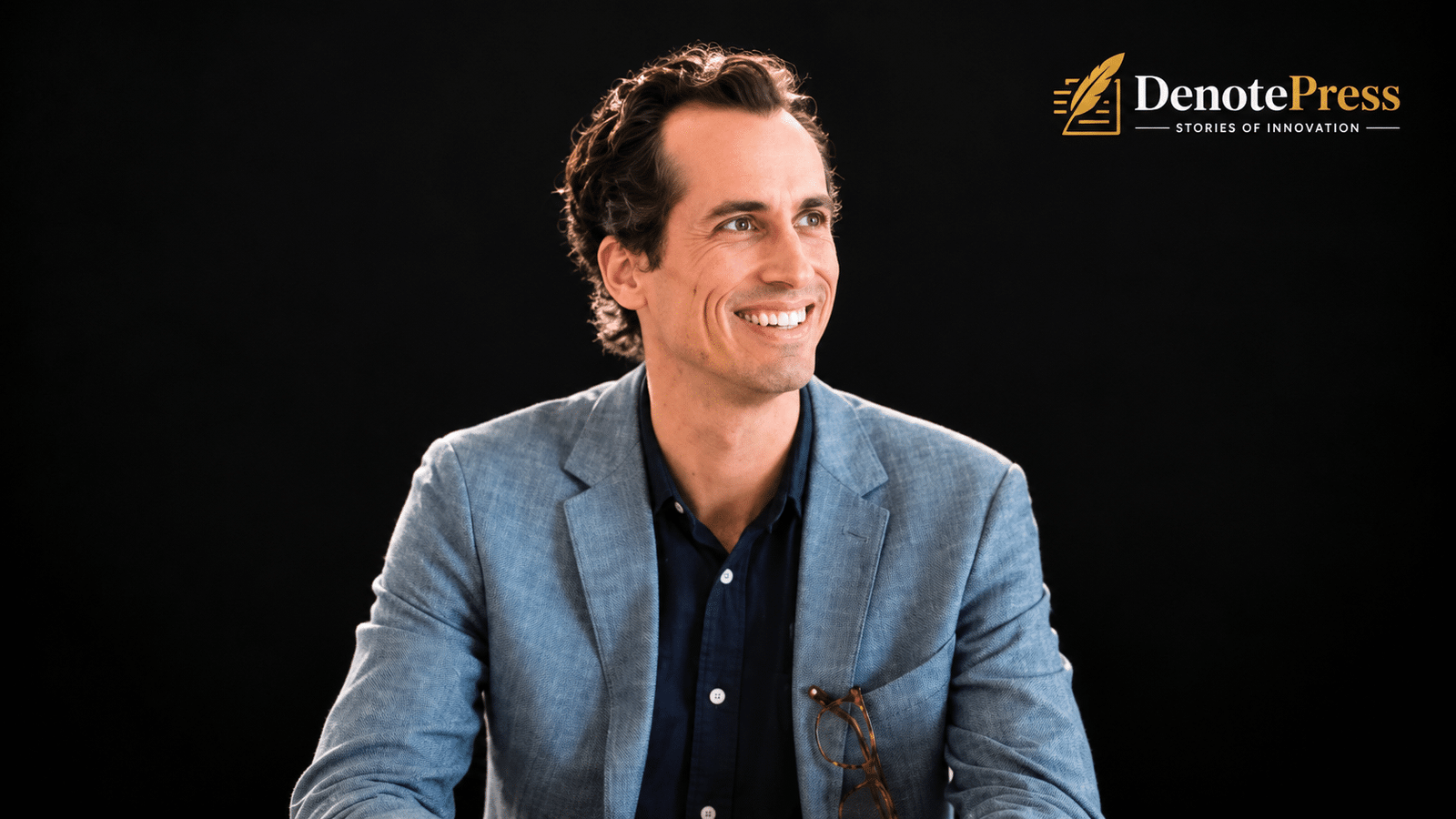
Thomas Galbraith Barkr is the story of an insurance professional who noticed that lenders were refusing to trust the price of the things they were lending against, and decided to put an insurer’s balance sheet behind the number. Galbraith is the co-founder and CEO of Barkr, a New York fintech, also spelled Barker in some coverage, that uses AI to value hard-to-price assets such as GPUs, art and aircraft, and offers a contractual guarantee on those valuations. In November 2025, the company announced a $3.5 million round led by Walkabout VC, and its guarantee is backed by Munich Re. Here is how Galbraith got there, how the product works and why AI infrastructure lenders are paying attention.
Thomas Galbraith Barkr: Who Is the Founder?
Thomas Galbraith is the CEO and co-founder of Barkr. According to a Fintech One-On-One podcast episode recorded in May 2026, he began his career in high net worth insurance at AIG and AXA before founding Barkr to bring accountability and AI-driven accuracy to asset valuation in the lending market. Crunchbase lists Madelaine D’Angelo as a co-founder, and PitchBook dates the company’s founding to 2022.
Galbraith’s earlier career also touched the art market. An older speaker biography from a contemporary art conference describes him as a partner at The Petraeus Group, a former managing director at the online art platform Paddle8 and a former director of global strategy at artnet. D’Angelo, per the same conference’s biography, founded the fine-art investment platform Arthena. Those details come from third-party conference pages, so they are worth checking against LinkedIn.
The common thread is valuation. People who work in insurance, art and luxury goods spend their careers asking what an object is really worth and who is liable if the answer is wrong. That question is the core of the Thomas Galbraith Barkr story.
From Insurance and Art to Hard-Asset Pricing
On the podcast, Galbraith described how a common thread across luxury assets led to founding the company. Barkr started with fine art and private jets, assets that are valuable, rare and difficult to price, before expanding into other asset classes.
His insurance background shaped the product. Traditional appraisals, he argued, fail in two ways: they can be inaccurate, and nobody stands behind them. An appraiser who gets the number wrong rarely pays for the mistake. A lender who relied on that number does.
That is why Barkr pairs an AI valuation with a contractual performance warranty. The structure borrows from insurance, where an insurer prices a risk and pays if it is wrong, and applies it to collateral. For Thomas Galbraith Barkr, the insight was that accountability could be a product feature, not just a promise.
The Problem: Collateral Nobody Can Price
Barkr’s website frames the problem in plain terms. Valuing illiquid assets for loan collateral is hard. Valuations are often analog, subjective and slow, and do not reflect real-time market movements. As a result, lenders do not trust them and offer defensive terms, such as lower loan-to-value ratios.
The company’s case study describes the trade-off. When collateral is hard to price, lenders act defensively and favor more concrete collateral over newer or more unusual assets, even when those assets could support more lending. The company positions this as a roughly $1 trillion opportunity in asset-backed lending, a figure from its own marketing.
Traditional appraisals also take weeks. Barkr says its valuations arrive in hours. That gap between weeks and hours, and between an opinion and a guarantee, is the problem Thomas Galbraith Barkr was built to solve.
Building Barkr: A Small Language Model and Resale Data
The technology is built on two pillars. According to the Barkr website, the company uses a small language model built on valuation methodologies, combined with proprietary data pipelines. Its About page says valuations draw on large datasets of resale transactions, macro market information and proprietary data, and that the company reports more than 350 million data points.
The workflow is simple on the client side. A lender uploads whatever information is available, such as photos, invoices and prior appraisals, through a portal. Barkr’s AI extracts the relevant details, runs the valuation and returns a report with the result, the methodology and comparable resale transactions. The company says no integration is required, and it describes its approach as AI plus human-in-the-loop review.
Transparency is part of the pitch. The About page says the company is not a black box and shows its work. It also offers different valuation types, such as Fair Market or Orderly Liquidation, depending on what the lender needs. The platform is the technical backbone of Thomas Galbraith Barkr.
The Guarantee: How Insurance Backs the Number
The guarantee is what separates Barkr from a pure software vendor. Barkr describes two ways to use the product: the Valuation Platform alone, or the Valuation Guarantee, which adds expert review and a contractual backstop. According to the company, if a defaulted asset sells for less than Barkr’s predicted value, Barkr and its A-rated insurance partners cover the error.
The mechanics were explained in an article by The Insurer. As reported in a search snippet from that article, Galbraith told the publication that lenders receive a month-by-month schedule showing the value at which Barkr is prepared to support a liquidation. If a borrower defaults and the GPUs are later sold through an approved arm’s-length venue for less than Barkr’s assigned value, Barkr covers the difference.
The article reports that Barkr’s guarantee generally supports up to about 85% of the assigned value, and that the company is setting up a Bermuda captive through which it intends to retain part of the risk and bring in additional risk-capital providers. The Insurer notes that this approach differs from residual value insurance, which other companies sell. The guarantee is the commercial heart of Thomas Galbraith Barkr, and it is subject to policy terms and conditions.
The Munich Re Partnership
Barkr’s insurance backing comes from Munich Re. The company’s launch partnership began in the first quarter of 2025, according to the funding announcement, and Barkr’s contractual liability is backed by Munich Re’s aiSure performance guarantee insurance. The case study explains that aiSure reimburses Barkr for its liabilities if its valuation was wrong, subject to policy terms.
On the podcast, Galbraith described how the relationship developed in stages. Barkr worked through Lloyd’s of London, then AXA, before landing Munich Re, and each step required proving the concept at the previous level first. That slow progression is part of why the company talks about patience in this business.
Munich Re executives have spoken publicly about the partnership. In the funding announcement, Michael von Gablenz, head of Insure AI at Munich Re, said that unreliable asset prices lead to unpredictable risks in lending, and that the partnership shows the power of combining technology with established risk protection. For a startup, having a global reinsurer as a named partner is a major credibility signal for Thomas Galbraith Barkr.
The $3.5 Million Seed Round
On November 18, 2025, according to PitchBook, Barkr announced a $3.5 million round led by Walkabout VC. FinSMEs described the company as a New York-based fintech that transforms illiquid asset valuations into insurance-backed instruments. Crunchbase lists Walkabout Ventures as the funder.
The company said the capital would accelerate expansion of its agentic valuation system into additional asset classes and deepen relationships with institutions across asset-based finance. In the announcement, Galbraith said the company is the “trust layer for asset-based finance,” and that insurance-protected valuations give lenders the confidence to turn illiquid assets into investable capital.
The round is small by AI standards, but it reflects a focused business. Barkr does not need huge capital for GPUs or data centers. It needs data, models, insurance relationships and people. For Thomas Galbraith Barkr, a modest seed gave room to prove traction before raising more. For more on how rounds like this shape young companies, see our Funding News section.
Traction: From $2 Billion to $4.5 Billion in Valuations
The traction numbers moved quickly. At the time of the seed round, BCR Publishing reported that Barkr had processed approximately $2 billion in valuations since launching its Munich Re partnership in early 2025, and FinSMEs said the company had been approved for use by large banks and private lenders.
By late 2026, the company’s About page showed larger figures: more than $4.5 billion in valuations to date, more than $400 million in guaranteed valuations and more than 13 asset classes priced. These are company-reported numbers. The Insurer’s article, in a different framing, reported that Barkr has backed more than $200 million of GPU valuations, so the figures depend on what is counted as guaranteed versus GPU-specific.
On the podcast, Galbraith described the early days honestly: finding clients took patience, and the company started by finding customers one at a time. The numbers suggest that the approach is working. That growth is why Thomas Galbraith Barkr has become a name in asset-backed finance circles.
The GPU Collateral Opportunity
The biggest recent story is GPUs. As AI companies build data centers, many are financing graphics processors with debt, which makes the question of how much a GPU will be worth in three or five years a central lending risk.
Barkr’s market report asks why NVIDIA is so confident in long-term GPU values, and the company’s podcast comments say its data on GPU durability challenges the conventional narrative that the chips lose value quickly. That is a company view and not a settled consensus, and the debate over GPU depreciation is active across the industry.
The website’s partner quotes make the case from the demand side. Nico Caprez, a vice president for AI infrastructure growth at NVIDIA, is quoted as saying Barkr is enabling the “asset-backed financing flywheel” for AI factories, as greater confidence in residual value attracts more capital. A representative from USD.AI says unpriceable risk kills deals in a way that expensive risk does not. An illustrative report on the site shows a guaranteed liquidation value for a next-generation NVIDIA superchip over a 180-day window.
The Insurer also noted that other players, such as American Compute, are tackling GPU residual value with a different approach: underwriting the lower end of a distribution of future prices rather than an expected value. Competition is already forming around Thomas Galbraith Barkr’s most visible use case.
The Investors and Partners Backing Thomas Galbraith
Barkr’s backers fall into two groups. Investors include Walkabout VC, which led the seed round. Partners, rather than equity investors, include Munich Re, which provides the insurance backing, and a set of institutions quoted on the website.
The website quotes Joshua Stevens of Macquarie, who says independent valuation frameworks built on resale data improve transparency and confidence in asset-backed lending. It also quotes Munich Re’s Tom Van den Brulle and Michael von Gablenz, NVIDIA’s Nico Caprez and USD.AI’s Conor Moore. These are testimonials selected by the company, so treat them as marketing, though the named titles make them easy to verify.
PitchBook counts one investor and a very small team, and Crunchbase lists a Growth Score of 74. For a company serving banks and credit funds, the more important audience is lenders and insurers, not venture investors. That mix strengthens Thomas Galbraith Barkr in a business built on trust.
How a Barkr Valuation Works for Lenders
The process is designed to fit into existing credit workflows. According to the company, a lender submits asset information, such as photos, invoices or prior appraisals, to the portal. The AI extracts details, runs the valuation and returns a report with a clear result, a transparent methodology and comparable resale transactions.
The site says valuations can be individual or portfolio-level, and that they reflect real-time market inputs. Time to valuation is measured in hours, compared with weeks for a traditional appraisal. When a guarantee is needed, a second layer of expertise reviews the work, and the valuation can ship with error protection.
An important detail is that each value reflects the minimum expected sale price within a defined time frame, according to the About page. That makes it a conservative number designed for downside scenarios, which is exactly what a lender cares about in a default. The approach is why Thomas Galbraith Barkr appeals to underwriters.
Where Barkr Stands in the Market
Valuation is an old industry, dominated by appraisers, specialist firms and internal teams at lenders. Barkr’s position is as a technology-first, insurance-backed alternative. The company says its target customers are asset-based lenders, specialty credit funds and global banks.
Its differentiators are clear. It combines AI speed with a contractual guarantee, which most valuation providers do not offer. It publishes methodology and comparable transactions rather than a black-box number. And it has a named reinsurer behind the warranty.
The risks are equally clear. A guarantee is only as strong as the model and the insurance behind it, and GPU residual values are uncertain. Insurance capacity can change. Lenders may be slow to change their processes, and competitors are emerging with different structures. The company also depends on a small number of large partners. In a young field, Thomas Galbraith Barkr competes on accountability.
This article is for information only and is not investment or lending advice. Valuation guarantees are subject to policy terms, conditions and limits.
Leadership Style and What’s Next
Galbraith’s public comments show a founder who values patience and proof. On the podcast, he described the company’s progression from Lloyd’s to AXA to Munich Re as a sequence in which each step required demonstrating the previous one. He also argued that valuation technology should augment rather than replace human experts, which matches the company’s human-in-the-loop model.
His message to lenders is practical. Valuations should empower lending, not constrain it, a line from the funding announcement. The company’s own language, about being the foundational pricing layer for hard-asset lending, shows an ambition to become infrastructure rather than a one-off service.
Looking ahead, the visible priorities are more asset classes, more institutional clients, a growing guarantee program and the planned Bermuda captive to retain part of the risk. The test will be performance: the guarantee only matters if valuations hold up across market cycles and if the insurance structure scales. That discipline will define the next chapter of Thomas Galbraith Barkr.
Lessons From the Thomas Galbraith Barkr Journey
The Thomas Galbraith Barkr journey offers five practical lessons for founders.
First, find the accountability gap. Appraisals were inaccurate and unaccountable. Barkr turned accountability into the product.
Second, borrow trust from established partners. A named reinsurer behind the guarantee gave a young company credibility with banks.
Third, climb the ladder one step at a time. Proving the concept with one insurer before approaching a bigger one built a track record.
Fourth, show your work. Publishing methodology and comparable transactions made the product easier to underwrite than a black box.
Fifth, ride a structural trend. AI infrastructure financing created sudden demand for a way to price GPUs as collateral.
Frequently Asked Questions
Who is Thomas Galbraith?
Thomas Galbraith is the co-founder and CEO of Barkr. He began his career in high net worth insurance at AIG and AXA before founding the company.
What is the Thomas Galbraith Barkr story?
It is the story of an insurance professional who built an AI valuation company that guarantees its prices, backed by Munich Re, to help lenders finance hard assets such as GPUs.
What is Barkr?
Barkr is a New York fintech that provides AI-powered, insurance-backed valuations for hard-to-price assets used as loan collateral. It is also spelled Barker in some press coverage.
How much funding has Barkr raised?
Barkr announced a $3.5 million round on November 18, 2025, led by Walkabout VC.
Who backs Barkr’s guarantee?
The guarantee is backed by Munich Re’s aiSure performance guarantee insurance, and the company says it works with A-rated insurance partners.
How does the Barkr guarantee work?
If a defaulted asset sells through an approved arm’s-length venue for less than Barkr’s assigned value, Barkr covers the difference, up to about 85% of the assigned value according to The Insurer, subject to policy terms.
How fast is a Barkr valuation?
The company says valuations are delivered in hours rather than the weeks a traditional appraisal can take.
What assets does Barkr value?
The company says it prices more than 13 asset classes, including GPUs, and began with fine art and private jets.
How many valuations has Barkr completed?
The About page reports more than $4.5 billion in valuations to date, and more than $400 million in guaranteed valuations. These are company-reported figures.
Where is Barkr based?
Press coverage describes Barkr as a New York-based fintech.
Conclusion
Thomas Galbraith Barkr shows what happens when an insurance mindset meets AI. By pairing a small language model and a large resale dataset with a contractual guarantee from a global reinsurer, Galbraith built a company that gives lenders a price they can underwrite and a backstop if it is wrong. With a $3.5 million seed, a Munich Re partnership, billions of dollars in reported valuations and a front-row seat to the GPU financing boom, Barkr is positioning itself as a pricing layer for hard-asset lending. The open question is whether valuations and insurance capacity hold up across a full market cycle. If they do, Galbraith may help turn a long list of hard-to-price assets into bankable collateral.
For more founder journeys in AI and fintech, see Francesco Decamilli’s Uniti, Jay Li’s Proception and Runlayer’s Series A on Denote Press, or browse all Founder Stories.
