

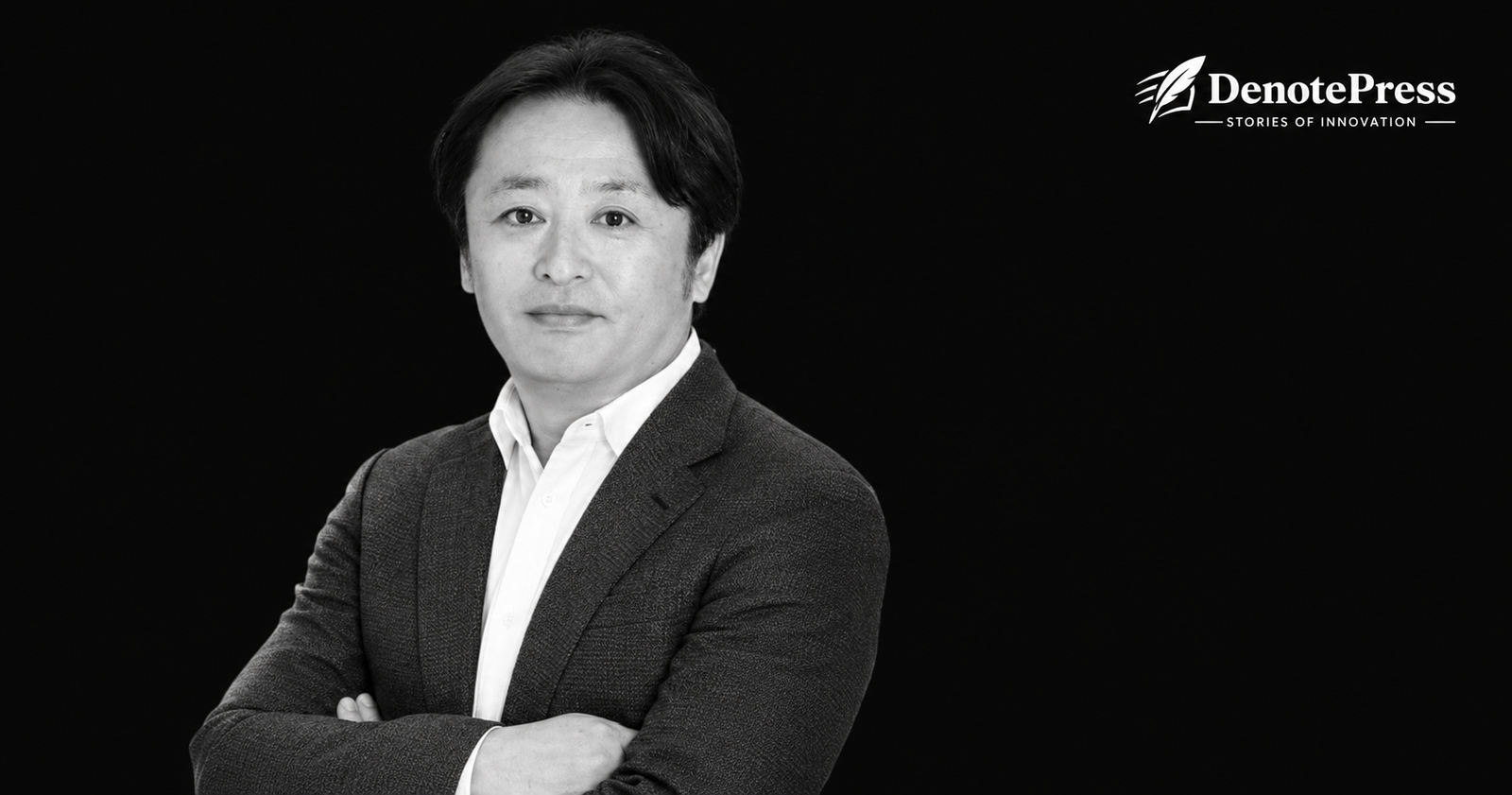
Kenichi Miki SustainaVerse is the story of a Hitachi business developer who spent more than two decades at the Japanese industrial conglomerate, joined an internal startup challenge in Silicon Valley and left to build a company that scores the sustainability of products the way a credit score rates a borrower. Miki is the founder and CEO of SustainaVerse, Inc., a Bay Area startup that describes itself as the first global carve-out venture from Hitachi, with Hitachi holding a minority stake of less than 10%. According to the company’s profile at the Asia Berlin Summit, its AI engine quantifies ESG and SDG performance using more than 200 indicators and turns the result into a single score. Here is how Miki got there, what the products do, who the partners are and what is still unproven.
Kenichi Miki SustainaVerse: Who Is the Founder?
Kenichi Miki is the founder and CEO of SustainaVerse, Inc. On the company’s About page, he is listed as chief executive officer, described as a visionary leader with more than 15 years in sustainable technology and business strategy, alongside Ajit Bhave as chief technology officer. Crunchbase lists him as the founder and a board member, with a team of one to ten people based in Palo Alto, California.
His LinkedIn profile says he founded SustainaVerse in February 2026 and describes the work as AI-based sustainability visualization, scoring and business development across food and social infrastructure. His headline puts the idea in one line: “Building sustainability in upfront—before products are made.”
Other sources date the start differently. An organizational chart site lists him as the founder as of April 2025, and the Asia Berlin Summit profile lists the company’s location as San Mateo, California. Those differences likely reflect the project’s path from internal idea to incorporated company. That path is the core of the Kenichi Miki SustainaVerse story.
More Than Two Decades at Hitachi
Miki’s career is built inside Hitachi. TheOrg’s profile says he worked at Hitachi, Ltd. as a senior engineer from April 2002 to December 2013, then as a solution and cloud solution product manager at Hitachi Data Systems from January 2014 to March 2016, and as a senior business development manager from April 2016. It lists him as Head of New Ventures at Hitachi Solutions America from April 2025.
His own LinkedIn profile adds that from 2012 to 2019 he did business development for SAP at Hitachi, where he says he launched a $100 million IT product business and a $100 million cloud service business. Those are self-reported achievements. It also lists a role as a committee member in the Data Strategy Division of Keidanren, the Japan Business Federation, from April 2021 to March 2024.
Experience of that kind matters for a founder selling to large companies. A career spent building business lines inside a global industrial group teaches how enterprises buy, how procurement works and what compliance teams worry about. The Hitachi years are the corporate foundation of Kenichi Miki SustainaVerse.
The Take Off Startup Challenge in Silicon Valley
The idea took shape inside a Hitachi program. Miki’s LinkedIn page says that from 2025 to March 2026 he took part in “Take Off: Startup Challenge in Silicon Valley,” a Hitachi carve-out project focused on “Towards a Sustainable Society for the Next Generation.” The Asia Berlin Summit bio uses the program’s tagline: “Universal Sustainability for the Next Generation.”
A Hitachi executive, Taiki Sakata, described the venture in a LinkedIn post after a panel. He wrote that Miki shared his conviction and passion for building a sustainable society for future generations, and how the venture grew from an internal idea into a carved-out business in Silicon Valley, and he called it a reminder of why a 115-year-old company continues to evolve.
Corporate venture programs rarely produce independent companies, so this one is notable. It gave Miki a structured way to test the idea, access to corporate resources and a path to spin out. The challenge is the incubator behind Kenichi Miki SustainaVerse.
The Carve-Out and the Minority Stake
A carve-out means a company separates a business or project into a new company. SustainaVerse describes itself as “the first global carve-out venture from Hitachi,” with Hitachi holding a minority stake below 10%. That is the company’s own description, repeated in its summit profiles, and the sources reviewed do not include a Hitachi press release confirming the structure or its “first” status.
Miki’s LinkedIn page describes the company as a “spin-out from Hitachi incubation,” located in Palo Alto. A December 2025 post of his said the company was preparing for incorporation as a carve-out initiative with active traction across private, public and non-profit sectors, and that he was seeking early-stage angels, seed venture funds and corporate venture partners.
For a founder, a carve-out has benefits and trade-offs. It can bring credibility, early customers and corporate relationships. It can also mean limits on independence and a smaller ownership share than a pure startup would offer. The carve-out structure is the legal backbone of Kenichi Miki SustainaVerse.
The Problem: Sustainability Is More Than CO2
The problem SustainaVerse describes is that sustainability is hard to compare. Miki’s LinkedIn post says sustainability is about much more than CO2 emissions. The company argues that companies, buyers and consumers lack a consistent, explainable way to judge products on environmental and social factors together.
The company’s website describes the opportunity in procurement terms. His profile lists focus areas such as procurement and supplier selection, product design trade-offs and ROI insights, supply chain transparency and traceability, and explainable, audit-ready scoring. In short, it wants to make sustainability a measurable input to everyday decisions instead of an annual report.
That is a real gap. Existing ESG ratings mostly score companies, not individual products, and many use opaque methods. A product-level score that shows its work could help buyers, though it also raises questions about data quality and methodology. That gap is the problem Kenichi Miki SustainaVerse set out to address.
Building SustainaVerse: 200 Indicators and One Score
The company’s central claim is the scoring engine. According to its profiles, the AI evaluates more than 200 ESG indicators and translates their impact into monetary value. The Asia Berlin Summit description says it quantifies ESG and SDG performance and turns it into a clear, trusted score, while Miki’s LinkedIn post says the aim is to make sustainability “measurable, transparent, and actionable.”
The monetary translation is an unusual choice. Instead of presenting a letter grade, the company says it converts environmental and social effects into financial terms, a method sometimes called impact valuation. The company also says it wants scoring to be explainable and audit-ready.
These are the company’s descriptions, and the sources reviewed do not include a published methodology, a list of the 200 indicators or any independent validation. Anyone relying on a sustainability score should ask how it is built. The scoring engine is the intellectual property behind Kenichi Miki SustainaVerse.
SustainaLens: The Consumer App
The consumer product is SustainaLens. An earlier version of the company’s site describes an app where you scan a product’s barcode and see its ESG score, the SustainaScore, at a glance. The Environmental part estimates a product’s footprint, including CO2 emissions, water usage and packaging waste, and the Social part assesses factors such as labor practices, supply chain ethics and community impact.
The company’s site lists app features such as real-time product scanning, ESG ratings, alternative product suggestions, personal sustainability tracking, community reviews and offline mode. The tagline on the older site is “Make Better Choices for a Sustainable Future.”
Miki said on LinkedIn that SustainaLens was featured in two public votings tied to CES 2026, and he asked supporters to vote. Voting contests are not independent judging, so they should be read as visibility, not validation. The consumer app is the front door of Kenichi Miki SustainaVerse.
SustainaEngine and SustainaLens for Brand
The business products sit behind the app. The Asia Berlin Summit profile says that for businesses, SustainaLens for Brand and SustainaEngine provide enterprise-grade tools for verified storytelling, ROI-based ESG insights and traceable impact, powered by transparent AI and blockchain integration through partner FutureSense of Korea.
The commercial model is described as free consumer engagement plus scalable software-as-a-service and API models. The company’s long-term vision, in its own words, is a global “Digital Twin for Humanity,” a universal infrastructure where sustainability data connects people, companies and governments.
One target use case is food. Miki’s profile says the focus is food and social infrastructure, and a company post describes building sustainable value chains with food industry partners. The company also sets a goal of reaching $100 million in annual recurring revenue within three years, which is an aspiration, not a result. The enterprise products are the revenue engine of Kenichi Miki SustainaVerse.
The Team: Yagi, Bhave and the Designer
Miki leads a very small team. The older site lists four people: Ken as founder and CEO, Nobu as COO, Ajit as CTO and Ritsu as designer. The Asia Berlin Summit lists Nobuo Yagi as Chief Sustainability Technology Officer, who leads technology and data innovation and works on visualizing and monetizing ESG impact at product and company levels.
The About page lists Ajit Bhave as chief technology officer, described as an AI and machine learning expert driving technical innovation in sustainability analytics. Crunchbase counts two board members and advisors, including Bhave and Miki, and a team of one to ten.
The sources reviewed do not describe Yagi’s or Bhave’s earlier careers in detail, so this article does not. A small team with complementary roles, sustainability, AI and design, is typical for a company at this stage. The team is the working core of Kenichi Miki SustainaVerse.
Partnerships: FutureSense and Bijupass
Partnerships are a visible part of the story. A SustainaVerse LinkedIn post announced a renewed strategic memorandum of understanding with FutureSense, a South Korean company, with CEO Dami An named, that leads in blockchain-based supply chain traceability. The plan is to combine FutureSense’s lot-level traceability data with SustainaVerse’s ESG scoring and analytics engine to deliver more transparent, verifiable and actionable ESG intelligence.
Another post, in Japanese, announced a business partnership with a company called Bijupass to develop an AI scoring system for Japanese crafts. Miki wrote that he had long wondered whether the value of craftsmanship could be made visible with AI.
An MOU is a statement of intent, not a revenue contract, and the sources reviewed do not describe customers or paid deployments. Still, pairing a scoring engine with traceability data makes technical sense, since scores are only as good as the data behind them. The partnerships are the ecosystem around Kenichi Miki SustainaVerse.
Berlin, Hamburg and CES 2026
Miki has taken the company on the road. In a LinkedIn post, he wrote that he would be in Hamburg from October 19 to 23 and Berlin from October 23 to 25, introducing himself as the founder of a newly founded, independent AI startup, and linked the trip to the Hydrogen Technology Expo. He also shared a reflection titled “What I Learned About Startups & True Sustainability,” with hashtags for JETRO, GTAI and J-StarX.
The company’s profile appears in the participant directory of the Asia Berlin Summit 2025, where it presents the company and invites investors. An earlier post shows Miki positioning the project for CES 2026 and describing a turning point in working on a Hitachi carve-out initiative.
Events like these are the standard path for a company looking for partners and capital. They build awareness, but they are not traction by themselves. The roadshow is the outreach engine of Kenichi Miki SustainaVerse.
Funding: Seeking Seed, No Disclosed Round
The funding story is still early. In the sources reviewed, there is no announced venture round, no named lead investor and no valuation. Crunchbase lists the company as private with an obfuscated founding date and no funding data in the excerpt reviewed.
Miki’s own words describe the stage. In a LinkedIn post, he said the company was seeking early-stage angels, seed venture funds and corporate venture partners who share a long-term vision for sustainability and technology. His profile also says he is open to proofs of concept and strategic partnerships.
Hitachi’s minority stake of less than 10%, as the company describes it, is the only disclosed ownership detail. For comparison with companies that publish their rounds, see our story on Uniti, and for more on how funding shapes young companies, see our Funding News section. The absence of a round is the current financing reality of Kenichi Miki SustainaVerse.
Where SustainaVerse Stands in ESG Software
ESG software is a crowded field. Large reporting platforms help companies collect data and file disclosures, carbon accounting startups measure emissions, and supplier risk platforms screen vendors. Search results for the category list companies such as Sustain.Life, Watershed and Greenly, and smaller European players such as Esgrid, which raised €900,000.
SustainaVerse’s differentiators are its product-level focus and its monetary framing. Instead of scoring a company’s annual report, it aims to score individual products and suppliers, and it translates impact into dollars so buyers can compare trade-offs. It also pairs a free consumer app with enterprise tools, and it comes with a corporate parent as a minority shareholder.
The risks are significant. ESG data is notoriously uneven, and a score is only as credible as its data and method. Large platforms with large customer bases can add similar features. Regulators in several regions are tightening rules on sustainability claims. And a team of a few people is competing with well-funded companies. In a crowded field, Kenichi Miki SustainaVerse competes on explainability and product-level granularity.
Risks and Open Questions
A fair article on an early-stage company should name the open questions.
Methodology. The company claims more than 200 indicators, but the sources reviewed do not publish the method or any independent validation.
Traction. No customer numbers, revenue or paid contracts are described in the sources reviewed.
Funding. No round is announced, and the company is publicly seeking capital.
Structure claims. “First global carve-out venture from Hitachi” and the minority stake under 10% are the company’s own descriptions, without a Hitachi announcement in the sources reviewed.
Dates. Founding dates differ across sources, from April 2025 to February 2026.
Name confusion. A separate UK product called sustainaVERSE exists, so searches can mix the two.
None of these is unusual for a company at this stage. Naming them is part of an honest look at Kenichi Miki SustainaVerse.
Leadership Style and What’s Next
Miki leads like a corporate intrapreneur. His posts are structured, multilingual and outward-facing, and they combine a clear mission with specific asks for partners and funding. He also continues to work at Hitachi, where his profile lists a role in service business planning for the HMAX generative AI platform since April 2026.
That dual role reflects the carve-out structure, and it signals both resources and constraints. His roadmap, as stated, includes proofs of concept with food-industry partners, the FutureSense integration, the Bijupass crafts-scoring project and a push for seed capital.
The test will be turning a compelling vision into paying customers and a documented methodology. That discipline will define the next chapter of Kenichi Miki SustainaVerse.
Lessons From the Kenichi Miki SustainaVerse Journey
The Kenichi Miki SustainaVerse journey offers five practical lessons for founders.
First, use the platform you have. Hitachi’s internal program gave Miki a path from idea to company.
Second, pick a problem that is specific. Product-level, explainable scoring is narrower than “ESG software.”
Third, pair data with a partner. The FutureSense MOU shows that scores need traceable inputs.
Fourth, show your work. Audit-ready, explainable scoring is a selling point only if the method is visible.
Fifth, ask clearly for what you need. Miki’s posts state exactly who he wants to hear from: angels, seed VCs and corporate partners.
Frequently Asked Questions
Who is Kenichi Miki?
Kenichi Miki is the founder and CEO of SustainaVerse, Inc. He has a long career at Hitachi in engineering and business development and works on new ventures at Hitachi Solutions America.
What is the Kenichi Miki SustainaVerse story?
It is the story of a Hitachi business developer who took part in an internal startup challenge in Silicon Valley and spun out SustainaVerse, an AI company that scores the sustainability of products using more than 200 ESG indicators.
What is SustainaVerse?
SustainaVerse is a California-based startup that builds AI sustainability scoring. Its products include SustainaLens, a consumer app that scans barcodes, and SustainaEngine for businesses.
Is SustainaVerse part of Hitachi?
The company describes itself as the first global carve-out venture from Hitachi, with Hitachi holding a minority stake of less than 10%. It operates as an independent company.
What is SustainaLens?
SustainaLens is a consumer app that lets users scan a product’s barcode and see its SustainaScore, an ESG score based on environmental and social factors.
What is SustainaEngine?
SustainaEngine is the company’s enterprise tool for ROI-based ESG insights, supplier selection, product design trade-offs and traceable impact.
How much funding has SustainaVerse raised?
No funding round has been announced in the sources reviewed. The founder says the company is seeking early-stage angels, seed venture funds and corporate venture partners.
Who are SustainaVerse’s partners?
The company has announced a strategic MOU with FutureSense, a South Korean blockchain traceability company, and a partnership with Bijupass on AI scoring for Japanese crafts.
Is SustainaVerse the same as sustainaVERSE from the UK?
No. A UK product called sustainaVERSE, from the D’Arcy Thompson Simulator Centre, is a different company.
Where is SustainaVerse based?
Sources list Palo Alto and San Mateo, California.
Conclusion
Kenichi Miki SustainaVerse shows how a corporate veteran can turn an internal project into an independent venture. By taking an idea through Hitachi’s Silicon Valley challenge, spinning it out with a minority stake from the parent and focusing on explainable, product-level sustainability scores, Miki built a very small company with a very large ambition. The open questions are the ones every early-stage ESG company faces: whether the method stands up to scrutiny, whether customers pay and whether capital arrives. If the answers are yes, SustainaVerse could help make sustainability a number buyers can compare.
For more founder journeys in AI and software, see Stephen Haney’s Paper, Runlayer’s Series A and Bookit N Go’s Series A on Denote Press, or browse all Founder Stories.
